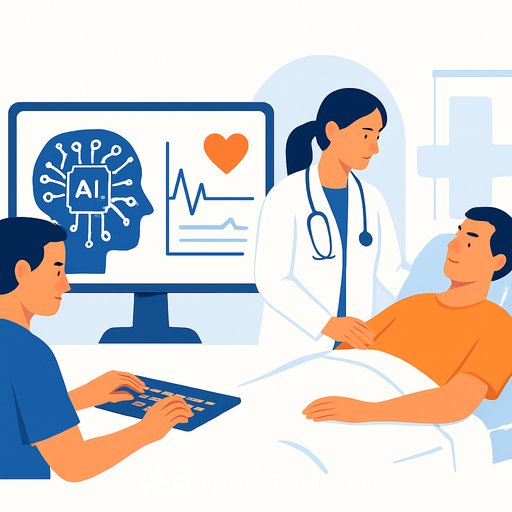
Singapore explores AI tools to improve diagnostics in resource-limited healthcare settings
January 31, 2026 - Hospitals with limited staff, equipment, and data face tough calls every day. One of the hardest: predicting neurological recovery after cardiac arrest. New work from Singapore shows how AI can help make that decision faster and with more confidence, even where resources are stretched.
What's new
Researchers from Duke-NUS Medical School and collaborators adapted an advanced AI model to predict neurological outcomes after cardiac arrest in a resource-limited setting. The study, published in npj Digital Medicine, used transfer learning-adapting a model trained on large external datasets to local conditions with minimal new data; see Research for background on these adaptation methods.
For clinicians, that means a practical path to decision support without years of data collection. For health systems, it offers a way to extend specialist-grade insights to hospitals that lack costly tools and deep datasets.
Why transfer learning fits low-resource settings
- Reduces data demands: Start with strong priors from large, diverse datasets; refine with a small local cohort.
- Faster deployment: Shortens the validation timeline and moves pilots from months to weeks.
- Better generalization: Models can be tuned to local practice patterns, case mix, and documentation styles.
- Cost-aware: Less reliance on advanced imaging or extensive lab panels where they are scarce.
None of this removes the need for clinical oversight. It simply compresses the gap between ambition and bedside utility.
Guardrails still lag behind the tech
Existing medical device frameworks don't fully address AI-specific risks-privacy leakage, ungrounded outputs, shifting performance after deployment, and unclear accountability for updates. To close that gap, the team proposes an international consortium: the Partnership for Oversight, Leadership, and Accountability in Regulating Intelligent Systems-Generative Models in Medicine (POLARIS-GM).
POLARIS-GM would focus on practical standards: how to regulate adaptive models, how to monitor real-world impact, how to set safety thresholds, and how to tailor guidance for resource-limited hospitals. These governance and leadership issues are explored further under AI for Management.
What healthcare leaders can do now
- Pick high-value, bounded use cases: e.g., post-cardiac arrest prognostication, triage, or early deterioration alerts.
- Start with transfer learning pilots: Use reputable pretrained models; fine-tune with local data under IRB oversight.
- Set a clear safety plan: Human-in-the-loop review, escalation criteria, and explicit "do-not-use" zones.
- Measure what matters: Calibrate on local outcomes, stratify by subgroup, and track calibration drift monthly.
- Protect privacy: De-identify rigorously, log model access, and restrict cross-border data sharing without legal cover.
- Clarify accountability: Name the clinical owner, model owner, and IT owner; define update cadence and rollback steps.
- Train your team: Clinicians need to understand model limits and failure modes, not just how to read a score.
Why this could change practice
Outcome prediction after cardiac arrest is high stakes and time sensitive. Bringing validated AI decision support to smaller hospitals can reduce variation in care and help teams communicate prognosis with more clarity and less delay.
The path forward is straightforward: pilot with transfer learning, validate locally, monitor continuously, and govern with discipline. With that playbook, AI can extend quality care to settings that need it most.
Helpful resources
- npj Digital Medicine (journal)
- WHO: Regulatory considerations on AI for health
- Complete AI Training: Courses by job (for teams building AI literacy)
Your membership also unlocks: