SIA, Singtel and More: How Singapore’s AI Leaders Could Boost GDP by 3%
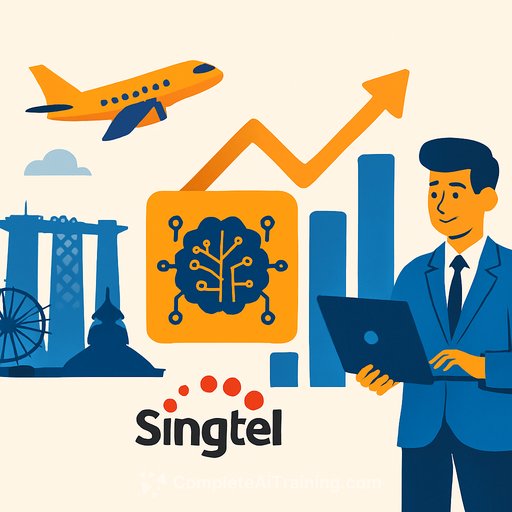
Singapore stands out as a top artificial intelligence market relative to its size, positioning itself for significant economic growth. Morgan Stanley’s research highlights that AI-driven innovation and productivity gains could sustain a 3% GDP growth rate for the city-state, keeping it among the fastest-growing developed economies globally.
Currently home to over 80 active AI research faculties, 150 AI R&D and product teams, and more than 1,000 AI startups, Singapore benefits from a government-backed ecosystem that nurtures AI development. This support has propelled the nation into the top 10 on indexes like the Stanford Global AI Vibrancy Index.
Strong AI Adoption Across Industries
According to Morgan Stanley’s recent survey, over 70% of companies in Singapore have adopted AI technologies. The most common applications include labor savings, product development, and supply-chain optimization. Generative AI (GenAI) has gained particular traction in 2025, with major players investing heavily in the space.
Salesforce, for example, has committed US$1 billion over five years to expand its AI presence, including its Agentforce platform, which supports workforce expansion amid demographic challenges. Oracle has also launched an AI Centre of Excellence to train students and professionals, while fostering early AI experimentation for businesses.
Key AI Enablers: Singtel, Keppel and Sembcorp
Singtel leads as a key AI enabler through its expanding infrastructure. The telecom giant is increasing data centre capacity and facilitating Nvidia’s AI factory development in Southeast Asia, with projected operational capacity exceeding 200 megawatts by 2026.
Keppel is set to benefit from this expansion, leveraging its expertise in integrated solutions for power, connectivity, data centres, and decarbonisation. Meanwhile, Sembcorp Industries is positioned to gain from rising energy prices due to high demand for European gas, which will boost its earnings through power and natural gas provision.
Major AI Adopters Driving Innovation
- Grab: With over 1,000 AI models, Grab launched a centre for AI excellence in May and is pushing autonomous vehicle adoption. Its AI leadership is expected to enhance efficiency and profitability, strengthening its market position in ASEAN.
- Sea: Using AI to improve recommendation accuracy and purchase conversion rates, Sea has boosted gross merchandise value and is considered a top pick in Asian e-commerce.
- Singapore Airlines (SIA): SIA employs GenAI tools like Jarvis to improve staff productivity and training. It also partners with Salesforce to develop AI-powered customer applications and airline-specific AI solutions at a Singapore research hub.
- ST Engineering: The company plans to more than double its digital business revenue to S$1.3 billion by 2029, focusing on AI infrastructure and projects for defence, aerospace, and smart cities.
These companies exemplify how AI adoption can lead to operational efficiency, market leadership, and profitable growth. Product development teams should monitor their innovations closely as they often set industry benchmarks.
Why This Matters for Product Development Professionals
Singapore’s AI ecosystem offers practical insights into integrating AI tools effectively. From enhancing labor productivity to optimizing supply chains and customer experience, these case studies provide valuable lessons for product teams aiming to accelerate innovation and improve outputs.
For professionals interested in expanding their AI expertise and skills, exploring targeted training programs can help keep pace with these advancements. Platforms like Complete AI Training offer up-to-date courses on AI applications relevant to product development.
In sum, Singapore’s AI adopters are not just boosting GDP growth—they’re setting examples of how AI can be pragmatically applied to improve products, services, and operational efficiency.
Your membership also unlocks: