
AI news ·
Sir John Hegarty says AI needs human imagination to rescue stalled marketing and media
Ad legend Sir John Hegarty says marketing stalled because it confused information with inspiration. AI won't fix that-human imagination will.
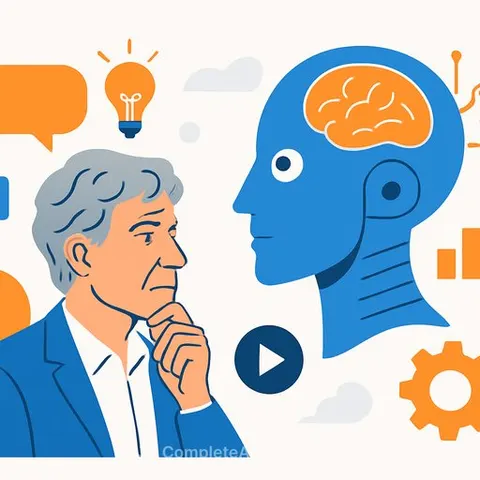
Sir John Hegarty: Marketing Has Stalled. AI Won't Fix It-Imagination Will.
Sir John Hegarty, who shaped global advertising for six decades at agencies including Saatchi & Saatchi and Bartle Bogle Hegarty, argues that marketing and media are stuck. The digital revolution promised endless growth. It didn't deliver. The reason: the industry confused information with inspiration.
Now, as AI enters the picture, Hegarty sees an opportunity-but not the one most people think. The technology itself isn't the frontier. Understanding human creativity is.
Stop Treating AI as a Tool
The mistake most marketers make with AI is viewing it as a hammer or a faster typewriter. Hegarty rejects this framing entirely. "Stop thinking about it as a tool," he said. "You collaborate with it."
AI lacks imagination. It regurgitates what already exists. Humans imagine constantly. Feed that imagination into an AI system, and it moves forward. Without human input, AI is "pretty useless."
This shift matters for agency economics. Smaller, faster teams can now compete with legacy giants. A UN project Hegarty helmed would have been financially impossible without AI handling the heavy lifting. The cost of big ideas is dropping.
Hegarty dismisses automation fears by pointing to opportunity. AI democratizes access to creative firepower. Agile groups outpace slower, larger competitors.
Branding Has Moved Beyond the USP
The unique selling proposition-the bedrock of 20th-century marketing-is fading. What replaces it is harder to measure but more powerful: how a brand makes you feel.
James Dyson's bagless, beautiful vacuum illustrates the shift. It succeeded not because it was cheaper or had a better feature list. It succeeded because it connected through aesthetics and belief.
Marketing is failing because it measures what spreadsheets can track-clicks, impressions, conversion rates-rather than what matters: taste, resonance, emotional alignment. "Do I like that brand? Does it resonate with my beliefs? Do I want to be seen with it?" These are the questions that matter.
Yet marketing remains trapped in Industrial Age thinking. The Attention Age requires different metrics.
News Media's Real Competitive Advantage
Hegarty has blunt advice for news executives watching margins shrink: rebrand yourselves. Stop calling yourselves "legacy media" or "traditional media." The language signals defeat.
Call yourselves "truthful media."
Digital platforms operate on what Hegarty calls "chimpanzee logic"-purely informational, transactional, often unreliable. News media practices something different: storytelling built on imagination and accountability. That's the real product.
Trust is the currency that matters. Big tech platforms refuse responsibility for their content. They can't mint trust. Print media can. When something is printed, someone puts their name to it. Fake news lives in digital spaces where accountability disappears.
Permanence matters too. Digital content evaporates. Print endures. That physical presence carries weight.
News organizations shouldn't compete with tech platforms on tech's terms. Don't sell space. Sell the future of the brand. Make people want accurate information through better storytelling, not just need it.
The Competitive Advantage Is Human
In a world of data and algorithmic optimization, being human is the edge. Creativity, taste, imagination, accountability-these can't be automated away. They're what separate signal from noise.
Hegarty's broader point applies across industries: principles remain constant, but practices change. Whether you're selling a newspaper, a vacuum, or a car, the fundamentals hold. Be daring. Be consistent. Remember that a brand is a constant in people's lives.
For marketers, the lesson is clear. AI for Marketing works best when it amplifies human creativity, not replaces it. The same applies to AI for Creatives-the tools exist to handle what's mechanical so humans can focus on what's imaginative.
AI isn't here to replace you. It's waiting for you to give it something interesting to do.