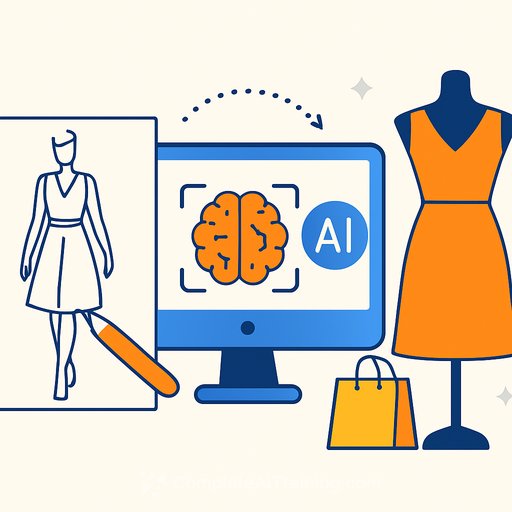
Fashion's Creative Clock Now Runs on AI
Trend cycles are faster. Budgets are tighter. Creative teams don't get extra time, they get extra pressure. That's why AI now sits at the center of fashion: it accelerates ideation, trims waste, and lets you ship work while attention is still hot.
Creation: From Mood Board to Options in Minutes
At major shows, designers feed silhouettes, fabrics, and references into generative tools and get thousands of variations back in minutes. Proportions, drape, and motion are studied on screen instead of burning days on sketches and sample sets. Less waste. More options. Faster judgment calls.
Trend to Product: Weeks, Not Months
Retailers are compressing the cycle from trend signal to shelf. Walmart's internal system analyzes social feeds, influencers, and customer data, then outputs briefs, mood boards, and first-pass garments. Designers edit, refine, and lock the spec. The timeline moves from six months to roughly six weeks.
Simulation That Actually Feels Real
Newer models simulate fabric behavior, surface texture, and movement with better accuracy. Teams test garments virtually, tweak details, and confirm fit before a single sample is cut. Brands also swap traditional photo shoots for AI model generators from companies like Lalaland and Botika-full campaigns created, updated, and localized on demand.
Footwear: Test Materials Before You Make Them
In footwear, AI models simulate sole compression, upper durability, and wear patterns. That means smarter material selection and fewer dead-end prototypes. Waste drops while decisions get cleaner.
Marketing: Real-Time, Not Seasonal
Marketing teams are treating visuals like software updates. Zalando has used AI to generate campaigns, app assets, and PDP images, cutting timelines from six to eight weeks down to three to four days and reducing image costs by up to 90%. Creative refreshes, A/B tests, and localized versions happen in days, not quarters.
Personalization: Storefronts That Adapt to Each Shopper
Luxury houses are serving different layouts, categories, and recommendations per visitor based on behavior and purchase history. As people browse, the site reshapes itself in real time. Others pair this with virtual try-ons for accessories and beauty so shoppers can preview looks and get smarter style suggestions as they click.
Representation and Sizing That Reduce Friction
Brands now maintain digital models across body types, skin tones, and poses to keep visuals consistent without repeated shoots. On sizing, fit guidance tools are finally moving the needle. Teams report that when customers use AI-driven size recommendations, satisfaction with fit jumps dramatically-addressing one of eCommerce's most expensive problem areas.
How Creatives Can Put This to Work
- Ideation sprints: Feed clear silhouettes, fabric libraries, and reference grids into your gen tools. Pull 50-200 variations, shortlist 10, iterate 3 rounds. Timebox to 2-3 hours.
- Simulation-first prototyping: Set baseline cloth and motion settings for your key categories. Pre-fit on a size range before approving any physical sample.
- Virtual model system: Define brand lighting, poses, backdrops, and skin/body diversity once. Generate full lookbooks and PDP sets on that system to keep consistency tight.
- Real-time content ops: Ship weekly refreshes: 3 concepts × 5 treatments. Track CTR, save rate, add-to-cart, and returns. Kill what doesn't move product.
- Personalized assets: Build modular PDP blocks (copy, video, detail crops) that can rearrange based on behavior signals. Prepare alt cuts for new vs. returning shoppers.
- Sizing clarity: Add AI fit tools plus plain-language fit notes. Show multiple body types wearing the item, not just one model.
- Sustainability targets: Set a digital-to-physical sample ratio (e.g., 80% virtual, 20% physical). Review fiber and trim choices inside the sim before anything is ordered.
- Prompt libraries and versioning: Save prompts by category and aesthetic. Use consistent file naming and keep a changelog so the team can reuse what works.
- Rights, ethics, disclosure: Confirm data rights for training and model use. Disclose synthetic imagery where required. Run bias checks on representation.
What This Means for Your Team
AI won't replace your taste. It compresses the path from taste to output. The teams that win set tight constraints, test more options, and keep a clean pipeline-from concept to simulation to content to storefront.
Next Step
If you're upgrading your creative stack, a curated tool path helps. Browse practical courses and tool lists for creative roles here: Complete AI Training - Courses by Job.
Your membership also unlocks: