Shift Up CEO: Smaller Nations Need AI To Compete With US and China
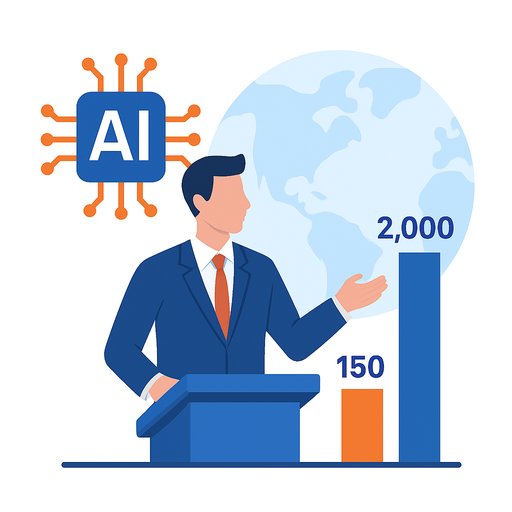
Hyung-tae Kim, CEO of Shift Up (Stellar Blade, Goddess of Victory: Nikke), says countries like South Korea must lean on AI to stay competitive against studios in China and the US. His point is blunt: a typical Shift Up project staffs around 150 people, while some Chinese productions scale to 1,000-2,000.
Speaking at South Korea's 2026 Economic Growth Strategy event, Kim argued AI can act as a force multiplier for talent and even protect jobs-if teams are trained to use it. He suggested that with generative tools in the mix, one well-trained developer could "perform the work of 100 people," as reported by GameMeca and covered by Automaton (via machine translation).
Why this matters
For policymakers, studio leads, and IT managers, the takeaway is simple: scale wins. If you can't match headcount, you need leverage. AI offers leverage-faster iteration, wider experimentation, and better reuse of assets-provided you put guardrails and training in place.
What Kim actually said
Kim contrasted a 150-person development team with Chinese teams that reportedly reach into the low thousands. He framed AI as a practical equalizer for smaller economies and mid-sized studios. Upskilling developers, in his view, makes them more valuable rather than replaceable.
The counterpoint from Larian Studios
Not everyone agrees on where AI should fit. Larian Studios recently clarified it will not use generative AI for concept art on the upcoming Divinity, after testing AI for exploration. That stance underscores a growing split: some teams are all-in on AI productivity, others draw hard lines to protect creative roles and style. For context on the studio, see Larian Studios.
Practical steps for governments
- Fund national AI upskilling: short, job-focused programs for developers, artists, producers, and QA.
- Offer grants/tax credits for AI-assisted pipelines that keep human oversight and credit intact.
- Create shared datasets and model access for local studios, with licensing rules and audit trails.
- Publish clear guidance on copyright, synthetic data, and disclosures to reduce legal uncertainty.
- Support compute access (cloud credits or shared infrastructure) for small and mid-sized teams.
Practical steps for studio and IT leaders
- Pick "needle-moving" use cases first: asset variations - see AI Design Courses, localization, QA triage, build tooling, and internal documentation.
- Establish policies: allowed tools, data handling, IP checks, human sign-off, and content provenance tags.
- Instrument everything: track cycle time, defect rates, asset throughput, content reuse, and review load.
- Run pilot squads (6-12 weeks), document wins and failures, then scale with training and revised SOPs.
- Secure your pipeline: private endpoints, model logs, red-teaming for leaks and unsafe outputs.
Risks to manage
- Copyright and style cloning: use licensed data and verify outputs before publication.
- Quality drift: require human review for narrative, concept, and final art; keep model versions pinned.
- Workforce impact: pair adoption with upskilling and job redesign to keep talent engaged and fairly credited.
- Vendor lock-in: favor portable workflows, open formats, and multi-model strategies.
What success looks like
- Shorter iteration cycles without sacrificing style or lore consistency.
- Smaller teams shipping more frequent updates, with clear human sign-off on creative decisions.
- Transparent provenance for assets and prompts, making audits easy.
Bottom line
AI won't magically replace headcount, but it can compress timelines and widen creative options. For smaller nations and mid-sized studios, the edge comes from smart adoption: targeted use cases, strong governance, and relentless training. That's how you close the gap with teams that have 10x the people.
Further learning
If you're planning structured upskilling by role, here's a curated starting point: AI Productivity Courses. It's useful for mapping skills to production workflows and compliance needs, and for practical programs that accelerate adoption.
Your membership also unlocks: