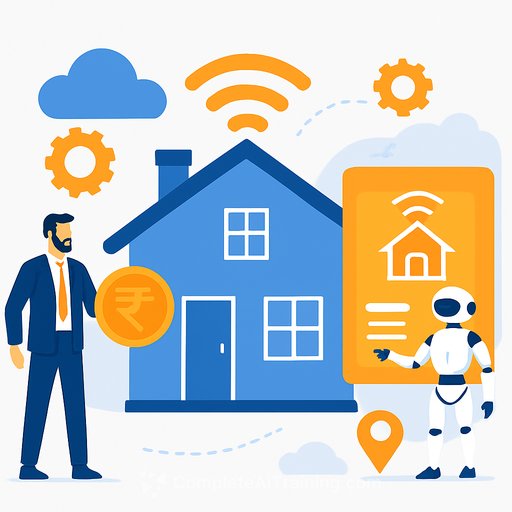
AI in Indian Real Estate: From Design Desk to Lift Lobby
India's property market is shifting from smart-home hype to real operational impact. Wealth created from startup exits and a tech-forward workforce has raised the bar: buyers expect homes that are safer, healthier, and easier to live in-without friction.
On the supply side, developers, architects, and MEP teams are using AI to shorten cycles, reduce waste, and make better calls earlier. The upside shows up in energy bills, uptime, and buyer confidence-numbers your board actually cares about.
What buyers want now: intelligent, private, healthy homes
Premium projects are moving beyond app-controlled lights. Biometric access in lifts, AI-enabled surveillance zones that respect privacy, and real-time monitoring of air and water quality are becoming baseline expectations.
Examples are already live. Central Park's Belanova in Gurugram uses biometric identification so residents don't touch a lift button. Hero Realty's partnership with Panasonic brings AI-led electrical and wellness features into residences, with a clear focus on purified indoor air.
If your value proposition includes health, consider aligning with established frameworks like the WELL Building Standard and ventilation guidance from ASHRAE standards. They give buyers trust and help your teams target measurable outcomes.
Design and engineering: better models, fewer surprises
Architects and MEP consultants are using AI to test building massing, orientation, daylight, ventilation paths, and thermal comfort during concept design. The result: fewer late-stage design changes and a cleaner path to statutory approvals.
Think of it as moving hard questions forward. When you validate solar gain or cross-ventilation early, you reduce rework in façade design, HVAC sizing, and even structural redundancies.
Construction and operations: predictive beats reactive
Facility teams are applying AI to HVAC, lifts, pumps, and fire systems for fault detection and predictive maintenance. That shifts teams from firefighting to planned interventions-and cuts downtime.
Real-time IAQ and water quality sensors feed living dashboards for property managers and residents. With the right triggers, you can auto-adjust outside air intake, tighten filtration, or dispatch housekeeping for water issues before complaints surface.
If you're building the backbone for this, start with a unified data layer over your BMS/CAFM, then layer anomaly detection on top. For practical frameworks and tools, see AI for Operations.
Commercial fit-outs: faster decisions, fewer change orders
In offices, AI-generated layouts and photorealistic visualizations cut weeks from design iterations. Clients see how their space will look and function before a single wall is marked, reducing ambiguity and late changes.
As Tushar Mittal of OfficeBanao notes, data capture and re-use across projects compounds gains. Your second, third, and tenth office of a similar size get cheaper and faster to deliver.
Transactions and financing: document intelligence and pricing
Developers, brokers, and lenders are pushing AI into deal mechanics. Lease abstractions that once took days now run in minutes-thousands of pages scanned for break clauses, escalation, indemnities, and unusual covenants.
Sales teams are pairing micro-market analytics with immersive walkthroughs to narrow choices and move buyers to a decision. For legal workflows, explore AI for Legal. For a broader view across build, sell, and manage cycles, see AI for Real Estate & Construction.
Implementation playbook: a 90-day starter plan
- Pick 2-3 use cases with clear ROI: lift downtime reduction, HVAC energy savings, lease abstraction throughput.
- Audit data and systems: BMS points list, sensor health, lease repositories, access control logs.
- Select vendors with open APIs and on-prem options for sensitive data (biometrics, access control).
- Run a controlled pilot on one asset or one vertical system; establish a baseline before activation.
- Integrate with existing CAFM/BMS for automated tickets and alerts; avoid "dashboard sprawl."
- Define governance: data retention, resident consent, and cybersecurity protocols.
- Publish results to leadership and customers; convert wins into standard operating procedures.
Metrics that make the case
- Energy: kWh/m² and HVAC load variance vs. baseline.
- Uptime: mean time between failures (lifts, pumps), mean time to repair.
- IAQ: PM2.5, CO₂, VOC compliance hours per month.
- Water: residual chlorine and turbidity within target bands, response time to anomalies.
- Fit-out: design-to-GFC days saved, change orders per 1,000 m².
- Transactions: pages abstracted per hour, error rate from QA samples.
- Sales: inquiry-to-booking days, conversion rate by micro-market.
Risks and guardrails
- Privacy: treat biometrics as highly sensitive; apply encryption, access limits, and explicit consent.
- Security: segment OT networks, enforce MFA for admin accounts, and test fail-safe modes for critical systems.
- Bias and fairness: validate pricing and scoring models against historical outcomes; document overrides.
- Model drift: schedule quarterly model reviews; monitor alert fatigue and tune thresholds.
- Compliance: map features to local codes and resident welfare norms; align with WELL/ASHRAE where relevant.
Bottom line
AI is changing how Indian homes are bought and lived in-and how offices are designed, built, and run. The winners won't be the loudest marketers. They'll be the operators who connect design intent to live building data, measure what matters, and keep improving quarter by quarter.
Your membership also unlocks: