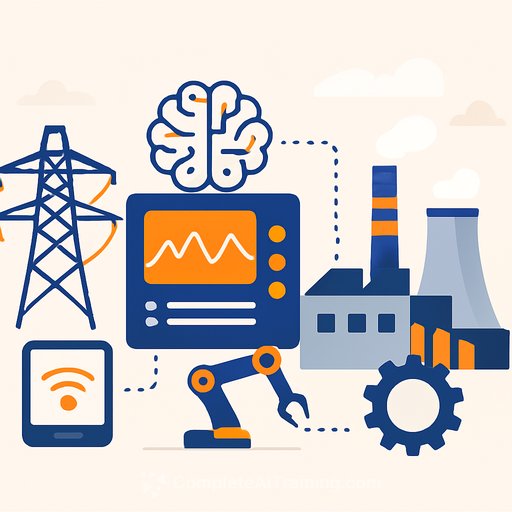
AI, IoT, and Digital Twins: A Practical Playbook for Energy Management and Operations
Operations teams face a new reality: energy is decentralized, assets are connected, and decisions need to be made in minutes, not weeks. The upside is big-lower cost to serve, fewer outages, better utilization, and less waste.
The path is clear. Use AI for Operations to coordinate distributed energy. Use digital twins to design, test, and refine operations before they hit the floor. Tie it together with interoperable data so systems keep getting smarter without locking you in.
At a Glance
- AI manages decentralized energy through IoT data analysis.
- Digital twins enable virtual testing and continuous performance optimization.
- Interoperable architectures support energy intelligence and operational goals.
Example 1 - AI and IoT: Orchestrating Decentralized Energy Systems
Renewables, microgrids, and prosumers make the grid more dynamic and complex. AI helps by analyzing live feeds from solar, EV chargers, and storage to forecast consumption, generation, and pricing. With that forecast, systems decide when to store, use, or sell energy to keep loads balanced and costs controlled.
For operations, this shifts design from "central brain" to "smart edges." Sensors and controllers need to act locally, talk fast, and adapt as new assets come online.
- Plan for intelligence at the edge: enable local decision-making in sensors, controllers, and meters.
- Design for speed and interoperability: low-latency comms and open data models between distributed assets.
- Build for adaptability: make it easy to add new assets, storage tech, or data sources without redesigning everything.
If you're evaluating microgrids, start with a clear operating model and data contract for each asset. The more predictable the data, the more reliable the decisions. For broader context, see the U.S. DOE's overview of microgrids here.
Example 2 - AI and Digital Twins: Designing Smarter Industrial Operations
Digital twins mirror your lines, machines, or entire sites in a virtual model. Teams can test scenarios, validate designs, and estimate performance before changes hit production. Once live, twins sync with operational data to reflect actual behavior.
This creates a feedback loop: simulate, deploy, learn, refine. You improve throughput, uptime, safety, and sustainability with less trial-and-error on the floor.
- Accelerated design validation: spot issues early and tune for target performance before rollout.
- Continuous optimization: feed real-time data back into the model to adjust setpoints and workflows.
- Predictive maintenance: simulate wear, anticipate failures, schedule interventions.
- Faster change cycles: try new configurations in a safe environment, then push the best version to production.
- Adaptive systems: keep evolving operations instead of freezing them at day-one specs.
Standards and frameworks are maturing quickly. The Digital Twin Consortium offers useful guidance on reference architectures and use cases here.
Connecting the Two Worlds
Energy intelligence and operational intelligence live on different layers, but they need the same foundation: clean, shareable data. Think open standards, scalable connectivity, and clear governance for data and models. If teams can find and trust the data, they can automate decisions with confidence.
In practice, that means consistent tagging, versioned data schemas, and a traceable chain from sensor to decision. It also means explainable AI-operators should see why a recommendation was made and what it depends on.
Designing for Scale, Resilience, and Responsibility
Scaling AI, IoT, and twins isn't just an engineering task. You'll need high-speed networks for real-time flows, cybersecurity hardening at the edge and core, and policies that reward flexibility and renewable integration. You'll also need playbooks for model governance and audit.
As more decisions become automated, transparency matters. Keep a log of model versions, training data sources, and approval workflows. If something drifts, you want quick root cause and safe rollback.
What Operations Leaders Can Do Next
- Audit data flows: map sensors, tags, and historians; fix missing or noisy data first.
- Instrument critical assets: add meters and condition sensors where downtime or energy cost is highest.
- Pick open standards: adopt interoperable protocols and a shared data dictionary across sites.
- Pilot with a tight scope: one line, one microgrid, or one cluster of assets; target a single KPI (e.g., peak demand reduction, OEE uplift).
- Close the loop: connect insights to control-automate setpoint changes and charge/discharge decisions with clear guardrails.
- Stand up MLOps: monitoring, retraining triggers, versioning, and rollback procedures for all models in production.
- Secure the edge: identity, patching, and network segmentation for gateways, PLCs, and IoT devices.
- Upskill your team: train operators and engineers on AI fundamentals, data literacy, and twin workflows. Explore role-based paths like the AI Learning Path for Plant Managers.
Bottom Line
Treat AI, IoT, and digital twins as core design principles, not add-ons. Build systems that learn, adapt, and scale with your operations. The grid and your plants will run on data as much as electrons-and the teams that act on that now will set the standard for cost, uptime, and sustainability.
Your membership also unlocks: