How to Leverage AI in Financial Services Regulatory Compliance
Compliance is a constant tax on time, capital and attention. AI can reduce that load - if it's embedded thoughtfully and supported by clear controls.
The shift underway is simple: AI is moving from bolt-on tools to the core of surveillance, KYC and risk operations. Done right, it makes monitoring continuous, reduces false positives and frees analysts to focus on real risk.
From Static Rules to Adaptive Intelligence
Rule-based systems flag thresholds. Useful, but noisy. Analysts burn hours clearing benign alerts.
Modern models learn context. They spot subtle relationships across entities, accounts and behavior - the patterns rules miss. Expect higher precision, fewer false positives and better fraud detection.
There's also an "AI vs. AI" reality. Bad actors use generative tools to hide; institutions counter with models designed to surface weak signals. The edge goes to teams training smarter, better-governed models - not those writing more rules.
Transparency Builds Regulator Confidence
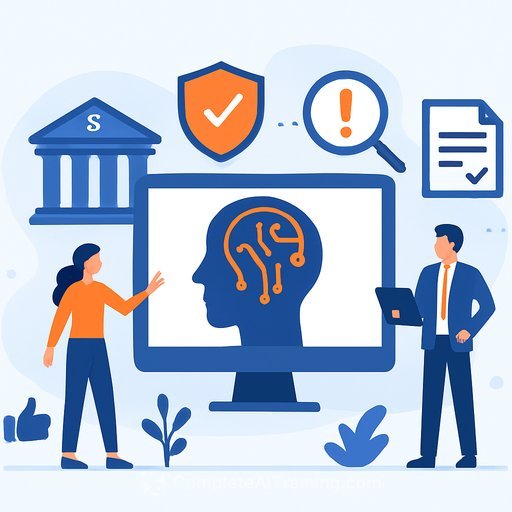
Performance alone isn't enough. Regulators want to know why a model made a call. That means explainability, traceability and evidence that decisions can be reproduced.
Generative tools can map policies, controls and audit evidence to standards from groups such as NIST and the FINRA. Instead of saying "we're compliant," you can show how controls tie to each requirement, with source documents and validation steps.
From Periodic Reviews to Always-On Assurance
Annual or semiannual reviews are outdated the moment they're published. A 90-day lag between assessment and board reporting makes findings stale.
AI can maintain an "always-on" assessment. Models watch new evidence, risk indicators and transactions across Microsoft Teams, SharePoint and Salesforce. When a new pattern appears, the system can classify it as threat or trend - fast enough to inform decisions, not just audits.
What Leading Institutions Are Doing Right Now
Firms engaged with the Cyber Risk Institute profile are moving past point-in-time exercises. They're applying platforms like Cortex from Palo Alto Networks or emerging natural language query tools from Cisco to generate near real-time risk views.
The practical benefit: correlate live threat intel to regulatory frameworks on demand, flag exceptions immediately and treat risk like a monitored metric - not a quarterly slide.
Foundational Requirements for AI in Compliance
- Traceable and testable decisions: Log inputs, outputs, model versions and human overrides so results can be reproduced for auditors.
- Human in the loop: Assign accountable owners. Use an AI Center of Excellence or governance board with IT, risk and finance represented.
- Policy-first deployment: Define acceptable use, data retention, PII handling, vendor requirements and model rollback criteria before scaling.
A Practical Playbook
- Discovery: Clarify the problem (e.g., false positive reduction, KYC cycle time, SAR quality) and target outcomes with measurable thresholds.
- Assessment: Inventory data sources and controls, benchmark against standards, and identify maturity gaps. Produce a risk heat map and a prioritized roadmap.
- Execution: Run a pilot with a narrow scope. Deliver an operational blueprint, success metrics, user feedback and the plan to scale.
Tooling: Off-the-Shelf vs. Custom
Most institutions can cover 80-85% of automation needs with commercial platforms from Palo Alto Networks, Cisco or CrowdStrike. Use them for ingestion, correlation, alerting and reporting.
The remainder is proprietary: models trained on internal data, tuned to your specific risk signals, product mix and customer behaviors. Build where differentiation matters.
Controls to Put in Place from Day One
- Model risk management: Document objectives, limits, monitoring and re-performance steps. Schedule periodic validations.
- Bias and drift testing: Track precision/recall across segments, and alert when distributions shift.
- Adversarial testing: Red-team models against synthetic fraud and obfuscation tactics (the "AI vs. AI" problem).
- Data governance: Provenance, lineage, role-based access and retention aligned to regulatory rules.
- Auditability: Immutable logs for decisions, overrides and notifications, with time stamps and identities.
Metrics That Matter
- False positive rate and alert precision/recall
- Average time to disposition and SAR quality
- Coverage of controls mapped to frameworks
- Model drift frequency and remediation time
- Reproducibility rate in audit re-performance
Next Steps
- Pick one workflow (e.g., transaction monitoring triage) and ship a 90-day pilot with explicit success criteria.
- Stand up governance early: owners, policies, approval gates and documentation templates.
- Scale only after you hit target precision/recall and prove audit readiness.
If your team needs a quick way to spot high-ROI tools for finance use cases, scan this curated list: AI tools for finance. Finance and accounting teams focused on KYC, SARs and controls can also follow the AI Learning Path for Accountants to build role-specific skills and governance practices.
The Bottom Line
AI can make compliance faster, more accurate and continuous - but only with transparency, strong governance and a clear scope. Start small, prove value, document everything and keep a human in the loop.
Your membership also unlocks: