Smarter Healthcare With AI: Efficient Workflows and Compassionate Care
Picture a clinic where documentation finishes itself, follow-ups queue automatically, and the care team steps into each visit already briefed. At the same time, patients use AI mental health tools that catch mood shifts early and offer support in the moment. That's not far off-it's here, and it's practical.
Two forces make it possible: clinical workflow automation and mental health AI. Together, they turn busy days into predictable systems while keeping care human.
Why AI and Automation Are No Longer Optional
Healthcare teams face rising costs, staffing gaps, and overflowing admin work. Many clinicians spend close to half their day on documentation and coordination. Demand for mental health support continues to climb, especially in younger populations.
Automation tackles repetitive tasks. AI extends care beyond the clinic. Combined, they shorten wait times, reduce burnout, and improve outcomes.
The Two Pillars
- Efficiency: Automate scheduling, reminders, intake, documentation, and billing to reduce errors and free up time.
- Compassion: Use mental health AI to provide continuous, accessible support between visits.
Clinical Workflow Automation
Clinical workflow automation uses rules and AI to streamline daily operations-intake, referrals, lab notifications, summaries, and claims. It handles the routine "plumbing" that slows clinicians down.
Key Benefits
- Less admin work: More focus on patient care and clinical decisions.
- Fewer errors: Reduced manual entry and better data quality.
- Faster turnaround: Minutes instead of hours for common tasks.
- Better morale: Teams spend time on meaningful work, not copy-paste.
Where It Shows Up
- Scheduling: Automated reminders cut no-shows and smooth daily volume.
- Labs: Automatic alerts when results arrive or fall outside normal ranges.
- Discharge summaries: Smart templates pre-populate accurate data.
- Claims and billing: Cleaner submissions, fewer denials, faster cycles.
In behavioral health, automation tightens referrals, check-ins, and documentation-creating a quick, responsive loop that supports timely intervention.
Mental Health AI
Mental health AI supports emotional well-being through pattern detection and personalized guidance. It's not a replacement for therapists-it's a companion that extends care and surfaces risk sooner.
Examples in Action
- AI chat companions: Supportive conversations and CBT-style exercises.
- Mood tracking: Language, tone, or wearable data highlight changes.
- Crisis prediction: Risk models flag concerning trends for review.
- Therapy support: Session summaries and progress tracking for personalization.
Why It Matters
- Access: Support is available anytime, anywhere.
- Cost: Augments care without adding staff hours.
- Early intervention: Continuous signals surface issues before they escalate.
- Personalization: Guidance adapts to the individual.
Where Efficiency Meets Compassion
Integration is where the real gains happen. A patient's mood tracker dips for a week. The system alerts the care team, books a check-in, and adds context to the chart. The clinician walks in informed, and documentation updates automatically. That's clinical workflow automation working alongside mental health AI.
Benefits of Integration
- Continuity of care: Patients get timely support between visits.
- Lower workload: Follow-ups, reminders, and notes run in the background.
- Data you can use: Mood trends, engagement, and symptoms at a glance.
- Patient empowerment: Daily self-awareness and structured self-care.
A Human Story: Anna
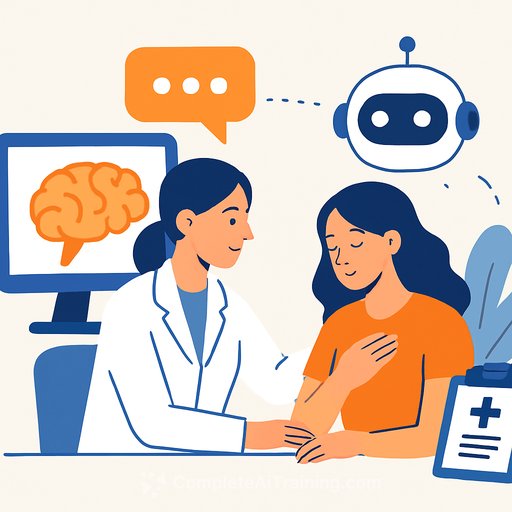
Anna, 32, uses an AI app to track anxiety. A sustained dip triggers a secure alert to her clinic. A check-in is scheduled, she gets a confirmation, and her therapist reviews a concise summary before the session. Notes update after the visit without extra clicks. Timely care, less admin, better experience-for both sides.
How to Implement in Your Clinic or Health System
- 1) Map current workflows: List time sinks: intake, reminders, documentation, referrals. Start with one.
- 2) Choose tools that integrate: Prioritize EHR interoperability, secure APIs, and mental health AI with clinical backing and strong privacy controls.
- 3) Pilot and measure: Run a small test (e.g., automated follow-ups for anxiety patients). Track:
- Time saved per clinician per week
- Patient engagement and adherence
- No-show reduction
- Patient and staff satisfaction
- 4) Train and communicate: Offer hands-on training. Clarify that tech supports, not replaces, clinicians. Explain to patients how data improves care.
- 5) Compliance and ethics: Follow privacy standards, document data use, and keep a human in the loop for sensitive decisions.
Common Challenges (and What Works)
- "We'll lose the human touch": Let automation handle repetitive tasks. Keep clinicians front and center in communication and decisions.
- Fragmented data: Pick platforms that sync across departments and maintain a single source of truth.
- AI accuracy and bias: Monitor outputs, audit models, and require clinician oversight for mental health signals.
- Change resistance: Involve staff early, demonstrate time saved, and recognize wins publicly.
What's Next
- Smarter documentation: Voice tools that summarize visits in real time, tied directly to workflows.
- Proactive mental health: Wearables and behavior signals flag relapse risk; automated workflows trigger outreach.
- Unified ecosystems: Apps, sensors, and clinical systems flow data into one patient record to personalize care at scale.
- Explainable AI: Transparent recommendations that clinicians can trust and verify.
FAQs
Q1: What is clinical workflow automation?
Software and AI that handle repetitive clinical and administrative tasks-like scheduling, referrals, and documentation-so teams can spend more time with patients.
Q2: How does mental health AI help patients?
It offers 24/7 support through mood tracking, guided exercises, and early-warning signals that surface distress before it escalates.
Q3: Can AI replace clinicians or therapists?
No. AI reduces routine work and provides insights. Human judgment and empathy remain essential.
Q4: How should we start?
Pick one workflow (e.g., post-visit follow-ups), automate it, integrate a mental health AI signal if relevant, measure impact, then scale.
Next Steps
- Review your top three admin time drains and select one pilot within 30 days.
- Confirm HIPAA-compliant data practices and role-based access for any new tool. See an overview from HHS: HIPAA Privacy Rule.
- If your team needs AI upskilling, consider structured training: Latest AI courses.
Your membership also unlocks: