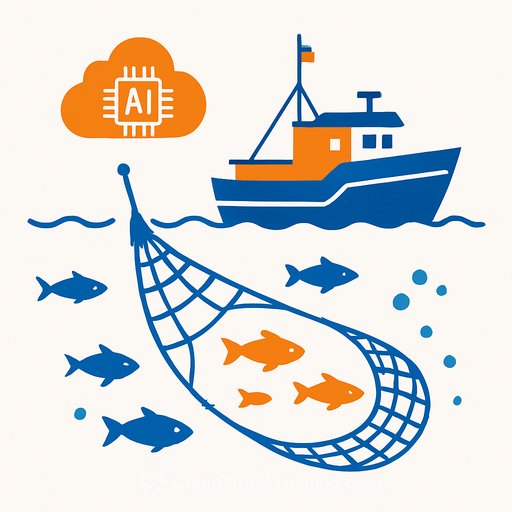
AI-Driven Smartrawl Shows Progress in Reducing Bycatch
Smartrawl 5.0 Trials Show Promise for AI-Powered, Selective Fishing Innovation
Smartrawl is an underwater system developed to reduce bycatch and discards in demersal trawl fisheries. Supported by Fisheries Innovation & Sustainability (FIS) and funded by the UK’s Seafood Innovation Fund, it combines artificial intelligence, stereo imaging, and a patented mechanical gate. This integration enables selective retention or release of fish directly in the water, offering a practical step toward more sustainable fishing practices.
An AI-Guided Approach to Selective Trawling
The core of Smartrawl is a smart gate system fitted into the cod-end extension of a commercial trawl net. It features three main components:
- A stereo camera capturing real-time images of fish entering the net
- An onboard single-board computer running AI to identify species and size
- A rotating gate controlled by AI that either retains target fish or releases unwanted species unharmed
Phase 5 focused on refining AI capabilities, integrating components, and conducting live sea trials off Shetland aboard the research vessel Atlantia II under commercial fishing conditions.
Findings from Shetland Trials
Initial trials in November 2023 produced mixed but encouraging outcomes. The system successfully rotated the gate at typical towing speeds and captured video evidence of catch-and-release actions. However, technical issues such as latch malfunctions, camera exposure problems, and battery failures affected data consistency.
Subsequent tests in early 2025 addressed many of these challenges. For the first time, Smartrawl achieved full automation—AI identification triggered the gate to switch between catch and release modes without manual intervention. Despite difficult environmental conditions, the trials confirmed the system's potential in mixed demersal fisheries.
Advanced AI for Species Identification
A major upgrade during Phase 5 was the AI’s improved accuracy. Researchers compiled a dataset of over 2,900 images covering nine commercial species, including cod, haddock, whiting, flatfish, and prawn. This dataset trained the AI to perform reliable species recognition in complex underwater settings.
The AI runs on the Jetson Nano Orin platform, enabling real-time processing linked directly to the gate’s mechanism. Smartrawl can be pre-set to retain specific species, allowing fishers to meet selectivity goals and support sustainable harvests.
Next Steps: Refinement and Expanded Trials
Some planned objectives, like testing aboard a commercial trawler, were delayed but are included in upcoming Phase 6 plans. This phase will focus on mechanical improvements, enhancing gate durability at depth, and broader sea trials.
Improvements currently underway aim to strengthen the gate structure and improve latch reliability. Smartrawl’s modular design requires no vessel wiring and is easily deployable, facilitating wider adoption.
By autonomously sorting catch underwater, Smartrawl reduces environmental impact and helps fishers comply with landing obligations while improving product quality. Continued development could make it a key tool in sustainable fisheries management.
Background and Development
Since 2016, Fisheries Innovation and Sustainability (FIS) has supported Professor Paul Fernandes of Heriot-Watt University in developing Smartrawl. The system enables fishers to keep only target species and release others unharmed. The trial aboard UHI Shetland’s vessel Atlantia II marked the first successful at-depth rotation of the patented gate, demonstrating rapid switching between catch and release positions.
For those interested in AI applications in environmental science and fisheries, further AI training resources are available at Complete AI Training.
Your membership also unlocks: