AI won't fix South Africa's productivity crisis - leadership will
South African businesses are adopting artificial intelligence rapidly. Boardrooms buzz with talk of automation, efficiency and cost reduction. But most companies are solving the wrong problem.
A report from Henley Business School warns that organisations are stuck in a narrow first phase: using AI mainly to cut costs and automate routine work. That delivers short-term gains. It won't transform businesses. And it won't address South Africa's deeper productivity challenges.
In fact, approached incorrectly, AI could make them worse.
The efficiency trap
South African firms face real pressure. Economic growth is sluggish. Margins are tight. Productivity has stagnated for over a decade. In this environment, positioning AI as a cost-saving tool makes sense. But it's exactly the wrong move.
When organisations focus only on efficiency, they risk "making what they currently do slightly more efficient" without changing how value gets created. They optimise yesterday's business model instead of building tomorrow's.
The real issue isn't access to AI tools. It's the ability to use them well. Many organisations lack the internal capacity to translate AI's potential into meaningful outcomes. AI acts less as a solution and more as a stress test - exposing gaps in leadership, capability and organisational readiness.
AI's real potential is transformational. It's about redesigning services, rethinking customer experience, and enabling better decision-making. Companies that move beyond cost-cutting will outpace those stuck in efficiency mode. For South Africa, where competitiveness is already under pressure, this distinction is critical.
The real constraint: people, not technology
The deeper challenge for South African organisations lies within themselves.
As AI becomes embedded in everyday work, success depends on whether people can understand it, apply it, and make sound decisions alongside it. Many cannot. Employees feel overwhelmed by the pace of change. Managers struggle to integrate AI into real workflows. Too few organisations have people who bridge the gap between technical capability and commercial reality.
South Africa faces a structural disadvantage here. Digital skills are unevenly distributed. Access to training is limited. Many organisations underinvest in the skills of the future.
The risk is clear: AI could deepen inequality between firms - and between workers - rather than closing it. AI for Management and leadership training at scale becomes not optional, but essential.
Productivity gains with hidden costs
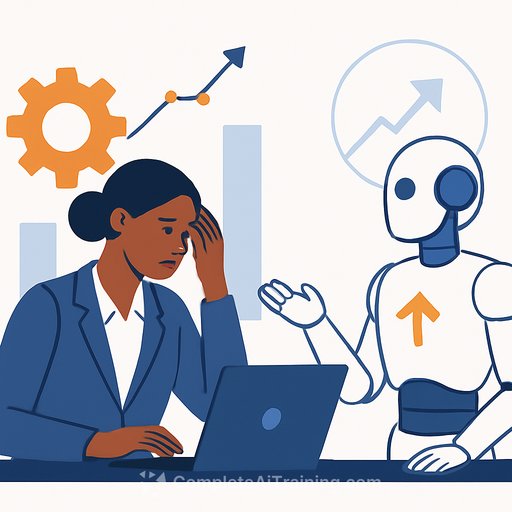
AI can boost productivity. Workers globally report being significantly more efficient when using AI tools. But the report highlights a less discussed consequence: AI users face burnout and disengagement.
Efficiency without redesign leads to pressure, not progress. If organisations simply layer AI onto existing workloads, they create faster, more intense work environments - without improving job quality or long-term performance. For South Africa, where employee engagement is already weak in many sectors, this is a serious concern.
This is a leadership problem
At its core, this is not a technology issue. It's a leadership issue.
AI forces organisations to confront deeper questions: What work should humans do versus machines? What about humans and machines together? How should decisions be made and governed? What kind of organisation do we want to build?
Answering these requires a different kind of leadership - one that goes beyond technical expertise. Leaders who succeed in the AI era are not those who understand algorithms best. They're those who exercise judgement under uncertainty, integrate technology with human capability, build trust and ethical accountability, and translate complexity into clear organisational action.
Leadership is shifting from control to sense-making.
A uniquely South African opportunity
South Africa is not yet fully locked into legacy AI approaches. It has the chance to leapfrog - to adopt AI in a way that is more human-centred, more inclusive, and more aligned with long-term value creation.
That means:
- Investing in skills and digital literacy at scale
- Redesigning work, not just automating tasks
- Prioritising judgement, creativity and problem-solving
- Building AI for Executives & Strategy capability as a strategic asset
- Resisting the temptation to see AI as a shortcut
The bottom line
AI will not fix South Africa's productivity problem on its own. It will not resolve skills shortages. It will not automatically make organisations more competitive.
What it will do is amplify whatever already exists - good or bad.
Companies with strong leadership, clear strategy and empowered people will accelerate ahead. Those without will simply automate inefficiency.
The uncomfortable truth: the future of AI in South Africa will be determined less by the technology adopted, and more by the leaders developed. The companies that win in the AI era won't be the most automated. They'll be the most human.
Your membership also unlocks: