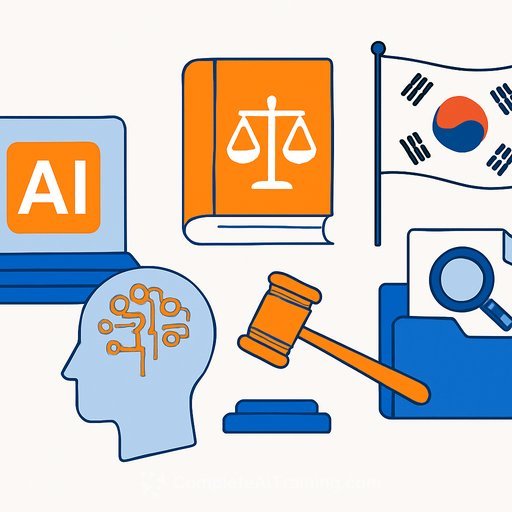
South Korea Refines AI Law Three Months After Enforcement Begins
South Korea has begun adjusting its AI Basic Act less than three months after it took effect on January 22, 2026. The government launched a public-private task force with more than 40 experts from industry, academia, and civil society. Ministries are also expanding policy briefings and direct consultation channels with startups.
This is not a rollback. The law has entered a phase where policy evolves through real-world deployment rather than remaining fixed at the point of enforcement.
How the Grace Period Functions as a Testing Ground
The AI Basic Act includes a regulatory grace period of at least one year. That period is being used actively. Government agencies are collecting feedback through policy briefings, consultations, and industry engagement. Additional briefing sessions are scheduled between April and August, including live Q&A and one-on-one consultations for startups.
The grace period is not a passive delay. It functions as a controlled environment where policy assumptions are tested against real deployment conditions.
What the Task Force Is Refining
The government's task force is not rewriting the law. It is refining how the law works in practice. Based on current developments and stakeholder participation, several areas are likely under discussion:
- Interpretation of what qualifies as "high-impact AI"
- Scope and depth of transparency and explainability requirements
- Practical compliance pathways for startups
- Technical expectations for auditability and governance
- Alignment between legal definitions and real deployment conditions
The task force structure-divided into academic, legal, industry, and civil society groups-suggests discussions are moving toward more granular, sector-specific standards.
The Real Pressure: Trust Over Rules
Technical capability alone rarely determines whether companies can deploy AI in regulated environments. What matters is whether regulators and stakeholders believe an organization understands the consequences of deployment, failure modes, misuse, and long-term responsibility.
This pressure intensifies in high-risk sectors. In telecom AI, for example, reliability means more than general helpfulness. It requires consistent, safe behavior under edge cases, robust guardrails, and auditable, repeatable governance. Pre-defined rules alone cannot address these realities. They require ongoing refinement.
Compliance as Market Access
Earlier discussions around the AI Basic Act often framed compliance as a regulatory burden. That framing is shifting. Alignment with Korea's law is becoming a form of global positioning-a "Global Entry Ticket" for companies seeking market access in regulated sectors and international partnerships.
This changes how startups compete. Advantage now shifts toward teams that can build audit-ready systems, document model behavior and risks, engage with regulators early, and adapt to evolving standards.
The Remaining Challenge
The system is still evolving. Definitions such as "high-impact AI" require more granular guidance. Technical standards for transparency and model disclosure are still being refined. Sector-specific evaluation systems-such as structured adversarial testing for telecom AI-are not yet standardized.
The challenge now is not designing policy frameworks. It is translating concepts such as trust, safety, and accountability into enforceable and testable standards across sectors.
Korea's Position in Global AI Governance
The European Union is adjusting implementation timelines and engaging directly with industry as its AI Act moves into phased enforcement. The United States is entering a transitional phase, with a federal AI law under discussion while state-level regulations continue to shape enforcement.
South Korea is developing its own model, combining early legal codification with iterative adjustment through industry participation and real-world feedback. This positions Korea as an adaptive governance environment rather than a fixed regulatory regime.
The next phase will depend on how effectively feedback from startups, industry, and technical operators can be translated into standards that both support innovation and maintain trust. For legal professionals, this means understanding that compliance frameworks in AI will continue to evolve-and that early engagement with regulatory bodies is increasingly a competitive advantage.
For more on how AI governance affects your field, explore AI for Legal Professionals and AI for Government.
Your membership also unlocks: