
AI news ·
South Korea selects four university labs to research artificial intelligence, solar energy, small modular reactors, and precision medicine
South Korea will fund four university labs with up to $7.5 million yearly for a decade. The projects target physical AI, solar energy, nuclear reactors, and precision medicine.
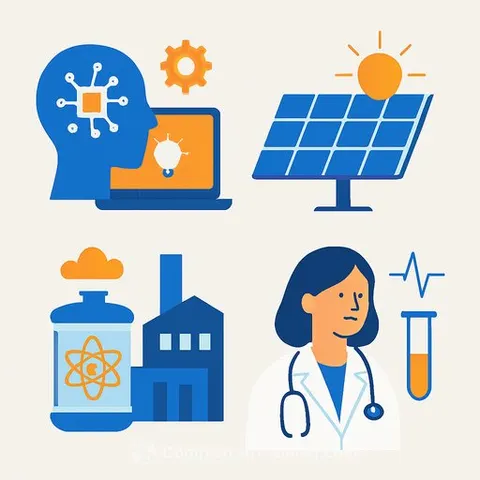
South Korea's government will fund four university-affiliated research labs with up to 10 billion won (roughly $7.5 million) each per year for a decade, beginning July 1. The labs will pursue physical AI, solar-based energy solutions, small modular reactors, and precision medicine - areas where the country wants to secure world-first or world-leading positions.
The National Research Lab (NRL) 2.0 program, launched last year, supports hub laboratories that draw on strong university research fields and infrastructure to drive large-scale convergent work. The Ministry of Science and ICT and the Ministry of Education announced the 2026 selections on the 29th.
Four labs, four research frontiers
Professor Kyu-Jin Cho of Seoul National University leads the Human-Centered Physical AI Robotics Research Lab. The team will develop robots that mimic human sensory and motor nervous systems, aiming for ultra-personalized robot services, manufacturing innovation, and improved quality of life for older adults.
At Sungkyunkwan University, Professor Nam-Gyu Park heads the Sungkyun Intelligent Energy Solutions National Research Lab. The group will combine high-efficiency solar cells and energy storage with AI and digital twins to support industrial electrification and power supply for AI data centers.
The SMR2 Platform National Research Lab, led by Professor Jae-Sun Lee of Changwon National University, will build an integrated platform for nuclear plant core materials, structural integrity, energy conversion, and system integration. Research on AI autonomous operation and verification of structural integrity in extreme environments is expected to accelerate the development of core SMR materials and hardware virtual verification technologies.
Professor Hak-Soo Choi of Chungnam National University directs the Theranostics Convergence National Research Lab. The lab will study molecular, cellular, and microenvironmental mechanisms behind intractable tumors, infectious diseases, and degenerative brain disorders. Theranostics combines diagnosis and therapy to detect diseases precisely and link them to targeted treatment.
Funding structure and regional participation
This year, the program split into Type 1 (nationwide) and Type 2 (regional) to widen participation opportunities for local universities. The government said the first year will provide 5 billion won, equivalent to six months of funding, and noted the support scale could change depending on the budget situation.
After a period for objections, the government will finalize the selected institutions and launch the project fully through agreements with the implementing organizations.
Lee Hae-sook, Director-General for Higher and Lifelong Education Policy at the Ministry of Education, said, "We expect National Research Labs to play a pivotal role in dramatically transforming universities' R&D ecosystems and contributing to regional development, while simultaneously producing world-class research outcomes."
Why this matters for science and research professionals
The decade-long funding commitment signals stable support for high-risk, high-reward projects that blend AI with physical systems, energy engineering, nuclear technology, and biomedicine. The labs' focus on AI - from autonomous nuclear plant operation to digital twins for energy systems - points to a growing need for researchers who can bridge AI and domain science. For professionals in these fields, the program creates new opportunities to work at the intersection of foundational research and real-world deployment.