South Korea Signs AI Computing Deals With Nvidia, HPE, and IonQ
South Korea's government signed three memorandums of understanding with major technology firms this week to build infrastructure supporting its K-Moonshot strategy, a push to strengthen AI-based science and technology capabilities.
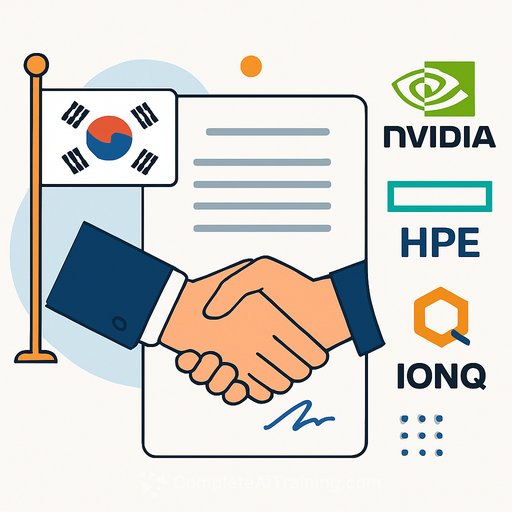
The Korea Institute of Science and Technology Information (KISTI) signed agreements with Nvidia, Hewlett Packard Enterprise (HPE), and IonQ at GTC 2026 in San Jose. The deals center on KISTI's sixth national supercomputer, Hangang, scheduled for deployment in the second half of 2026, and IonQ's quantum computer, Tempo.
Quantum and High-Performance Computing Integration
KISTI, Nvidia, and IonQ will jointly develop quantum-HPC hybrid computing technology. The collaboration links Hangang with Tempo to advance quantum algorithm research and talent development, targeting applications in drug discovery, materials science, and financial optimization.
HPE will help optimize operational efficiency for Hangang and improve the AI and high-performance computing research environment. The agreement includes optimizing scientific software for supercomputing and establishing a foundation for training scientific models.
Nvidia Partnership Focuses on Science AI Models
Nvidia will work with KISTI to develop large-scale science AI models and domain-specific foundation models using Hangang's GPU infrastructure. The partnership includes joint training programs such as GPU boot camps and hackathons.
Kim Seong-su, head of the research and development policy office at the Ministry of Science and ICT, said next-generation computing technology drives a shift toward AI-based scientific research. He said the agreements should help domestic researchers produce results and accelerate K-Moonshot objectives.
Researchers working on AI applications in science may find value in exploring AI for Science & Research resources to build relevant skills in this expanding field.
Your membership also unlocks: