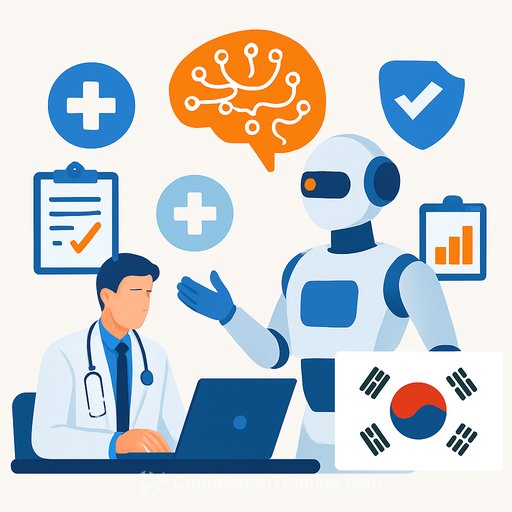
South Korea sets 2026 support program for AI-driven medical products: What product teams should do now
South Korea's Ministry of Food and Drug Safety (MFDS) plans to launch a 2026 program to speed the development, use, and export of medical products that apply AI. The ministry's annual policy report points to new approval routes, clear review standards, and a certification system built around performance and reliability.
The signal is simple: if you build digital health, AI SaMD, or AI-enabled drug development tools, Korea is preparing a faster, clearer path - with higher expectations on data quality and evidence.
Highlights from the ministry's plan
- Lay the groundwork to expand AI-based medical product development and use.
- Create a custom approval pathway for digital medical products.
- Streamline rules for new-technology and "convergence-type" products (e.g., software + device, drug-device-software combos).
- Define approval and review standards for digital information processing in AI-driven drug development.
- Offer regulatory support to speed market entry, including data-based clinical trials and oversight of AI training data quality.
- Develop national performance standards for AI-based digital medical and health-support devices, plus a certification system to back exports.
Why this matters for product development teams
This isn't just a policy change; it's a product constraint set. Your model choices, data pipelines, and clinical design will need to meet explicit standards and pass certification that buyers and regulators can trust.
- Regulatory strategy: plan for a defined Korea-specific path for digital/AI products that may differ from the US/EU.
- Evidence design: expect demand for data-driven trials and thorough dataset documentation (provenance, curation, bias checks).
- MLOps maturity: reproducible training, clear versioning, and change control will be essential, especially for models that update.
- Export leverage: certification could become a procurement shortcut with hospitals and distributors across Asia and beyond.
Action checklist for 2025 (to hit the 2026 window)
- Map your product to a likely category (AI SaMD, clinical decision support, health-support device, AI for drug R&D) and define the evidence plan.
- Audit your data supply chain: sources, consent, lineage, preprocessing, labeling QA, and subgroup performance reporting.
- Document model behavior end to end: training config, versioning, datasets, monitoring, post-market update policy, rollback triggers.
- Design data-based trial protocols now: endpoints, comparators, dataset representativeness for Korean populations, and external validation.
- Stress-test against performance standards: accuracy, specificity/sensitivity, fairness metrics, clinical risk thresholds, and usability.
- Prepare for certification: product file, test reports, cyber/privacy posture, real-world performance plan, and supplier attestations.
- For convergence products, align device, software, and (if applicable) drug teams under a single change-control and evidence strategy.
If you need a global reference point for AI medical devices, see the FDA's AI/ML SaMD resources for principles that often echo across markets: FDA: AI/ML-enabled medical devices.
Certification and export: plan your proof
The ministry plans national performance standards and a certification system to back "high-reliability, high-quality" products. Treat this like a go-to-market asset you can reuse across sales, procurement, and partner integrations.
- Build a clean, shareable performance dossier: datasets, test methods, limits, known failure modes, and human factors results.
- Line up third-party testing where possible to speed certification.
- Map certification outputs to EU MDR, US expectations, and IMDRF principles to reduce duplicate work.
Open questions to clarify with regulators
- How will "learning" or periodically updated models be handled (change control, re-approval triggers)?
- What qualifies as acceptable external validation for Korea-based use?
- Will synthetic data be accepted, and under what constraints?
- How will performance standards address subgroup performance and bias?
- For convergence products, which component drives classification and evidence depth?
Timeline
- 2025: Plan and align - data governance, clinical protocols, documentation, and internal audits.
- 2026: Program rollout - expect formal standards, approval routes, and a certification track to come online.
Want to upskill your team on AI product workflows and evidence fundamentals ahead of 2026? Explore role-based programs here: Complete AI Training - Courses by job.
Your membership also unlocks: