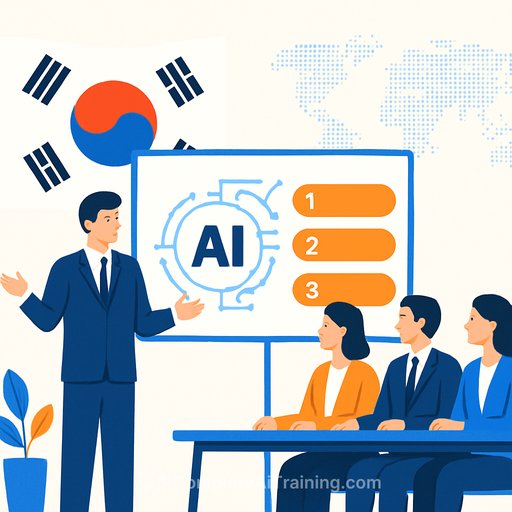
AI Strategy Council sets 3-pillar plan to push Korea into AI leadership by 2030
Korea's Presidential Council on National Artificial Intelligence Strategy outlined a three-pillar action plan to speed up the country's AI ambitions. The plan details 98 tasks and 300 guidelines across ministries, aiming to lead in physical AI and make Korea a top AI-driven manufacturer by 2030.
Vice Chair Im Moon-young was blunt: Korea underinvested after 2012's deep learning shift and is now paying down tech debt. The response: replace aging systems, modernize law and policy, and move faster on core tech, AI chips, data centers, regulation, industry support and education.
The three pillars at a glance
- Pillar 1 - Innovation ecosystem: Expand access to advanced compute, back leading research centers and startups, and attract top-tier talent. The goal is a durable base for model training, commercialization and scale.
- Pillar 2 - Nationwide AI transformation: Accelerate AI across manufacturing, culture and defense. Push full-stack AI exports and build collaborative human-AI defense systems to strengthen domestic capability and export potential.
- Pillar 3 - AI basic society: Update labor, welfare, education and health care policies for AI adoption. Strengthen leadership in international standards and governance to set the rules, not follow them.
Infrastructure and governance backbone
The government will stand up an integrated AI and data governance framework and an "AI highway" spanning compute, data and security. This includes large-scale GPU and high-bandwidth memory resources, trusted data platforms and strong cybersecurity.
For enterprises, that means better access to training capacity, higher-quality datasets and safer deployment pathways. Expect shared infrastructure, clearer rules and faster paths from prototype to production.
Why this matters to executives
This roadmap prioritizes manufacturing scale, export readiness and standards leadership. If your business relies on compute, data pipelines or AI-enabled operations, the policy is setting the conditions you'll build on in the next 12-24 months.
Think in terms of timing and placement: where you source compute, how you align to evolving standards, and how quickly you can convert pilots into products for domestic and export markets.
Timeline and participation
The council will post the draft plan for public comment for 20 days, from Tuesday through Jan. 4, 2026. Input will be collected from academia, industry, research institutions, the public and other organizations, with finalization targeted at the council's second general meeting.
As Im noted, the draft will be revised based on feedback, and the policy may shift as technology and the economy move. Expect iteration, not a one-and-done decree.
Practical steps for strategy and operating leaders
- Map workloads to the AI highway: Identify training and inference workloads that could benefit from shared GPU/HBM capacity and plan for data movement, privacy and latency.
- Prioritize near-term value: Move 2-3 production-grade use cases in manufacturing, supply chain, or customer operations from pilot to scaled deployment within 6-12 months.
- Align governance now: Benchmark internal policies to the NIST AI Risk Management Framework (NIST AI RMF) and OECD AI Principles (OECD Principles).
- Build talent pipelines: Upskill engineers, ops and product teams on model lifecycle, evaluation and security. Curated role-based programs can shorten the ramp (Courses by job).
- Track incentives and procurement windows: Prepare to apply early for grants, co-development programs and public-sector procurement tied to the plan.
- Design for export: Use international standards from day one and document model provenance, safety and evaluation to meet cross-border requirements.
- Strengthen security: Treat AI supply chain risk, data integrity and red-teaming as first-order requirements, not add-ons.
What to watch next
- Details on compute access models, pricing and priority queues for industry and research.
- Standardized datasets and trusted data platforms for training and evaluation.
- Defense-industry openings for dual-use AI systems and human-AI teaming.
- Education and workforce programs tied to certifications and job placement.
- Updates to legal frameworks that affect data use, model liability and export compliance.
The direction is clear: clear the debt, build the base, and move from pilots to scaled deployment. If you lead strategy, plan for phased adoption-quarterly milestones, budget corridors for compute and data, and governance that can flex as the policy finalizes.
Your membership also unlocks: