South Korea's Labor, Business Leaders Chart Policy Path on AI and Workforce Changes
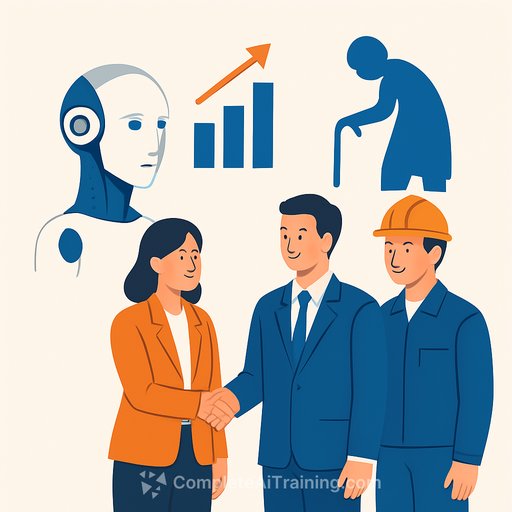
Labor unions, major business groups, and South Korea's National Assembly reached consensus Monday on how to address artificial intelligence adoption, aging demographics, and low birth rates-and committed to turning that agreement into law.
The tripartite forum, led by National Assembly Speaker Woo Won-shik, released a joint declaration after more than a year of discussions. The group included the Speaker's Office, the Korea Chamber of Commerce and Industry, the Federation of Korean Trade Unions, and the Korean Confederation of Trade Unions.
Speaker Woo said the priority is converting the consensus into concrete policies and legislation. He specifically flagged the need to expand social protections for workers outside formal employment-including dependent contractors, platform workers, and freelancers-to maintain competitiveness as AI becomes embedded in the economy.
What Business and Labor Agreed On
Chey Tae-won, chairman of the Korea Chamber of Commerce and Industry, said AI has already moved beyond theory into daily operations. "We must continue seeking solutions that market participants can accept, especially for workers outside the formal system," he said.
He framed the challenge as economic: labor, management, and government need to grow the overall economy and distribute gains more broadly.
Kim Dong-myung, president of the Federation of Korean Trade Unions, said there is growing consensus on redesigning the social safety net to match labor market changes driven by industrial transformation. His group will continue building on these agreements in future reforms.
Yang Kyung-soo, president of the Korean Confederation of Trade Unions, acknowledged the talks involved "sharply conflicting interests." He called for swift legislative action and a more structured approach to social dialogue going forward.
Next Steps: Institutionalizing the Dialogue
Participants called for the swift establishment of an institutional foundation for social dialogue within the National Assembly. The joint declaration reflects a shared commitment to use ongoing dialogue as a mechanism for addressing crises tied to AI adoption and demographic shifts.
For government officials, the declaration signals where labor and business have found common ground on workforce policy-and where disagreements remain. The challenge now is translating months of talks into legislative language that all three sides can accept.
Learn more about AI for Government and how policy leaders approach AI implementation, or explore AI for Executives & Strategy to understand how leadership teams navigate institutional change.
Your membership also unlocks: