South Korea Pushes Joint AI Autonomous Navigation R&D. Shipbuilders Push Back
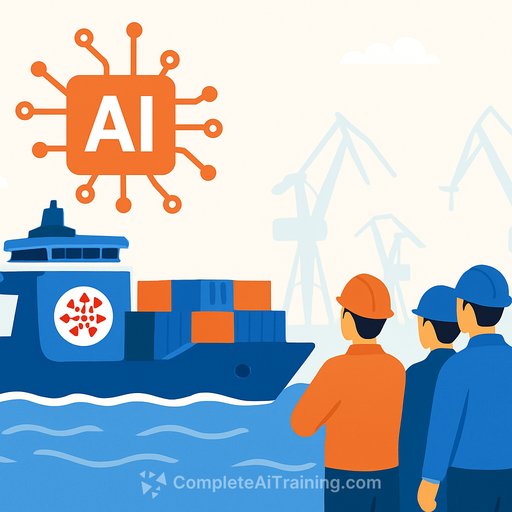
South Korea plans to co-develop AI-driven autonomous navigation with Hanwha Ocean, HD Hyundai Heavy Industries, and Samsung Heavy Industries. The state's goal: centralize data and accelerate progress. The industry's response: cautious, citing misaligned roadmaps and protection of proprietary systems.
As Deputy Prime Minister and Minister of Economy and Finance Koo Yun-cheol put it, the government will work with the "three major shipbuilding companies" to fully advance AI autonomous navigation vessels. The companies have reportedly initiated a joint data program spanning environmental signals and ship operations.
What the Joint Project Covers
- Environmental data: waves, wind, ocean currents
- Operational data: AIS, engine speed, radar information
- Goal: build a shared foundation for training, simulation, and decision systems
On paper, this sets the stage for shared datasets and consistent benchmarks. In practice, differences in tech maturity and product direction could slow alignment.
Why Shipbuilders Are Skeptical
- Tech maturity: firms are closing in on Level 3 (remote control of unmanned vessels). Joint work may add friction rather than speed at this stage.
- Divergent focus: one firm prioritizes real-time route optimization from environmental and vessel-track signals; another emphasizes shore-based control and data exchange. Same problem space, different architectures.
- Differentiation: the vessel operating system is a key factor in winning orders. A single, shared stack dilutes competitive edge.
- IP sensitivity: like automotive autonomy, these systems are built through large investments and guarded as trade secrets.
A representative from KEIT noted that clear incentives will be required if the government expects firms to contribute high-investment R&D assets into a joint effort.
Where the Big Three Stand Today
- Samsung Heavy Industries: its SAS (Samsung Autonomous Ship) system was installed on Evergreen Marine's 15,000 TEU container ship, completing trans-Pacific verification.
- HD Hyundai's AVIKUS: HiNAS Control has been in commercial use since 2023, showing a 15% drop in carbon emissions and a 15% gain in fuel efficiency through performance verification.
- Hanwha Ocean: the Hanbi test vessel is progressing toward fully unmanned navigation (Level 4) by 2030.
What Would Make Joint R&D Work (Practical View for IT & Dev)
- AI Design Courses: standardize data schemas, APIs, and safety cases while allowing unique perception, planning, and control modules. Think common substrate, differentiated models.
- Federated learning over raw pooling: keep sensitive data on-prem/ship, share gradients or model updates. Add differential privacy where feasible.
- Shared simulation and test suites: one validated simulator, shared scenarios, common KPIs (COLREGs adherence, time-to-collision margins, fuel per NM). Private weights; public benchmarks.
- Edge-first MLOps: define reference stacks for on-vessel inference (sensor fusion pipelines, redundancy, low-bandwidth updates), with robust rollback and audit trails.
- Secure ship-to-shore protocols: authenticated, low-latency links with QoS and failover. Co-designed with shoreside control centers.
- Incentives that matter: tax credits, procurement guarantees, IP-safe collaboration frameworks, and export support tied to compliance milestones.
Implications for Developers and Vendors
- Data platform opportunity: maritime-grade data models, time-series synchronization across radar/LiDAR/cameras/AIS/INS, and event labeling tools.
- Safety and compliance by design: formal methods for fail-safe modes, evidence packs for audits, and COLREGs-aware planners.
- Connectivity-aware engineering: models that degrade gracefully under limited bandwidth and high latency; store-and-forward strategies.
- Cybersecurity: hardening gateways, secure boot on edge devices, signed model artifacts, and intrusion detection tuned for OT networks.
- Digital twins: near-real-time twins for route planning, fuel optimization, and regression testing across weather and traffic variations.
Standards and Context
Expect policy and certification to shape product design. For reference:
What to Watch in 2026
- Data-sharing frameworks that protect IP while enabling training and validation
- Pilot corridors and regulatory sandboxes for Level 3 operations
- Procurement specs from ports and carriers requiring standardized interfaces
- Partnerships between shipbuilders, sensor makers, and AI firms to fill capability gaps
If you're building in autonomy, MLOps, or maritime AI, sharpen your stack and stay close to standards and incentives. Transportation managers may find the AI Learning Path for Transportation Managers helpful. For structured upskilling in AI automation and deployment, explore this certification: AI Automation Certification.
Your membership also unlocks: