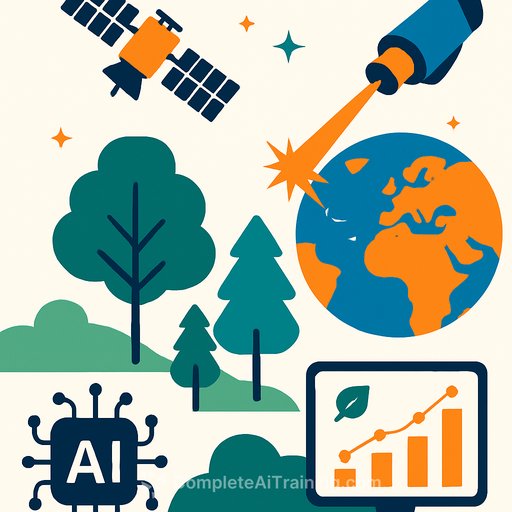
Space-Laser AI Maps Forest Carbon in Minutes
Estimating aboveground forest biomass key to climate change research
Date: June 14, 2025
Source: University of Arkansas System Division of Agriculture
Measuring Forest Carbon More Efficiently
Forests store about 80% of the planet’s terrestrial carbon and regulate climate by absorbing CO2. To track this carbon, scientists calculate aboveground forest biomass—the total mass of living plants above the soil. Traditional ground surveys are slow, labor-intensive, and limited in geographic scope.
Using open-access satellite data combined with AI algorithms on platforms like Google Earth Engine, researchers can now map biomass over large, remote areas quickly and accurately. This approach overcomes the challenges of terrain and accessibility that hamper ground measurements.
Satellite Data and AI Algorithms
- NASA’s GEDI LiDAR: Installed on the International Space Station, GEDI uses three lasers to create precise 3D models of forest canopy height, vertical structure, and surface elevation.
- ESA’s Copernicus Sentinel satellites: Sentinel-1 and Sentinel-2 provide optical imagery that complements GEDI’s 3D data.
By fusing GEDI’s LiDAR data with Sentinel’s optical imagery, researchers improved biomass estimation accuracy. Four machine learning models were tested: Gradient Tree Boosting, Random Forest, Classification and Regression Trees (CART), and Support Vector Machine (SVM).
Gradient Tree Boosting delivered the highest accuracy and lowest error rates, followed by Random Forest. CART provided reasonable estimates but was less comprehensive, while SVM performed poorly in this context. The best results came from integrating multiple data sources—optical imagery, vegetation indices, topography, and canopy height—using GEDI LiDAR as the reference for training and testing AI models.
Why Accurate Biomass Mapping Matters
Precise forest biomass data enables governments and organizations to track carbon sequestration and emissions more effectively. This improves the quality of climate policy decisions and helps manage forests sustainably to mitigate climate change impacts.
The Path Forward
Challenges remain, including weather interference with satellite data and uneven LiDAR coverage globally. Future research may explore advanced AI techniques like neural networks to refine predictions further.
As climate pressures increase, leveraging satellite technology and AI will become essential tools for protecting forests and managing carbon at scale.
For more on AI applications in environmental science and beyond, explore courses and resources at Complete AI Training.
Your membership also unlocks: