From speed to defensibility: what OpenAI sees in the next wave of AI startups
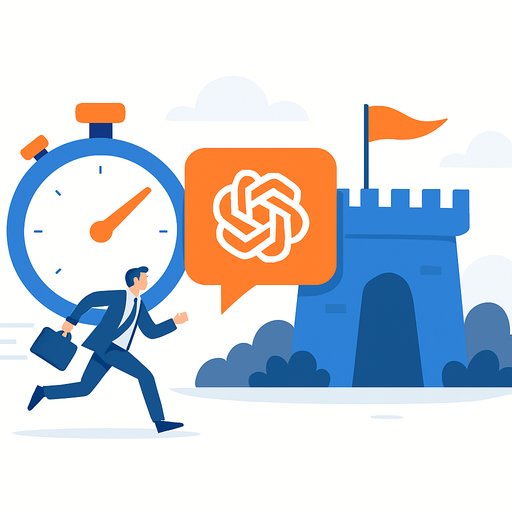
If you build products, you've felt the shift. Speed got you attention in 2023. In 2025, it gets you parity. What separates a quick demo from a durable company is how deeply you understand the problem - and how precisely you use models to solve it.
That's the message coming from OpenAI's startup leaders, Marc Manara (Head of Startups) and Romain Huet (Head of Developer Experience). Their vantage point: a global portfolio of AI-native teams shipping at the frontier, and a direct feedback loop into OpenAI's roadmap.
What OpenAI for Startups actually gives you
OpenAI for Startups isn't just API keys. The program pairs model access with people, credits, and infrastructure so teams can move from prototype to production faster. Expect API credits, higher rate limits, and hands-on guidance from technical teams.
There's also a VC partnerships track. If your fund participates, you can unlock additional support and founder-focused events where OpenAI's leadership and product teams share what's shipping and what's working in production. The goal is simple: give founders leverage.
If you want the official overview, see the program page at OpenAI for Startups.
The litmus test: AI-native or AI-assisted?
OpenAI's bar is clear. The best startups are AI-native - an LLM sits at the core. Remove it, the product breaks. That's the "is this real?" test they apply across categories like coding, support, legal, healthcare, and new hybrids.
This matters because it creates a tight loop. Startups push the models with concrete, reproducible use cases; OpenAI tunes capabilities that map to those tasks. Model gains often line up with a team's product-market fit. Both sides move faster.
Defensibility beats novelty
Access to strong models is widespread. So the moat isn't access - it's depth. As Romain Huet puts it, teams that win have two things: sharp AI intuition and a near-obsessive grip on the customer's pain. You can't fake either.
Product design still separates contenders from noise. Clean UX, crisp scoping, thoughtful constraints. On the AI side, it's about how you use models: prompt strategy, context shaping, data pipelines, evaluation, and a feel for what's in distribution.
Speed still matters. But speed without problem depth is just motion. Speed with insight compounds.
Distribution: go where the users already are
Investors are increasingly asking about distribution inside ChatGPT's ecosystem. With hundreds of millions of weekly users, embedding experiences there is a real wedge for some products. Treat it as one channel in a broader go-to-market plan.
Team DNA: engineers who "get" LLMs
The teams breaking through often look like product + research hybrids. They aren't training foundation models, but they do understand data composition, overfitting risks, and evaluation design. They use fine-tuning when it earns its keep, not by default.
This is a different skill set than wiring a web app to a database. You're designing behavior, not just features. Your unit tests are evals. Your product debt shows up as model brittleness.
How startups influence OpenAI's roadmap
Startups feed OpenAI with high-signal, reproducible issues that turn into research priorities and evals. Recent focus areas include more reliable tool-calling for agents, better schema adherence, and major upgrades across the coding surface area.
Coding is no longer "autocomplete with benefits." Models behave more like teammates, taking on larger units of work and returning complete outputs. That's why OpenAI continues to ship models optimized for code. If you rely on tools and functions, keep an eye on improvements in tool use and function calling (docs).
Pivots got cheaper - use that
Founders used to spend 6-12 months to pivot. Now it's days or weeks. You can test new segments, workflows, and pricing with a small slice of functionality and realistic data. Many accelerator teams are iterating multiple times before demo day.
- Run 1-2 week spikes with a clear success metric
- Instrument usage from day one; record task success, latency, and human-correction rate
- Decide: kill, iterate, or graduate to production experiments
Underused surfaces: multimodal and voice
Multimodality and speech-to-speech are now good enough and priced to ship. If your product touches field work, support, sales, healthcare, education, or devices, voice is likely your fastest path to real usage. Latency and barge-in support matter more than glossy features.
- Design for interruptions and handoffs between voice, text, and UI
- Stream partial results; optimize first-token time
- Treat transcripts as product data - label, learn, and improve prompts and tools
Europe is punching above its weight
OpenAI's team is seeing category leaders emerging from Europe across multiple verticals. Talent density is up. Funding is healthier. And many European startups are teaching OpenAI how models behave at scale in production.
A practical checklist for AI-native product teams
- Problem depth: Spend dozens of hours with real users; write a one-page spec of the job-to-be-done and failure modes
- AI core: Make the model central to the workflow, not a feature bolted on
- Data advantage: Identify proprietary or hard-to-collect data you can legally use to improve results
- Evals over vibes: Build an evaluation harness early; track accuracy, consistency, latency, and cost per task
- Tool use: Push complex tasks into tools/functions; keep prompts simple and testable
- Selective fine-tuning: Fine-tune only when retrieval, tools, or prompt fixes won't close the gap
- Reliability: Add guardrails, fallbacks, and human-in-the-loop for high-stakes steps
- Distribution: Stack channels (ChatGPT, integrations, API, bottoms-up adoption) and measure conversion by segment
- Unit economics: Model token budgets, context size, and caching; track gross margin per workflow
- Privacy and compliance: Clarify data retention, opt-outs, and regional constraints upfront
Where to skill up
If you're a product leader leveling up on prompt strategy, evals, and AI product patterns, explore focused learning paths at Complete AI Training - Courses by Job and hands-on material on prompt engineering.
The takeaway
Speed gets you to users. Defensibility comes from deep problem insight, sharp product taste, and real LLM fluency. If you're building at the edge, keep the feedback loop tight - with customers, with your evals, and with the platforms you build on.
OpenAI's stance is simple: they want startups at the frontier, they listen to production feedback, and they're investing where teams need reliability the most. If that's you, use the support, ship faster, and earn your moat.
Your membership also unlocks: