
AI news ·
Stanford's FutureLaw Week draws scholars and industry leaders to discuss AI's role in legal systems as Daniel Ho wins 2026 CodeX Prize
Stanford Law School's FutureLaw Week drew over 600 hackathon competitors and featured panels on AI in courts, legal services, and computational law. Daniel Ho won the CodeX Prize for his research on AI in public governance.
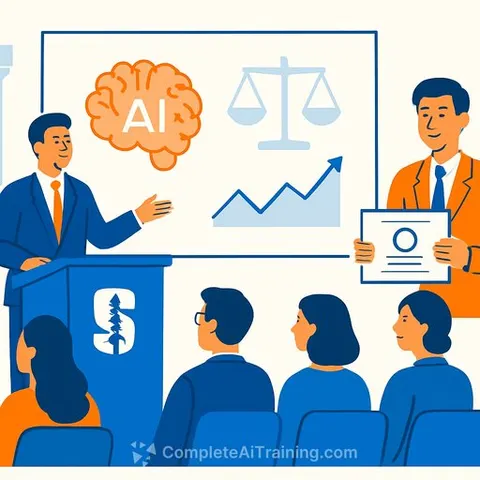
Stanford Law Brings Together AI Researchers and Industry Leaders for Week of Conferences and Competitions
Stanford Law School hosted FutureLaw Week in mid-April, drawing scholars, practitioners, and technologists to examine how artificial intelligence is reshaping legal practice, education, and institutions. The week-long program included conferences, workshops, a hackathon, and a bootcamp focused on building AI tools for legal work.
The centerpiece was the all-day FutureLaw conference on April 16, which featured panels on generative AI in courtrooms, AI-native legal service providers, computational law, and the future of legal reasoning. Discussions moved beyond efficiency gains to address quality, accessibility, and integrity in legal systems.
Hackathon Draws 600 Participants Worldwide
The LLM x Law Hackathon attracted over 600 competitors from Stanford and around the world. Teams of law students, engineers, and computer scientists designed new tools for automating and augmenting legal practice.
Joshua Waldman and Will Dinneen, both Stanford law students, won the Harvey Challenge Award for Warhol, a copyright tool that scans the internet for visually similar works. The system uses machine learning to evaluate similarity beyond simple pixel matching and applies agents to analyze copyright doctrine based on actual case law.
The hackathon grew from CodeX's inaugural LLM x Law competition in 2023, marking the first hackathon of its kind at the intersection of large language models and law.
Ho Receives CodeX Prize for Legal Technology Research
Daniel E. Ho, the William Benjamin Scott and Luna M. Scott Professor of Law at Stanford, received the 2026 Stanford CodeX Prize for his work on how technology can help legal systems and institutions function better.
Ho directs the Regulation, Evaluation, and Governance Lab (RegLab), which conducts interdisciplinary research on data science and artificial intelligence in public law and governance. His foundational papers-including "Algorithmic Accountability in the Administrative State," "Government by Algorithm: Artificial Intelligence in Federal Administrative Agencies," and "Large Legal Fictions"-have shaped contemporary thinking about AI and legal institutions.
The CodeX Prize recognizes annual contributions to legal informatics with significant and lasting positive impact on the field. Michael Genesereth, associate professor of computer science and CodeX co-founder, said Ho's work "combines technical rigor, legal insight, and public purpose in a way that has deepened our understanding of how technology can improve legal systems and governance."
Conference Sessions Address Practical and Foundational Questions
Panels examined how courts can responsibly deploy AI and whether traditional law firms can compete with AI-native challengers built around automation. One session, "Beyond Efficiency: Building Reliability into Courtroom Use of Artificial Intelligence," focused on opportunities and risks from generative AI in litigation and judicial workflows.
Another panel, "The Great Unbundling: Can Traditional Firms Compete with AI-Native Challengers?," explored how new business models are reshaping legal services. A third session, "Computational Law as a Blueprint for AI Reasoning," asked whether reasoning models can support the formal, inspectable analysis that law requires.
David Freeman Engstrom, LSVF Professor in Law and Co-Director of the Deborah L. Rhode Center on the Legal Profession, delivered the opening keynote on "The Future of the Law Firm." Alex Pentland, a faculty lead for digital society at Stanford, closed the conference with a keynote address.
CodeX's Two-Decade Focus on Legal Technology
CodeX, which bridges Stanford Law School and the computer science department, has served as a research hub for computational law-the branch of legal informatics concerned with mechanizing legal reasoning. The center helped establish foundations for much of today's legal AI technology.
Roland Vogl, Executive Director of CodeX, said the center's guiding theme has been "legal empowerment through information technology" since its founding. "This year's conversations underscored the enormous AI-driven transformation of the law and the importance of building legal and technical systems that are responsible and grounded in real-world needs," Vogl said.
CodeX is part of Stanford Law's AI Initiative, which coordinates research and scholarship on artificial intelligence across the school's AI-focused centers, labs, and clinics.
The week also included the second UN AI for Good conference, which addressed AI's role in promoting sustainable, ethical, and responsible law and legal systems. The track was sponsored by CodeX affiliate DLA Piper.