AI-driven tech sell-off: signal vs. noise for finance pros
February's rotation out of tech left the Nasdaq Composite down more than 4%. The trigger: concerns that AI will upend software economics and compress demand for seat-based licensing across data-heavy industries.
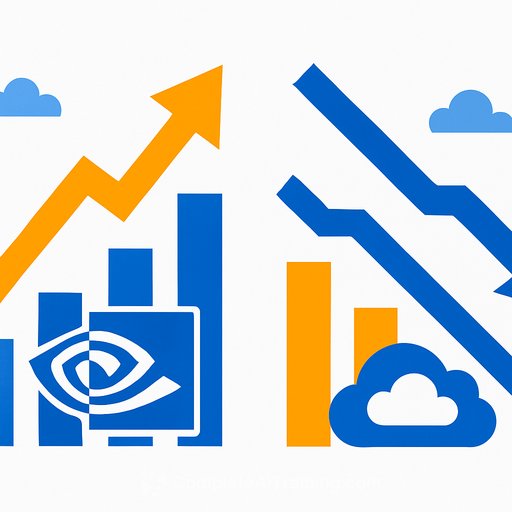
Under the surface, there's a clear split. Hardware tied to AI compute still shows durable demand, while software tied to headcount is facing hard questions.
Hardware strength vs. software strain
"There was such a stark contrast between the earnings from Nvidia, which we do own, and Salesforce, which we don't own." That take captures the market's current filter: AI infrastructure spend looks funded; software tied to "seats" looks exposed.
Nvidia's ~5% post-earnings pullback and sideways YTD action is being framed as a buy window by some managers. The core thesis: roughly $650 billion in 2026 hyperscaler data center capex from Microsoft, Meta, Amazon, and Alphabet keeps GPU demand tight. "One man's capex is another man's revenue source, and that's Nvidia."
The SaaS question: seats, pricing, and AI disintermediation
On Salesforce and peers, skepticism is rising. Clients can increasingly build in-house workflows on top of large language models (e.g., Anthropic), which can reduce reliance on packaged SaaS. If AI boosts productivity, companies need fewer seats - and seat-based pricing takes the hit.
"When you're selling software by seats, you're tied to the job market, ultimately. So we wanted to be in other places." With unemployment projected by Goldman Sachs to drift from 4.3% to 4.5% this year, the risk is simple: fewer employees, fewer licenses. As Melissa Otto puts it, "If the number of seats are ultimately going to shrink in the next couple of years, that raises concerns."
Watch labor prints closely. Seat contraction risk rises if unemployment ticks up and job openings cool. Baseline data is available at the U.S. Bureau of Labor Statistics.
Memory is the quiet winner (for now)
For AI compute, memory is a bottleneck and a margin lever. Prices have surged, capacity is tight, and upward estimate revisions continue. "Memory stocks are amazing. They trade at lower multiples, and the upward revisions are incredible. It reminds me of what I saw in Nvidia two years ago."
Micron, Western Digital, SK Hynix, and Samsung are up roughly 60% year to date. Meanwhile, a broad tech software ETF is down about 24% since January. For context on DRAM/HBM supply-demand trends, track industry updates from TrendForce (DRAMeXchange).
Market bottom? Not yet
Strategists are hesitant to call a floor. Concerns about AI disruption across software, media, education, and business services won't be disproven in a quarter. As one team notes, investors likely need multiple quarters of resilient results - or meaningfully cheaper multiples versus the market - before rotating back in size.
What to watch: a finance-focused checklist
- Hyperscaler capex: Track run-rates and guidance from MSFT, META, AMZN, GOOGL. GPU/networking order commentary and delivery schedules drive upstream revenues.
- AI infrastructure KPIs: Nvidia data center growth, networking mix, lead times; supplier commentary on HBM capacity and yields.
- Memory pricing: DRAM/HBM spot vs. contract spreads; capex and bit growth guidance from MU, WDC, Samsung, SK Hynix.
- SaaS unit economics: Net revenue retention, gross retention, AI feature attach rates, usage-based vs. seat-based mix shifts, consolidation churn.
- Labor signals: Unemployment rate and JOLTS openings; tighter labor supports seats, softer labor pressures licenses.
- Valuation spreads: Require a discount or proof - rerating needs either multi-quarter evidence of durability or cheaper entry points.
- Policy and supply risk: Export controls, supply chain constraints, and energy availability for data centers.
Portfolio and planning implications
Until software proves resilience or reprices, overweight picks-and-shovels tied to AI workloads and memory where pricing power is visible. Keep SaaS exposure concentrated in vendors with measurable usage-based monetization and AI-native workflows that cut customer costs.
- Build sensitivity models: -5%/-10% seat counts, +X% usage-based pricing, and AI add-on attach; quantify ARR and margin impact.
- Capex-to-revenue mapping: Translate hyperscaler capex to upstream revenue for GPUs, memory, and networking; stress test for supply slippage.
- Vendor rationalization: Push for unit-based discounts or usage tiers; model consolidation savings vs. switching costs.
- Hedging and timing: Pair trades (semis vs. software), stagger entries around earnings and macro prints; keep dry powder for volatility.
- Operating playbook: Align internal AI spend with near-term ROI; prioritize projects that replace software seats or material OPEX.
Bottom line
This sell-off looks like a repricing of software assumptions - not a broad AI retreat. Cash flows tied to compute and memory still show momentum; seat-tied software needs to prove durability or get cheaper. Until then, focus on capex-backed demand, disciplined entry points, and clear unit-economics in SaaS.
For deeper analysis on AI's impact on forecasting, valuation, and risk, see AI for Finance.
Your membership also unlocks: