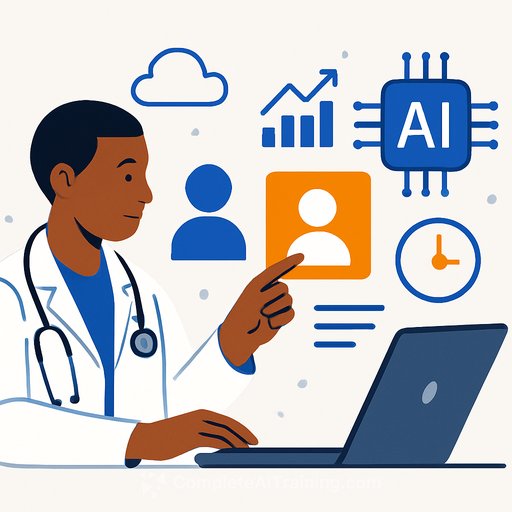
AI with guardrails: how Adobe Population Health gives clinicians time back
Alex Waddell, CIO at Adobe Population Health, has a clear stance on AI in care delivery: start inside the walls, focus on staff support, prove value, then expand. "We're looking at it as more of an internal support mechanism, rather than externally-facing."
The organization serves more than 400,000 people and is already reporting real wins. Using Salesforce's Agentforce, early metrics indicate clinicians are saving roughly 375 hours each week by pulling answers across systems in seconds. The goal: remove admin friction so clinicians can focus on the human in front of them.
Start simple: summarize, search, and transcribe
Waddell's team began with low-risk, high-friction tasks: quick summaries and fast data retrieval. "What's changed for this member since the last visit?" should be a button, not a scavenger hunt. Even compressing picklist summaries reduces the time lost to typing the obvious.
The next big lever is clinical transcription. "I'm really excited about the opportunity for transcriptions for clinicians… They don't have to worry about typing into a computer while they're having a conversation or working after hours to finish charting." That's the point-protect the patient interaction and protect clinicians' evenings.
Trust first, then scale
Healthcare has a non-negotiable: do no harm. "We really have to make sure that it is representing our members' data accurately," Waddell says. An AI-generated assessment that steers a clinician wrong is unacceptable.
Trust was built in steps. The team started with a single process that was pulling clinicians off the phones and out of homes for about six hours a week. Two clinician super-users co-built the proof of concept. Then peers validated it across the organization. "Don't just take our word for it… hear from other clinicians." Adoption followed the proof.
Operational wins you can measure
Prep for a home visit used to take up to 20 minutes per member. Consolidating details from multiple sources with agent technology cut that time significantly-current estimates put annual savings at over $1 million. Small improvements at scale matter in care operations.
Beyond the time, AI is helping the CIO understand clinical reality faster. "It's great to be able to utilize this resource to enhance and augment my intelligence and my ability to ingest information and ask the right questions." Faster comprehension, better decisions.
The CIO lens: AI in every solution conversation
Waddell's team has long relied on Salesforce and MuleSoft. Now AI is the third core pillar, and it's changing how they think about the first two. "AI is now being discussed and considered in every solution conversation," he notes. The mindset shift is direct: AI-first where it makes sense, always with guardrails.
Waddell stays hands-on. "I came up as an admin and a developer… I'm constantly innovating, so it's just another tool for me." The energy is contagious-clinical and technical teams are raising their hands with ideas that weren't possible two years ago.
What's next: proactive, member-facing support
After internal wins, the team plans to move outward. Agentforce will help members schedule care, track screenings and vaccinations, send proactive reminders, and offer personalized education based on specific needs. That's practical, timely support that keeps people healthier at home.
A practical playbook for healthcare leaders
- Pick internal workflows with clear time sinks (summaries, data pulls, charting). Prove value fast.
- Co-design with clinician super-users. Peer validation beats slideware.
- Set accuracy thresholds and keep a human-in-the-loop for clinical outputs.
- Log evidence: what the agent used, why it answered the way it did, and how a human verified it.
- Pilot with tight scope, then expand. Measure hours saved and downstream outcomes.
- Secure data flows. Map PHI exposure, restrict prompts, and audit outputs. See HIPAA Privacy Rule.
- Adopt a risk framework for AI. Nudge accuracy, bias, and safety with process-not hope. Reference the NIST AI Risk Management Framework.
- Train your teams. Policy without practice fails; practice without policy drifts.
Why this matters
"Our goal is to keep people out of the hospital, so that they can stay home and be healthy." EMRs didn't deliver that on their own. Practical AI, embedded in daily work with clear safeguards, can close that gap.
Waddell's view of the near future is straightforward: if healthcare players adopt proven agent workflows with strong governance, the industry can catch up fast-and give time back to the people doing the most important work.
Build team skills
If you're standing up an AI program and need targeted upskilling by role, explore courses by job to accelerate adoption without adding noise.
Your membership also unlocks: