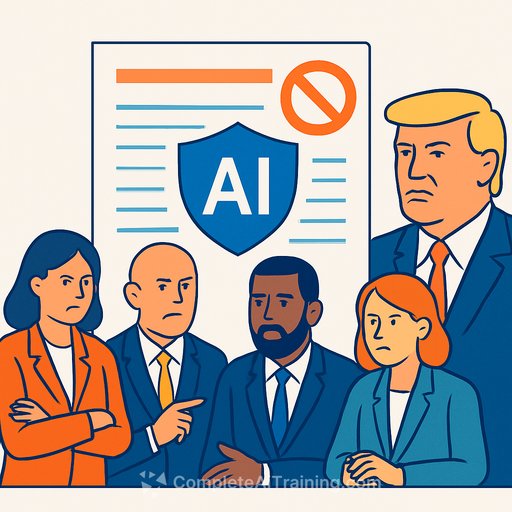
State Insurance Legislators 'Greatly Disturbed' by Federal AI Preemption Push
Date: December 15, 2025
State insurance lawmakers are pushing back against a new executive order from President Donald Trump that seeks to rein in state-level artificial intelligence regulation. Officers of the National Council of Insurance Legislators (NCOIL) said they are "greatly disturbed" by a federal move they believe would limit state authority over AI used in insurance.
NCOIL's position is direct: state legislators need room to write and enforce policy that protects consumers without stifling useful innovation. With Washington gridlock and polarized politics, they argue states are better positioned to move quickly and pragmatically.
What the executive order tries to do
The order frames state AI rules as fragmented and potentially burdensome, arguing they can include "ideological bias within models" and may impede interstate commerce. It calls for a "minimally burdensome national standard - not 50 discordant state ones," and sets up a federal task force to challenge state AI regulations viewed as inconsistent with the order's policy.
It also states that it is U.S. policy to sustain the country's global AI dominance through a national policy framework. In short, it leans toward federal preemption where state efforts are seen as conflicting with the administration's approach.
NCOIL's response and the recent backdrop
NCOIL says this is exactly the kind of moment when states should serve as "laboratories of democracy." They also signaled that litigation is likely, saying they don't believe the executive order is the "final word."
This dispute follows an earlier proposal - bundled into a federal tax bill - that would have created a 10-year moratorium on state AI regulation. Congress rejected that idea, after strong objections from NCOIL and multiple insurance trade groups who said a blanket ban would preempt rules already active in dozens of states and risk disrupting the markets they oversee.
For more on the group's work and model laws, see NCOIL's site: ncoil.org.
What this means for insurers
If you use AI in underwriting, rating, claims, SIU, marketing, or distribution, expect a period of uncertainty. Some states will continue to write and enforce rules. The federal task force may challenge certain state standards. Court rulings will shape the line between state authority and federal policy.
The practical takeaway: plan for a dual track. Maintain strong state compliance while preparing contingency plans if parts of the order gain traction or get blocked in court.
Immediate actions to protect your book and your brand
- Inventory your AI footprint: Catalog every model and tool used across underwriting, claims, fraud, pricing, customer engagement, and vendor solutions. Include data sources, model purpose, versioning, and where decisions impact consumers.
- Tighten model governance: Stand up or strengthen a model risk committee with Legal, Compliance, Actuarial, Data Science, and Claims. Require documentation for objectives, performance, drift monitoring, retraining cadence, and approvals.
- Bias and fairness testing: Run pre- and post-deployment assessments. Track protected class proxies, feature importance, and adverse impact analysis. Document mitigations and re-tests.
- Explainability: Build clear summaries for regulators and consumers. Maintain rationale templates for adverse actions and claim decisions that rely on AI-assisted outputs.
- Third-party risk: Amend vendor contracts to require transparency on data lineage, training sets, monitoring, and incident reporting. Add audit rights and service-level expectations for model changes.
- State rule mapping: Keep a live matrix of state AI and insurance guidance, model laws, and bulletins. Assign ownership for updates and implementation timelines.
- Filing strategy: Where relevant, prepare rate/pricing support that addresses AI use, controls, and fairness evidence. Anticipate regulator questions and provide clear exhibits.
- Incident playbook: Define triggers for disclosure, consumer remediation, and regulator notifications if an AI error or bias issue is discovered.
- Consumer communications: Use plain language. If AI informs a decision, be ready to explain how, why, and what recourse a consumer has.
- Train your teams: Align product, underwriting, claims, and compliance on acceptable AI use, documentation standards, and escalation paths.
What to watch next
- Litigation: Expect challenges on federal authority versus state insurance powers and commerce implications. Court outcomes will set important guardrails.
- Task force actions: Track which state rules get flagged and on what grounds. Prepare responses and evidence packs.
- State innovation: Many states will continue piloting AI oversight through model bulletins, testing frameworks, and data calls. These can become de facto standards.
- Congressional signals: After rejecting the prior moratorium, watch if Congress codifies any AI guardrails that preserve state roles.
Bottom line for carriers and regulators
Keep building compliant, explainable AI that stands on its own under state scrutiny. Document everything. Be ready to pivot as courts weigh in. The insurers that can show their work - data lineage, bias controls, and consumer fairness - will move faster with fewer surprises.
If your team needs structured upskilling on AI governance, model risk, and practical use cases, explore curated programs by job role: Complete AI Training - Courses by Job.
Your membership also unlocks: