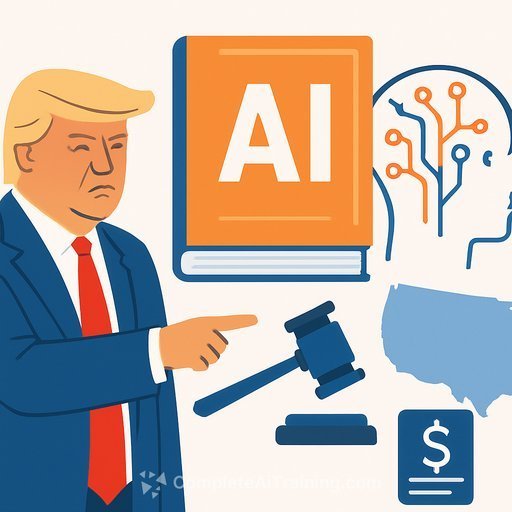
State politics drive the legal risk of Trump's AI 'framework' order
The administration's December executive order sets up Justice Department lawsuits against states with "onerous" AI laws and hints at pulling federal funds, including BEAD broadband grants. How much that chills new legislation depends on the state: blue states are pressing forward, while some red states are pausing to assess exposure - without abandoning their own frameworks.
For legal teams, this is a preemption and Spending Clause fight dressed in AI policy. Expect quick procedural moves, venue jockeying, and a long runway on the merits.
What the order does - and where it's vulnerable
The order directs Commerce and White House AI adviser David O. Sacks to identify state AI laws they consider "burdensome" within 90 days, then greenlights DOJ suits and threats to withhold certain federal grants. It also pulls in the FCC and FTC for AI-related action.
ACLU senior policy counsel Cody Venzke called the plan "a hodgepodge of … faulty legal theories," questioning: (1) whether an executive order can preempt state law without a federal statute; (2) the agencies' authority to regulate or preempt state AI rules; and (3) the legality of reshaping grant conditions after Congress set them. The order's litigation theory will likely lean on the Dormant Commerce Clause and claimed conflicts with federal policy rather than classic statutory preemption.
Funding threats raise standard Spending Clause hurdles: conditions must be clear, related to the program, and not coercive (see South Dakota v. Dole and NFIB v. Sebelius). Efforts to recut BEAD terms midstream will face scrutiny. Program background: NTIA's BEAD overview.
Utah's early test: HB 286
The White House Office of Intergovernmental Affairs circulated a memo opposing Utah's HB 286, which would require frontier model developers to publish public safety and child-protection plans, conduct risk assessments, report certain safety incidents, and protect whistleblowers. The memo labeled the bill "unfixable" but offered no legal theory.
Bill sponsor Rep. Doug Fiefia, a Republican, pushed back, arguing AI rules should come through Congress and invoking the Tenth Amendment. The bill advanced from a House committee; if enacted, it could be a first target or a bellwether for how far the administration is willing to push.
Blue states: moving ahead despite litigation threats
Colorado's AI Act is slated to take effect this summer. It covers "high-risk" systems that make consequential decisions and imposes a "reasonable care" duty to prevent discriminatory outcomes under a disparate impact standard. The order singled out Colorado's approach as forcing "ideological bias" into models - a preview of the administration's talking points.
A preexisting Colorado working group is refining the law. Industry voice Loren Furman (Colorado Chamber of Commerce) reports little attention to the order in the Capitol and expects additional AI bills this session, including in health care. If DOJ sues, the state's attorney general is expected to contest it.
California enacted SB 53 (Transparency in Frontier AI), requiring frontier developers to publish frameworks describing standards and best practices and to submit a catastrophic risk assessment summary. Advocate Teri Olle described the order as a "harassment scheme" and said California would not back down. The larger political headwind she points to isn't the White House - it's well-funded industry resistance in state races.
Red states: recalibrating without retreating
Texas' HB 149 prohibits developing or deploying AI with the intent to unlawfully discriminate and states that disparate impact alone doesn't prove intent. It also requires agencies to disclose AI-generated interactions and bars government "social scoring."
Conservative policy voices in Texas expressed disappointment with the order, arguing the state is being penalized for responsible guardrails. They note parts of HB 149 track the order's carve-outs (child safety, data center infrastructure, and state procurement/use of AI). Even critics of the order doubt the administration will threaten BEAD funds against Texas as quickly as against blue states.
Texas was approved for roughly $1.27 billion in BEAD funding. If pressed to choose between that money and parts of its AI law, state leaders face a hard call. With the legislature out of session in 2026 and an attorney general race ahead, stakeholders are in "wait and see" mode.
The legal questions courts will press
- Preemption without Congress: An executive order does not create statutory preemption. Any claimed conflict will lean on agency authority and federal policy preferences. Expect arguments under the major-questions line of cases if FCC/FTC try to displace broad state regimes.
- Dormant Commerce Clause: Are state AI rules regulating extraterritorially or imposing undue burdens versus legitimate police powers (privacy, discrimination, safety)? Foundational primer: Cornell LII overview.
- Spending Clause limits: Withholding BEAD or other funds requires clear, related, and noncoercive conditions. Mid-grant "re-conditions" are vulnerable, especially if states already relied on approved plans.
- Anti-commandeering: The federal government can't force states to administer federal policy; watch for overreach if agencies attempt to make states "stand down" on enforcement as a price of participation.
- Procedural posture: DOJ may seek preliminary injunctions; states will move to dismiss or for declaratory relief. Forum selection, standing, ripeness (especially for funding threats), and remedy scope will be pivotal.
Practical playbook for counsel
- Map exposure: identify applicable state AI statutes and bills (Colorado, California, Texas, Utah, New York) across product, HR, lending, health, and public-sector deployments.
- Segment by carve-outs: separate child-safety, data-center, and procurement/use provisions from general AI controls; these are more likely to survive administration scrutiny.
- Prepare Dormant Commerce Clause defenses: build records on in-state interests, non-discriminatory design, and less-burdensome alternatives considered.
- Audit grant reliance: document BEAD and other federal funding dependencies, approval letters, and performance milestones; preserve evidence for coercion arguments.
- Contract for volatility: add change-in-law, forum, and funding-risk clauses to vendor and data-center agreements tied to AI deployment.
- Calendar the 90-day report: watch Commerce/White House's "onerous laws" list; be ready to comment and to litigate designation errors.
- Coordinate with AGs and agencies: align litigation posture, enforcement priorities, and communications if your organization is a likely test case.
What to watch next
- Commerce/Sacks list of "onerous" state AI laws (due ~90 days from Dec. 11).
- Utah HB 286 floor action and any immediate federal response.
- Colorado working group revisions before summer effective date.
- California SB 53 compliance timelines and guidance.
- Texas AG race and any interim guidance on HB 149 enforcement.
- New York proposals on AI news disclaimers and data-center permitting moratorium.
- Early DOJ filings to test the order's litigation theory and venue strategy.
For deeper practical guidance on compliance, risk, and litigation strategy across state AI rules, see AI for Legal.
Your membership also unlocks: