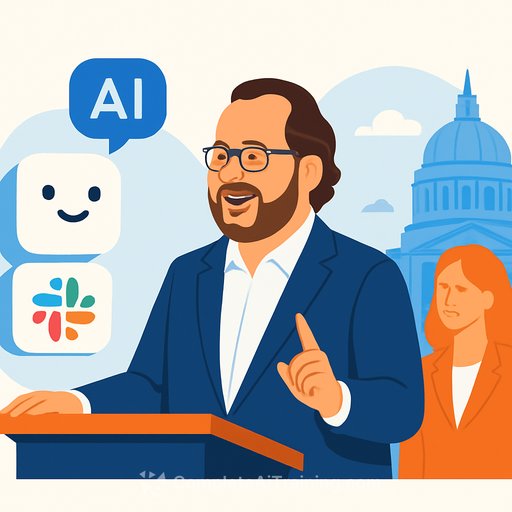
States Push Back Against Trump Administration's AI Regulation Strategy
Republican state lawmakers are defying White House pressure to halt their own artificial intelligence regulations, arguing that Congress cannot act fast enough to protect constituents. The Trump administration, through its AI czar and science policy office, has made clear it wants a single federal framework instead of what it calls a "patchwork" of state laws.
The conflict reveals a rare split within the Republican Party over how to govern AI, with state officials - some of them Trump allies - rejecting federal overreach in favor of local control.
White House Intervention Stops State Bills
Utah State Rep. Doug Fiefia, a Republican and former Google employee, proposed legislation requiring technology companies to be transparent about consumer protections. The White House killed the bill with a one-line memo saying it opposed the measure and deemed it "unfixable" and contrary to the administration's AI agenda.
No explanation accompanied the memo. A White House official told reporters the administration has never blocked child safety protections, though they did not address the specific memo to Fiefia.
Michael Kratsios, head of the White House Office of Science and Technology Policy, said this week that only Congress can provide the regulatory certainty that innovators need. He framed state laws as obstacles to development.
State Lawmakers Say Congress Is Gridlocked
Fiefia argues the White House misses a basic reality: Congress cannot act. "Congress is in a gridlock and they not only will not act, they can't act," he said. "In states like Utah we see this as an opportunity to step forward and protect our constituents and our citizens, especially as it relates to child safety."
Pennsylvania State Sen. Tracy Pennycuick, also a Republican, sponsored the SAFECHAT Act, which requires AI companies to include safeguards preventing chatbots from providing content that encourages self-harm or violence. "States are the first ones to see when there's a problem and they have the ability to pivot and act quickly," she said.
Texas State Sen. Angela Paxton, another Republican, echoed the concern. "When you have no regulation, what you have is the wild west," she said. "I like the idea of there being strong federal legislation but until that exists, I think we have to preserve the ability of states to pass laws."
The White House Framework Falls Short
The Trump administration released a four-page regulatory framework it wants Congress to enact. It outlines principles for protecting children from harm and consumers from rising data center costs, but offers little detail on critical issues.
Riki Parikh, policy director at the Alliance for Secure AI, said the framework lacks specificity on job displacement risks and does not sufficiently hold technology companies accountable. "A federal standard is better than a 50-state patchwork," Parikh said. "But what they are proposing here is not sufficient. It does not earn the right to replace the good work states are doing."
Mixed Reactions on Capitol Hill
Tennessee Attorney General Jonathan Skrmetti sees the framework as progress. He remains concerned about the White House's push last year for a 10-year moratorium on state AI laws - a proposal that would have prevented enforcement action by state officials. That effort failed.
"If you had a 10-year lockout of anybody with enforcement authority and the will to use it, who knows what would've happened," Skrmetti said. "That was really, genuinely scary."
Sen. Marsha Blackburn, a Tennessee Republican, said she is working with the White House on her TRUMP AMERICA AI Act, which expands significantly on the administration's framework.
Public polling shows skepticism of the administration's approach. A January survey by Morning Consult and the Tech Oversight Project found that a majority believes the Trump administration is too close to Big Tech. Vanderbilt University polling shows more Republicans than Democrats favor regulating artificial intelligence.
The White House says it continues having "productive conversations" with legislators, but no legislation has moved yet.
Learn more: Explore AI for Government or the AI Learning Path for Policy Makers to understand how government bodies approach AI governance and regulation.
Your membership also unlocks: