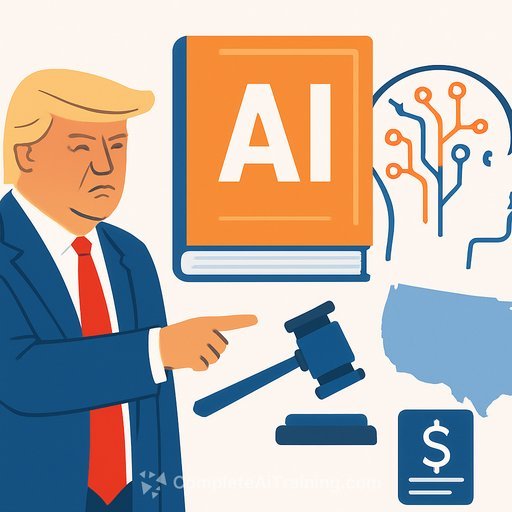
States vs. White House: The coming fight over AI regulation
States are moving ahead on AI rules. The White House just drew a line.
On Dec. 11, President Donald Trump signed an executive order that seeks to curb state AI regulation in the name of "national and economic security and dominance." The order's authority is uncertain without congressional backing, and many provisions are likely to be tested in court.
For counsel advising governments, enterprises, or trade groups, this is a federalism case wrapped in AI policy; see the AI Learning Path for Regulatory Affairs Specialists for guidance on regulatory policy and compliance. The next 90 days matter.
What the executive order attempts to do
The order sets a national AI policy framework and lays out two levers to deter state regulation it views as burdensome:
- Create an AI Litigation Task Force to challenge state AI laws.
- Condition certain federal funding by restricting access for states with "onerous" AI laws.
There are carve-outs: laws on child protection, data center infrastructure, and state government use of AI are shielded.
States get 90 days to assess and align. They can repeal, narrow, or amend provisions to fit within the new guidance.
Does it reach cities and counties?
The order targets state statutes. Local rules that govern how a city uses AI internally are effectively permitted and, in practice, a lower priority for federal challenge.
AI Litigation Task Force: what to expect
Housed under the attorney general, the task force will identify and litigate state AI laws flagged as barriers to interstate commerce or innovation. Even weak claims can tie up enforcement. Expect preliminary injunction practice, venue fights, and coordinated multi-state actions.
Collision course with existing state AI laws
So far, 27 states have enacted AI-related laws, and nearly every state has introduced bills. Not all will be targeted, given the carve-outs.
The order singles out the Colorado AI Act as an example of "ideological bias" being embedded in systems. Supporters say the law is aimed at preventing algorithmic discrimination in high-stakes uses like housing, employment, and healthcare. Any challenge still has to survive in court.
Will this chill new state laws?
Politics will drive the answer. In states like Maryland, expect legislators to press ahead and be ready to litigate. In Republican-led states, the order may complicate strategy since several have already passed AI statutes. Florida's governor has said the order won't stop the state from setting its own AI rules.
Funding leverage: BEAD and conditional spending
The order ties eligibility for remaining allocations under the Broadband Equity, Access and Deployment (BEAD) program to state compliance with the federal AI approach. That could affect non-deployment uses such as digital skills and workforce programs.
Some states have already made concessions under updated criteria. Maryland's proposal, for example, dropped from $268 million to $78 million and awaits NTIA approval. The agency has indicated no immediate impacts, but future guidance could change how remaining funds are used.
What else is happening federally?
There's no federal AI statute. Agencies are using existing authority, with the Federal Trade Commission applying consumer protection laws to AI practices. Some members of Congress have proposed bills focused on AI discrimination, and a summertime attempt to pause state AI laws via budget amendment failed.
In July, the administration released an AI action plan focused on data center buildout, deregulation, and exporting U.S. AI systems.
FTC guidance on AI and consumer protection
Can the president do this? A quick legal read
Short answer: not outright. An executive order can't preempt state law without a statute. The order leans on the Commerce Clause and federal preemption, but courts typically require an actual federal law or clear agency rule under valid delegation.
On funding, this looks like conditional spending. Expect arguments under South Dakota v. Dole (clear notice, relatedness, no independent constitutional bar) and NFIB v. Sebelius (no coercion). If conditions are too punitive or vague, they're vulnerable. The anti-commandeering doctrine and the major questions doctrine may also surface.
Process matters too. Any funding limits or enforcement guidance coming from agencies will draw Administrative Procedure Act scrutiny. Prior attempts to use executive action alone to reset major policy have been enjoined by federal courts.
90-day clock: what legal teams should do now
- Inventory your state's AI statutes, regs, and guidance; tag what falls outside the order's carve-outs.
- Map exposure to BEAD funds and other federal streams potentially tied to compliance; model fiscal impacts.
- Prepare two legislative pathways: repeal/narrow provisions most likely to be targeted, and refine high-value protections (e.g., child safety) to fit carve-outs.
- Draft litigation posture: standing, venue, and theories (spending clause limits, preemption gaps, Tenth Amendment, APA).
- Coordinate with the attorney general's office and relevant agencies on record-building and intergovernmental strategy.
- Engage stakeholders (industry, civil rights groups, municipalities) for amicus support and practical impact statements.
- Update internal AI governance policies for state agencies; these are explicitly protected and can proceed - see the AI Learning Path for CIOs for governance, strategy, and policy considerations.
Key timing
The order sets 90-day deadlines for the Commerce Secretary's review of state laws and for funding guidance. That puts initial actions in early March. Actual preemption will turn on case-by-case litigation, which could run well beyond 2025.
Bottom line for counsel
Treat this as a conditional spending and federalism dispute with AI as the test case. The order is a starting shot, not a final word. Plan for parallel tracks: targeted legislative cleanup, funding risk management, and readiness to litigate.
Your membership also unlocks: