Stevens School of Computing to Lead the Next Era in AI and Technology Education
On Jan 29, 2026
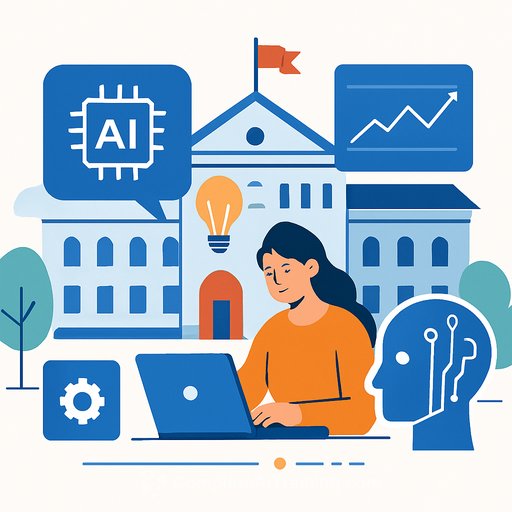
The board of trustees at Stevens Institute of Technology has approved a new School of Computing with $36 million in initial philanthropic support. A national search for the founding dean is underway, with a target launch in fall 2026. The move answers a clear shift in hiring: employers want graduates who pair computational skill with deep domain expertise, not pure coding in isolation.
"Artificial intelligence represents a transformation as profound as the widespread adoption of the internet," said Nariman Farvardin, president of Stevens Institute of Technology. "Institutions of higher education must adapt to AI's impact on society and the labor market, quickly and strategically. A dedicated School of Computing positions Stevens to lead rather than follow, creating a structure designed for this new landscape where the real competitive advantage lies in integrating AI with disciplinary expertise."
The new school will build programs that blend computing with life sciences, finance, engineering, and more. The focus goes beyond technical roles to prepare students for leadership across industries being reshaped by AI.
Why this matters for educators
Computing-related majors already make up more than 25% of Stevens' enrollment, and all students engage with technology-infused coursework. This aligns with labor demand: the U.S. Bureau of Labor Statistics projects computer and IT roles to grow much faster than average, with median wages more than double the national median. View BLS outlook.
While traditional computer science enrollments have softened nationally, demand is rising for people who apply computational thinking within specific fields. Stevens' approach centers on data fluency, analytical interpretation, and human-centered design, paired with domain areas like computational biology, financial technology, cyber-physical systems, and digital health. Educators and curriculum leaders can consult the AI Learning Path for Teachers to help design AI-infused coursework and classroom-ready modules.
Program and talent strategy
Stevens has launched a national search for a founding dean with an entrepreneurial mindset. The school will also recruit a cluster of faculty across AI, machine learning, and cybersecurity, along with roles at the interface of computing and domains such as finance, healthcare, and robotics. The goal: strengthen instruction and scale research in areas of national significance.
Initial philanthropic support sets a strong foundation, with more expected. The initiative advances the university's strategic plan, "Stevens 2032: Inspired by Humanity, Powered by Technology," aiming to elevate student experience and success while preparing graduates to contribute meaningfully to ongoing technological transformation.
Practical takeaways for higher ed leaders
- Integrate computing across majors: pair domain courses with applied AI, data literacy, and software tools.
- Prioritize human-centered design and ethical practice alongside analytics and systems thinking.
- Build co-taught, interdisciplinary pathways (e.g., bio + data, finance + ML, mechE + cyber-physical systems).
- Tie curricula to labor data and ROI metrics; spotlight long-horizon outcomes alongside first-destination stats.
- Invest in faculty clusters and industry partnerships to accelerate program creation and research impact.
"Today's students pursue education that will make them indispensable in the job market, and employers are signaling they need professionals who can integrate and apply AI and computational methods within their own disciplines," said Jianmin Qu, provost and senior vice president for academic affairs. "A dedicated school structure enables us to attract the very best faculty and students in what has become one of the most competitive areas in higher education."
If you're planning faculty upskilling or new course sequences aligned to workforce needs, explore curated AI learning paths by role to accelerate development cycles: AI Learning Path for Training & Development Managers.
What's next
With the dean search in motion and hiring planned across priority areas, the School of Computing is positioned to move quickly ahead of its fall 2026 launch. Expect interdisciplinary programs that meet employer demand, clearer ROI stories for prospective students, and a stronger pipeline of graduates ready to lead in AI-infused industries.
Your membership also unlocks: