Researchers Gather to Study How AI Moves Beyond Software Into Physical World
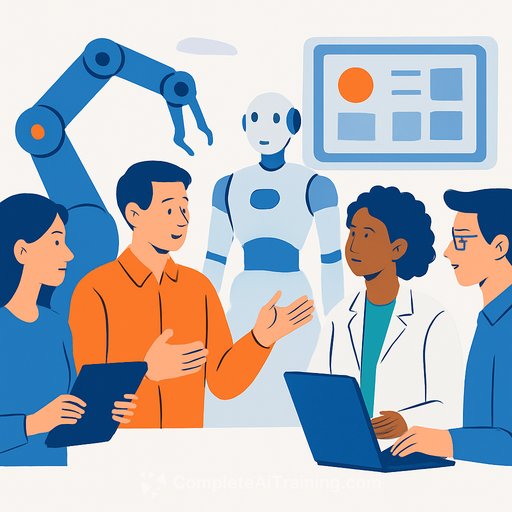
Researchers from MIT, Columbia University, Duke University and Brookhaven National Laboratory met at Stony Brook University on February 27 for a workshop focused on embodied AI - systems that perceive, reason and act in physical environments rather than existing purely as software.
The invite-only event examined how AI interacts with robots, buildings, people and creative work. Organizers I.V. Ramakrishnan, C.R. Ramakrishnan and Nilanjan Chakraborty brought together experts across robotics, machine learning and human-AI interaction.
Concrete Applications, Environmental Impact
Lav Varshney, director of Stony Brook's AI Innovation Institute, discussed how AI methods can design building materials with lower carbon footprints. Concrete production accounts for roughly 8 percent of global carbon emissions, making efficiency gains in the material significant.
Varshney also presented creative applications: AI systems generating choreography and movements designed for human spaces.
The Communication Problem
Owen Rambow, a professor of linguistics and computer science at Stony Brook, highlighted a persistent limitation in current large language models. These systems struggle with "pragmatic competence" - the ability to track shared context and mutual understanding during conversations.
Humans perform this naturally when collaborating or referring to objects in shared tasks. Building AI systems with equivalent capabilities remains unsolved.
Why This Matters for Research
Samir Das, chair of Stony Brook's Department of Computer Science, said the workshop created space for AI research across disciplines. "Bringing together researchers from different institutions helps us explore how intelligent systems will interact with the physical world and with people in increasingly meaningful ways," Das said.
As AI systems move from screens into physical environments, understanding how they perceive, reason and communicate with humans becomes central to the field's next phase.
Your membership also unlocks: