Can AI Be a Good Creative Partner? Yes-If You Co-Develop, Not Just Generate
Creativity isn't a lottery. It's a process. And according to recent work by Cambridge researchers, AI can play a real role in that process-but only if you set clear rules for how you build ideas together.
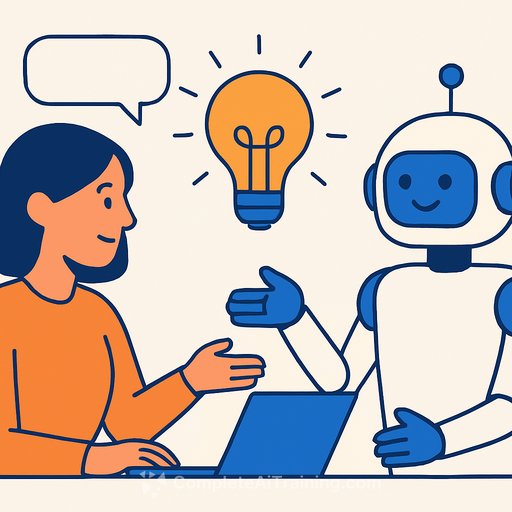
The key takeaway: adding AI doesn't make ideas better by default. What improves creativity is structured co-development-humans and AI refining the same idea through back-and-forth feedback.
What the research actually found
Across three studies with hundreds of participants, human-AI pairs did not become more creative just by working together repeatedly. Creativity only improved when people were told to co-develop ideas-exchange feedback, make edits, and iterate-rather than ask for endless new concepts.
In short: idea generation is cheap. Refinement is where value is created.
If you want the source, the work was published in Information Systems Research. See the journal.
A practical model for creatives
Treat AI like a collaborator with a specific role in each stage. Don't throw it the whole project. Break it down.
- Stage 1 - Generate: You define the brief and constraints. Let AI propose options (3-5 max).
- Stage 2 - Evaluate: You critique. What works, what doesn't, and why. Prioritise one direction.
- Stage 3 - Refine together: Ask AI to improve the chosen option using your critique. Repeat 2-3 cycles.
- Stage 4 - Adapt: Test tone, audience, medium. Keep the message, change the packaging.
The collaboration patterns that matter
- Human proposes, AI refines: You write a rough draft or outline; AI adds structure, examples, alt headlines.
- AI proposes, human refines: AI offers versions; you trim, reorder, and set the voice.
- Joint refinement (the winner): You and AI exchange targeted feedback on one living draft.
Prompts that push co-development (copy/paste-friendly)
- "Here's the idea and target audience. Give me 3 concise variations with different angles. Keep them within [constraints]."
- "We're choosing option 2. Improve it with: sharper hook, tighter transitions, and one unexpected detail. Keep the voice [describe]."
- "Critique this draft like a senior creative director. List 5 specific edits, then apply them. Explain each change in one line."
- "Turn this into a version for [platform]. Maintain core message. Max length: [limit]."
Why Netflix is a useful example
They split writing into stages-idea generation, evaluation, refinement. Humans create drafts. AI analyses character arcs, pacing, and audience patterns to improve development and marketing. The lesson: define roles per stage.
Team setup that actually works
- Define the brief: problem, audience, constraints, and success metric.
- Set roles: AI explores options; humans choose and critique; AI implements edits; humans finalise.
- Use templates: critique checklists (hook, clarity, tension, proof, CTA, tone).
- Limit idea sprawl: 3-5 options per round. Depth over volume.
- Timebox: two refinement loops before testing or shipping.
Pitfalls to avoid
- Endless generation with no selection criteria.
- Letting AI choose direction without human judgment.
- Vague prompts ("make it better"). Be specific about what "better" means.
- Switching topics too quickly. Stick to one draft and iterate.
Design your AI workflow for creativity
Consider applying established Design practices to structure roles, templates, and handoffs between human and AI.
- Force a critique step: require feedback before new generations.
- Version control: track drafts and why a version was chosen.
- Feedback memory: keep constraints and tone consistent across iterations.
- Templates for briefs, critiques, and handoffs between human and AI.
A 20-minute creative sprint
- Minutes 0-3: Write a tight brief (goal, audience, constraints, voice).
- Minutes 4-7: Ask AI for 3 options. Pick one. Explain why.
- Minutes 8-14: Two refinement loops using specific critique.
- Minutes 15-18: Adapt to platform (post, script, email). Keep message intact.
- Minutes 19-20: Final human pass. Ship or test.
If you lead a creative team
- Create standard briefs and critique checklists.
- Train people to co-develop, not just prompt.
- Assign roles per stage: generator, critic, refiner.
- Measure outcomes: clarity, originality, engagement-not output volume.
Next steps
- Sharpen your prompting and iteration habits with role-based workflows: Courses by job
- Explore practical tools for writers: AI tools for copywriting
Bottom line for creatives: AI becomes a useful partner when you treat it like one. Give it constraints, make it argue with you, and keep refining the same idea until it's clean. That's where the good work lives.
Your membership also unlocks: