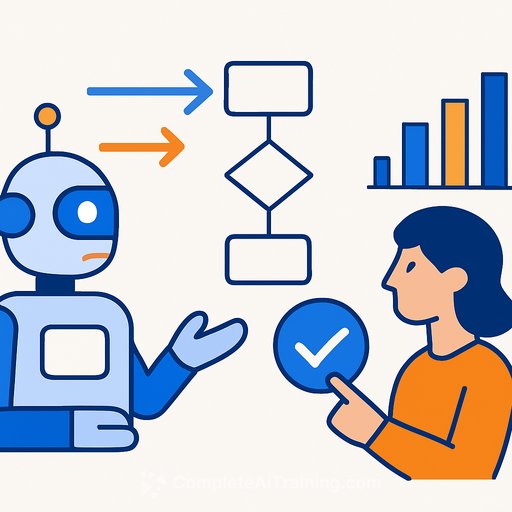
Why AI agents fail - and how process intelligence makes them work
Many ops teams wired AI agents into workflows and waited for lift. What they got was friction. The issue isn't the agent or the model - it's missing context about how work actually moves through the business. This challenge is central to AI for Operations.
Hype peaked in early 2025. Yet heading into 2026, a quiet pattern is obvious: agents act on fragmented data, not end-to-end workflows. That gap drives cost, noise, and canceled projects. One industry forecast projected more than 40% of agentic AI initiatives could be scrapped by 2027 due to unclear value and weak risk controls.
The unseen blocker: weak process visibility
Most organizations believe their processes are clear. In practice, approvals fork in email, exceptions live in spreadsheets, and ownership blurs across teams. In recent AI Research, a large majority of leaders cited "invisible inefficiencies" as the top bottleneck - not tools.
Agents walk straight into that fog. They flag late invoices, stalled pull requests, or missed handoffs - but can't tell a normal exception from a true failure without the full picture. The result: alert fatigue, escalations to the wrong teams, and mistrust.
Process mining isn't enough anymore
Process mining gave enterprises X-ray visibility from system logs. It revealed loops, rework, and workarounds hiding behind official process maps. Helpful, but passive. Seeing the issue didn't fix it.
The next phase is process intelligence: a real-time map that doesn't just describe current flow, but recommends what to fix and when to intervene. If you bake broken processes into agent workflows, you scale the mess. Map and improve first; then automate.
One messy proving ground: order-to-cash
Order-to-cash cuts across sales, logistics, finance, and service. It breaks in subtle ways. Consider a split shipment: the ERP triggers an invoice early, the agent sees "overdue," and auto-escalates to finance. Technically correct. Operationally wrong.
With process intelligence, the agent recognizes partial delivery patterns, suppresses false escalations, and routes to logistics. Same agent. Same model. Different outcome - because context changed.
From dashboards to decisioning
Dashboards explain yesterday. Ops teams need live guidance inside workflows. That's the push behind decision intelligence: give agents a shared source of truth, guardrails, and next-best actions embedded where work happens.
Vendors are moving this way with digital twins of operations that unify data across ERP, ticketing, and CI/CD. The goal is simple: fewer guesses, more grounded decisions, and safe automation at scale.
What this means for Operations leaders
Start small, go deep, prove value, then scale. Here's a practical path:
- Pick one value stream with clear cash impact (order-to-cash, procure-to-pay, or claims).
- Connect core systems (ERP, CRM, WMS, service desk) and rebuild the real process from logs.
- Quantify friction: rework loops, exception paths, manual touches, and aging queues.
- Fix hotspots before automation: simplify rules, standardize handoffs, remove dead ends.
- Add guardrails: data quality checks, policy boundaries, and human-in-the-loop for edge cases.
- Orchestrate agents against the live process map, not isolated tables or services.
- Measure relentlessly and retire what doesn't move the needle.
Metrics that prove it's working
- Cycle time and on-time delivery
- DSO and touchless rate per order
- Exception rate per 1,000 transactions
- Manual escalations and rework loops removed
- Inventory turns and expedite costs
A reference stack you can explain in one slide
- Data and events: ERP, CRM, SCM, CI/CD, service desk, plus logs and messages
- Process intelligence layer: real-time map (digital twin) of how work actually flows
- Policy and guardrails: compliance rules, SOD, thresholds, exception routing
- Agent orchestration: task-specific agents with role scopes and approval steps
- Human-in-the-loop: review queues for edge cases and learning loops to improve
Market direction (and why it matters to you)
Process intelligence is moving fast from insight to execution. The category is growing quickly as cloud providers and large enterprises standardize on a shared operational map for AI. Robotic automation alone hits a ceiling; scale requires clarity.
The companies pulling ahead pair agent orchestration with a live process twin. They cut rework, reduce escalations, and turn analytics into action inside the flow of work - not after the fact.
The bottom line
Automation can't fix what you don't understand. Fix the workflow first, then automate. Agents don't need better guesses - they need the real map of how your business runs. That's the prerequisite for trust, resilience, and measurable impact.
Next step for your team: if you're skilling up ops managers and analysts on AI agents, process improvement, and automation, explore curated training by role at Complete AI Training.
Disclosure: Event coverage referenced here included paid media partnerships. Sponsors did not have editorial control.
Your membership also unlocks: