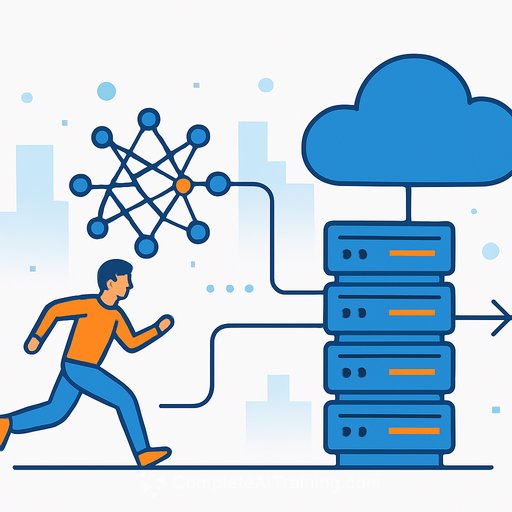
Rethinking AI Scale: Local Intelligence vs. More Data Centers
Companies are spending billions on GPUs and floor space. The bet: bigger clusters yield better AI. That bet rests on one assumption - advanced models require centralized compute to be useful.
That assumption is starting to crack. Local intelligence - training, fine-tuning, and inference near the data - can replace a large share of data center dependency and still meet enterprise-grade outcomes.
Key Takeaways
- Centralization is a choice, not a law. For many use cases, smaller models, fine-tuning, and retrieval can live on devices or at the edge.
- Value comes from proximity to data. Privacy, latency, and cost are often better when compute sits closer to where data is created.
- Hybrid will win. Train foundations in the cloud; adapt and serve locally for speed, privacy, and control.
- Measure outcomes, not FLOPS. Prioritize cost per task, latency, privacy compliance, and uptime over raw cluster size.
What Actually Matters
Your customers and teams don't care how many GPUs you own. They care about faster responses, safer handling of sensitive data, and lower costs. That's where local intelligence can outperform centralized setups.
For many workloads - document Q&A, sales support, customer ops, field service - small models with retrieval or light fine-tuning deliver 80-90% of the result at a fraction of the spend.
Why the Old Assumption Is Breaking
- Data gravity and privacy. Moving regulated or proprietary data is expensive and risky. Keep it on device, learn from it without shipping it.
- Latency and uptime. Real-time workflows (support, ops, on-site work) suffer on a congested network path. Local wins on responsiveness.
- Cost and supply constraints. GPUs are scarce and pricey. Distributed endpoints already exist - laptops, phones, edge servers - and they're underused.
- Efficiency gains. Techniques like federated learning, parameter-efficient fine-tuning, quantization, and distillation reduce hardware needs dramatically.
If you're exploring collaborative training without centralizing raw data, see Google's overview of federated learning here. For a neutral take on edge patterns, NIST's perspective on edge computing is a useful reference here.
Where Centralized Compute Still Fits
Foundational pretraining on trillions of tokens still needs serious clusters. So do heavyweight multimodal models and large-scale research. Keep that work centralized.
But most enterprise value sits downstream: fine-tuning, retrieval-augmented generation (RAG), and task-specific models serving known workflows. Those can run on a workstation, an edge node, or even a phone with an NPU.
Options Beyond the Data Center
- Federated learning. Train across endpoints, send only gradients or updates with secure aggregation and differential privacy.
- On-device fine-tuning. Use LoRA/PEFT on small to mid-size models for org-specific tasks without shipping datasets out.
- RAG close to the source. Keep sensitive content in local vector stores; query with compact models for fast answers.
- Distillation and quantization. Compress a larger model into a smaller one; run at 4-8 bit to fit consumer NPUs and edge GPUs.
- Hybrid training, local serving. Pretrain or major fine-tunes in the cloud; push updates to endpoints for inference and light adaptation.
The Business Case (Executive View)
Stop optimizing for theoretical peak throughput. Optimize for outcome economics.
- TCO levers: Lower data egress, smaller cloud bills, and fewer privacy reviews when data stays put.
- Compliance risk: Reduce exposure by minimizing data movement; simplify audits and residency.
- Experience: Sub-200ms responses increase adoption and task completion rates.
- Vendor resilience: Less lock-in. If a provider throttles access or pricing shifts, your endpoints still deliver.
Back-of-the-envelope: If 1,000 laptops run a 7B parameter model at 4-bit with basic RAG, you offload thousands of daily queries from the cloud. Even at modest usage, you free up spend that would otherwise chase scarce GPUs.
A 90-Day Plan to Test the Shift
- Weeks 1-2: Pick two high-volume, low-risk workflows (e.g., policy Q&A, internal ticket triage). Define baseline metrics: latency, cost per task, accuracy, and privacy flags.
- Weeks 3-6: Build a small model + RAG pilot. Keep data local. Add basic observability. Compare against your current cloud setup.
- Weeks 7-10: Try LoRA fine-tuning on-device or at the edge. Quantize to 4-8 bit. Validate output quality and drift.
- Weeks 11-12: Roll to 10-20% of target users. Review savings, SLA adherence, and user feedback. Decide to scale or shelve.
Risks to Manage
- Model/version drift: Set a cadence for updates and guardrails. Automate rollback.
- IP and data safety: Enforce secure enclaves, signed models, and encrypted local stores.
- Observability: Capture metrics without capturing data. Monitor token usage, latency, and error rates.
- Hardware variation: Standardize a small set of target devices; use containers and ONNX runtimes to reduce friction.
Metrics that Matter
- Cost per completed task vs centralized baseline
- P95 latency and offline reliability
- Privacy incidents and audit exceptions
- Adoption rate and user satisfaction
- GPU spend avoided and egress costs reduced
Decision Check: Central vs Local
- Choose centralized if you need frontier-scale pretraining, complex multimodal research, or strict global coordination.
- Choose local/hybrid if the workload is repetitive, text-heavy, latency-sensitive, or bound by data residency.
Strategy Note
The next edge in AI isn't bigger everything. It's smarter placement. Put compute where the data is, not the other way around. Start hybrid, measure outcomes, and scale what proves cheaper, faster, and safer.
Further Learning
- AI courses by job role to upskill teams on edge AI, RAG, and on-device adaptation.
- Research - curated articles and resources on federated learning, efficient model deployment, and edge AI patterns.
Your membership also unlocks: