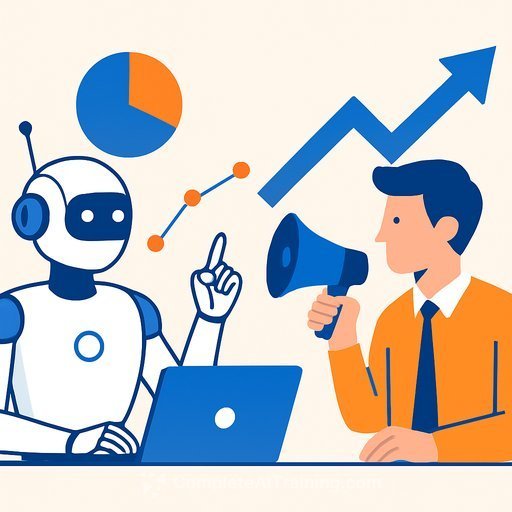
AI won't fix your marketing until the system gets simpler
The hardest part of marketing right now isn't learning prompts or picking tools. It's designing campaigns, content engines, and customer journeys so AI can actually help-from planning and production to testing and optimization.
That takes clean data, clear workflows, and systems that talk to each other. Do this well, and AI drives results you can measure. Ignore it, and you get noise.
From add-ons to a coherent system
Many teams bolt on a chatbot here, a recommender there, plus a few extra dashboards. Each tool adds data, dependencies, and reporting. Soon, people spend more time reconciling numbers than making decisions.
That's the Frankenstein effect: capable but disconnected tech moving in isolation while the organization stalls. AI should sharpen vision, not bury insight. The real move isn't "more AI," it's better system design.
Simplification is a catalyst for creativity
Simplification is a strategy. The quick test: does your operating design make marketing easier to run, or harder? When the infrastructure is smooth, teams stop firefighting and start thinking. They can experiment, test, and iterate without dragging a spreadsheet chain behind them.
Leading teams even track simplicity. Spotify used onboarding time-how long it took a new engineer to merge a code change-as a signal. After introducing Backstage, it dropped from 60+ days to about 20. They also watched engagement, search success, and employee surveys to keep internal tools easy to use. See Backstage.
The three commitments that make simplification stick
- Clear ownership of data. Define who curates, who governs, and who interprets intelligence. No gray areas, no "shared" ownership.
- Disciplined decision protocols. Speed matters. Write down who acts when new data hits, and what "good enough" looks like.
- A culture of continuous experimentation. Every campaign informs the next. Treat results as inputs, not verdicts.
When these are in place, AI stops being a side project. It becomes the connective tissue from strategy to execution.
AI as a creative amplifier
Automation expands capacity, but human insight creates meaning. Models can test variants all day; only your team can create stories people care about.
Use the extra bandwidth to ask better questions: What story are we reinforcing in the market? How does our message fit customer identity? How can data inform creativity without dictating it?
How to build an enduring AI advantage
Quick wins are fine-predictive targeting, campaign automation, smart routing. But lasting advantage comes from foundations that compound.
- Data foundation. Treat data quality, compliance, and access with the same rigor as creative. Build unified environments so insights flow across campaigns and learning compounds every cycle.
- Capability foundation. Technology produces information; people produce meaning. Train teams in algorithmic reasoning-question models, spot bias, read probabilities as signals. If you want a structured path, explore practical skill-building for marketers: Courses by job, the AI Certification for Marketing Specialists, or the AI Learning Path for Marketing Directors.
- Cultural foundation. Reward smart tests. Treat failed experiments as data, not defeat. Make each campaign a learning loop that improves models and execution.
A simple 90-day plan
- Weeks 1-2: Map your stack. List tools, data sources, owners, and the top five decisions they enable. Kill duplicate dashboards.
- Weeks 3-4: Write decision protocols for two core funnels (e.g., lead gen and retention). Define who decides, on what signal, within what SLA.
- Weeks 5-8: Stand up a clean data pipeline for one journey (awareness → trial). Lock in definitions for key metrics. Automate a weekly learning report.
- Weeks 9-12: Run three controlled experiments informed by model outputs. Ship, measure, close the loop, and feed outcomes back into the system.
Final thought
AI is changing what marketing can do, which changes what leaders must do. The modern CMO acts as strategist, systems designer, and creativity conductor-bridging data science and storytelling, analytics and empathy.
Your job isn't to chase every tool. It's to design an organization that learns faster and executes smarter. AI won't replace CMOs, but CMOs who commit to intelligent design will replace those who don't.
Your membership also unlocks: