Why your IT operations can't stay reactive in the AI era
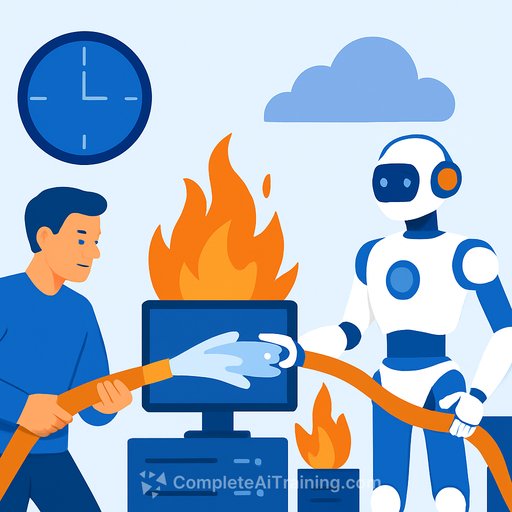
It's 2:47 a.m. The NOC flags database latency spikes and payment processing starts to crawl. Twenty alerts hit at once. An operator pivots across tools, skims logs, hunts past incidents, and trials a few risky fixes. Four hours later, the issue is gone-along with revenue, customer trust, and your team's energy.
Now picture an agentic AI that correlates the events, searches 847 past incidents, points to the root cause with 89% confidence, and serves you ranked remediation options. You approve one. It executes the change, watches the blast radius, and verifies recovery. Alert to resolution: 14 minutes. That gap-hours down to minutes or even seconds-is where competitive advantage now lives.
Here's the reality
The size and pace of modern environments make reactive operations a liability. Even teams pushing "proactive" monitoring are still spending most cycles firefighting. Autonomous operations reset the model. With AIOps and agentic AI, systems can detect, correlate, and remediate with human-in-the-loop guardrails.
"The transformation from reactive to autonomous [IT] operations is no longer optional; it is a strategic priority that defines an organization's ability to compete." - Enterprise Artificial Intelligence: Building Trusted AI in the Sovereign Cloud (OpenText)
From reactive to autonomous: what actually changes
- From noise to signal: Alerts are deduplicated and correlated across apps, infra, and networks. You see one incident thread, not 50 fragments.
- From symptoms to causes: Root cause is inferred using topology, time-series patterns, dependency graphs, and historical incidents.
- From playbooks to action: The system proposes ranked fixes, runs pre-checks, executes with approvals, and validates outcomes.
- From toil to prevention: Self-healing reduces busywork so ops can focus on SLOs, capacity planning, and better change practices.
Capabilities that cut MTTR
- Event correlation across telemetry, changes, and tickets to collapse alert storms.
- Anomaly detection with context so spikes are explained, not just flagged.
- Topology and dependency mapping to trace impact paths.
- Knowledge search over past incidents, runbooks, and code repos to surface proven fixes.
- Autonomous remediation with guardrails: approvals, change windows, rollbacks, and post-checks.
- Continuous learning from outcomes to refine confidence and recommendations.
Proof from the field
- Türk Telekom saw a 49% improvement in service outages and a 53% improvement in outage duration.
- Vodafone Shared Services cut alarm noise by more than 70% and resolved root causes in minutes instead of hours.
- A global healthcare technology leader reduced equipment downtime by 30% and hit a 50% remote diagnosis rate for CT service cases.
- Early AI adopters report average annual cost savings of 23% (Prediction Machines, Harvard Business Review Press).
These aren't incremental wins. They're structural shifts that free capacity, protect revenue, and stabilize customer experience.
What to measure (so you know it's working)
- MTTR and MTTD by service
- Alert volume per incident and noise reduction percentage
- % of incidents auto-resolved or resolved with one-click actions
- Change success rate and rollback frequency
- Error budgets and SLO burn rate
- Operator hours saved and after-hours pages avoided
A practical 90-day plan
- Days 0-30: Pick one critical service. Map dependencies. Connect observability, logs, config/CMDB, change, and ticket data to an AIOps platform. Baseline SLOs and alert volumes. Identify top 10 recurring incidents and their fixes.
- Days 31-60: Turn on correlation and noise reduction. Encode known runbooks as automated actions with approvals. Add safe pre-checks and rollbacks. Start post-remediation verification and outcome tagging.
- Days 61-90: Expand to auto-remediation for low-risk incidents (e.g., cache flush, pod restart, feature-flag rollback). Integrate with change control. Publish a weekly scorecard on MTTR, noise, and auto-resolve rate. Capture lessons and iterate.
Guardrails and trust (so ops actually sleeps at night)
- Human-in-the-loop: Require approvals for medium/high-risk actions; auto-approve only for pre-agreed fixes.
- Audit and rollback: Log every step, keep diffs, and maintain instant rollbacks.
- Drift control: Enforce desired state via IaC and policy-as-code.
- Safety checks: Synthetic tests and canary verifications before and after changes.
- Data governance: Limit training data to necessary scopes; monitor model drift and access controls.
Playbooks that deliver fast wins
- Auto-remediate container or service restarts with health checks and backoff logic.
- Scale-out rules for known saturation patterns tied to SLO burn rate.
- Feature-flag rollback on error spikes or elevated latency in a single region.
- DB connection pool resets with traffic shaping to minimize customer impact.
- Queue drain and replay flows when downstream dependencies flap.
Tooling (vendor-agnostic checklist)
- AIOps platform with correlation, topology, and action framework
- Observability stack (metrics, logs, traces) with open standards
- ITSM and incident response with robust APIs
- IaC and configuration management for safe, repeatable changes
- Runbook automation and event-driven workflows
- Policy-as-code for approvals, risk tiers, and change windows
Who needs to be in the room
- Ops/SRE leads and NOC managers
- Platform, network, and database engineers
- Security for change controls and audit
- Service owners for SLOs and error budgets
- Finance/Procurement for the business case and savings tracking
Why this matters now
The volume of change and the complexity of dependencies won't slow down. Teams that stay reactive will ship fewer features, burn out talent, and pay the tax in downtime. Teams that go autonomous cut MTTR, protect margins, and keep customers. Simple as that.
Next step
If you run NOC workflows, on-call rotations, or infra at scale, start building the skill stack now. A practical place to begin: the AI Learning Path for Systems Administrators.
Further reading
Your membership also unlocks: