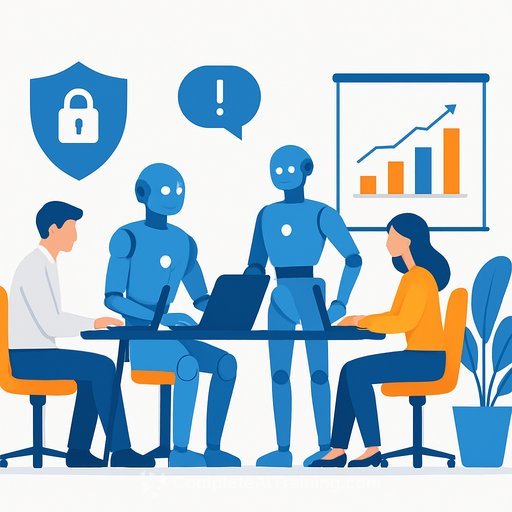
Why AI Is Making Attack Surface Management Mandatory
AI is speeding up how fast new systems, agents, and integrations appear across your environment. That means more entry points, more unknowns, and more ways for something small to become a public incident. If you lead security, IT, or risk, "good enough" inventory and periodic scans won't hold.
The shift is simple: visibility, continuous assessment, and proactive risk management are now baseline expectations. The orgs that win see what an attacker sees, validate what's reachable, and fix the small set of exposures that can actually move the needle.
The trap: vulnerability whack-a-mole
Most teams are still working long lists that don't map to real risk. The bottleneck isn't tools; it's signal. If you can't reliably enumerate internet-facing assets, map ownership, and check what's exposed from outside, your prioritization becomes guesswork and your queue never ends.
- Start by fixing visibility: assets, owners, and external reachability.
- Shift from "critical on a scanner" to "exploitable from the internet with a clear path to impact."
- Cut duplicates and noise at the source; don't push junk into ticketing.
What AI changes
- More to secure: New agents, MCP Model Context Protocol-style integrations, and frequent deployments create constant, sometimes invisible, exposure. Shadow services appear faster than legacy processes can catch.
- Faster operations: AI can act like a junior analyst-summarizing logs, flagging patterns, enriching findings, and pre-triaging issues-so humans focus on decisions and fixes.
Validate what's actually reachable
Attackers care about what they can see and touch. Treat reachability and chainability as the gatekeeper for priority. Validate exposures from the outside-in, confirm owner and business context, then move.
- Prove exposure from an external vantage point before you escalate.
- Check whether credentials, misconfigurations, or adjacent services create an attack path.
- Tie every finding to an owner, an app/service, and a customer or revenue impact.
Connect discovery to the rest of the business
External discovery without workflow is shelfware. The fix is a unified view that ties inventory, ticketing, and exposure findings together. That's how you cut duplicated effort and make progress visible to leadership.
- Sync with CMDB, cloud accounts, DNS, CI/CD, and SSO to resolve owners automatically.
- Push only validated, deduplicated issues into ticketing with clear runbooks.
- Track states end to end: discovered → validated → assigned → remediated → verified.
A practical operating model for security leaders
- Daily external assessment: Scan internet-facing assets, validate reachability, confirm ownership, and suppress false positives.
- Risk-based prioritization: Score by exploitability and business impact, not raw CVSS. Use public intel like the CISA KEV catalog and align to common techniques via MITRE ATT&CK.
- Tight workflow loops: Auto-create tickets with owner, evidence, and steps. Set SLAs by exposure class (e.g., internet-exposed criticals).
- Change-aware checks: Re-test after every deployment, DNS change, or new integration. No "set and forget."
- Automate the obvious: Guardrails for common misconfigurations, routine patching, and certificate hygiene.
Metrics executives care about
- Total internet-exposed services and trend over time.
- % of exposed services with known exploited vulns and average time to remediate.
- % of assets with a confirmed owner; reduction in duplicate tickets.
- Incidents tied to external exposure, associated downtime, and customer impact.
- Exception counts with expiration dates and documented business justification.
How AI fits your team
Use AI to compress time, not to replace judgment. Let it summarize logs, correlate alerts, and draft tickets with context and runbooks. Keep humans on validation, risk calls, and cross-team coordination.
The executive conversation
Frame exposure management in business terms. Compliance requirements, downtime, customer disruption, and revenue loss are straightforward anchors. Show how continuous external assessment reduces incident probability and shortens recovery when something slips through.
Start small, then scale
Pick one business unit or internet-facing app. Map assets, validate exposures, connect to ticketing, and measure outcomes for 30 days. Prove the loop works, then roll it out.
The bottom line: continuous assessment and proactive risk management are now table stakes. See your environment the way an adversary does, and act on the few exposures that truly matter.
If you're upskilling your team on practical AI for security operations and IT workflows, explore targeted training and practical labs to accelerate adoption without adding noise.
Credit: Insights in this article reflect perspectives shared by Amit Sheps on the operational shifts security leaders need to make in an AI-accelerated threat environment.
Your membership also unlocks: