
AI news ·
Stripe agrees to acquire AI model router OpenRouter for $7.5 billion
Stripe has agreed to acquire AI model-routing platform OpenRouter for about $7.5 billion, marking its largest deal to date. The price is nearly six times OpenRouter's $1.3 billion valuation from a May 2026 funding round.
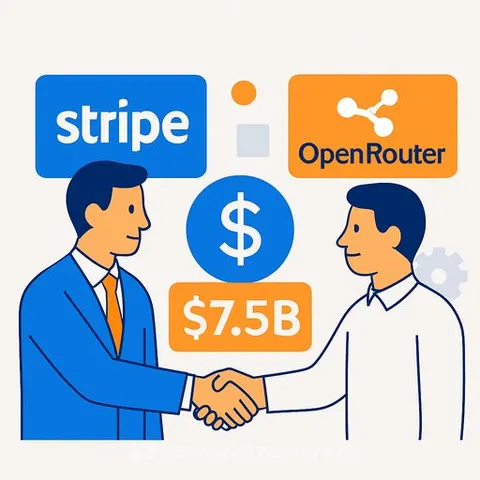
Stripe has agreed to acquire OpenRouter, an AI model-routing platform, in a deal reported to be worth approximately $7.5 billion. The acquisition moves Stripe beyond online payments into AI infrastructure, giving businesses a single interface to manage and route requests across roughly 400 AI models from providers including OpenAI, Anthropic and Google.
Stripe confirmed the planned acquisition but did not disclose financial terms. The valuation was first cited by the New York Times and reported by TechCrunch. People familiar with the agreement said about $1.5 billion is allocated to OpenRouter's founders, with investors receiving the remaining estimated $6 billion.
From $1.3 billion to $7.5 billion in months
The price is a dramatic jump from OpenRouter's previous valuation. The company raised $113 million in a Series B funding round in May 2026 at a valuation of about $1.3 billion. If the reported price holds, Stripe is paying nearly six times that valuation only a few months later.
The transaction is widely described as Stripe's largest acquisition to date. It reportedly drew interest from other potential buyers, including data-and-AI platform company Databricks.
What OpenRouter does
OpenRouter operates as an AI gateway and model marketplace. Instead of building separate integrations for every large language model, developers use a single application programming interface, or API, to access a wide range of models.
The flexibility matters because no single AI model is best for every task. A business might use one model for customer-service summaries, another for coding assistance and a third for complex analysis. OpenRouter routes requests based on a company's preferences for quality, speed, availability or cost.
The platform also helps enterprises track and manage token spending. Tokens are the units of text processed by AI models, and their cost can rise quickly as companies deploy generative AI across customer support, marketing and software development.
Stripe's AI infrastructure play
Stripe's core business is payment processing, billing and financial infrastructure for online businesses. Adding OpenRouter positions the company to become part of the financial and operational backbone of AI applications.
Stripe co-founder and CEO Patrick Collison said the company is building "the economic infrastructure for AI." He said the combined businesses aim to help companies increase profitability by routing AI requests intelligently and managing token spending efficiently.
The deal could let Stripe integrate AI usage, billing, spend controls and payments into a single enterprise platform. For example, a company could use OpenRouter to automatically pick the most cost-effective model for a task while Stripe tracks expenses and processes payments.
OpenRouter said it expects to continue operating independently after the acquisition, keeping its name, product roadmap and customer commitments.
Why this matters for customer support professionals
Customer support teams are heavy users of AI for one simple reason: every response consumes tokens, and token costs add up fast. Stripe's acquisition means those costs could become a managed line item rather than an unpredictable expense.
The integration of routing, billing and payments could eventually let support teams set budgets per task - automatically sending a simple ticket to a cheap fast model and reducing complex escalations to a premium one. For professionals in the field, training in AI cost management and model selection is becoming a practical job skill. AI Customer Support Courses cover token usage and model selection in service workflows, and AI Automation for Call Centers addresses the operational side of running AI-assisted support at scale.