Students Are Missing From AI Policy Decisions That Shape Their Education
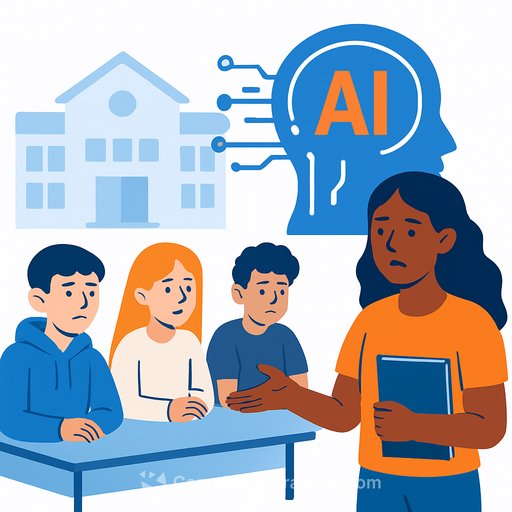
Schools across the country have locked in AI policies without asking the people most affected by them: students themselves. Three years after ChatGPT's release, institutions implemented blanket restrictions through internal decisions made by administrators, with no student input, no open forums, and no surveys asking those who live under these rules what they think.
Only Ohio and Tennessee require school districts to develop and publish AI policies. When policies do exist elsewhere, they typically emerge from top-down decisions that exclude student voices entirely.
The Cost of Policies Built Without Student Input
Brittany Carr, a Liberty University student and military veteran, had three essays flagged by an AI detector in early 2023. She provided her revision history and explained her writing process for deeply personal essays about her cancer diagnosis and recovery. The university rejected her explanation. Fearing a second accusation could cost her financial aid, she began running every essay through an AI detector herself, rewriting sentences until her writing voice became unrecognizable. By semester's end, she left the university.
An NBC News investigation found that Carr's experience was not isolated. Students across the country deliberately simplified their vocabulary and avoided complex sentence patterns-not to improve their writing, but to avoid triggering automated detection systems. Students reshaped their education around software they had no role in approving.
Student involvement would not have guaranteed a different outcome in Carr's case. But it might have changed the structure that enabled it. Students could have raised concerns about relying on automated detectors without corroborating evidence. They could have described how fear of false accusations pushes students toward simpler vocabulary and less intellectual risk. They could have asked what procedural protections exist before a software flag becomes an academic charge.
What Students Actually Do With AI Tools
A Pew Research Center survey found that 54% of U.S. teens now use AI chatbots for schoolwork. The most common uses are research and brainstorming-not copying answers.
In practice, students use ChatGPT and similar tools to unravel difficult concepts, study for tests, and work through problems collaboratively. When a student in an AP Physics class couldn't answer a question about a formula, a classmate opened ChatGPT and worked through the problem interactively. Minutes later, the entire class understood circuits better. Another student used an LLM to compile notes from Multivariable Calculus, which helped her earn a near-perfect score on her test. A third used ChatGPT to learn Java syntax-not to write code, but to understand the language itself.
This "secret loop" in the learning process goes completely disregarded by schools. It's easier to blanket-ban the technology than to understand how students actually use it.
The Model That Works
In Los Altos, California, students did more than sit in on policy meetings. They designed and ran community workshops, facilitated discussions between sixth graders and administrators, and built an AI chatbot to help other districts draft policies. A 2024 Harvard report found that students overwhelmingly want to be part of decisions about how AI is used in their education-and that many already hold sophisticated views on its risks and potential.
The fact that Los Altos made national news tells you how rarely that invitation is extended.
Why Students Must Be at the Table
AI policies directly affect students' academic outcomes and futures. Excluding them from these conversations is undemocratic. If educational institutions are serious about preparing students for democratic citizenship, that commitment must extend beyond coursework into policy-making.
The generation that grew up with these tools understands their texture in a way no outside committee can replicate. They know what actually happens in classrooms when students encounter these systems. They can articulate risks that policymakers miss. They understand the difference between using an AI tool to cheat and using it to learn.
Schools face a choice: treat students as subjects of policy, or as participants in it. AI for Teachers training can help educators understand these tools better, but that education means little if students themselves remain on the outside of the decisions that govern their use.
The time to invite students into these conversations is now.
Your membership also unlocks: