Google's AI Overviews lean on YouTube for health answers. Here's what clinicians need to know
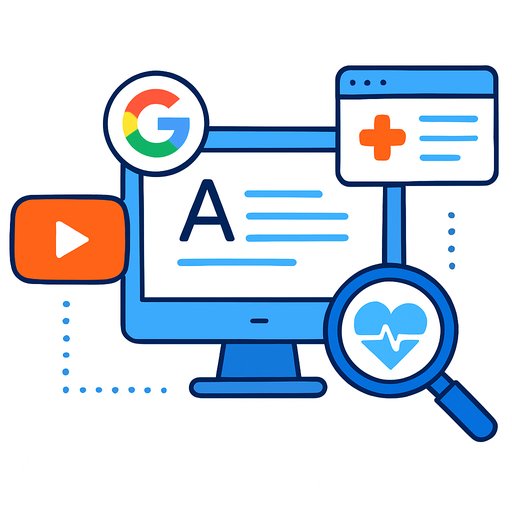
A large German study of 50,807 health queries found that Google's AI Overviews cite YouTube more than any single medical site. The feature appeared on 82% of health searches and drew 4.43% of all citations from YouTube-more than any hospital network, government portal, medical association, or academic institution.
That matters because YouTube isn't a medical publisher. It's an open platform where credible hospital channels sit next to wellness influencers and creators with no clinical training. The confident tone of AI Overviews can make weak sources feel authoritative at a glance.
The German study joins broader Research into how search and AI shape public health information and trust.
Key numbers at a glance
- Dataset: 50,807 healthcare prompts; 465,823 total citations; captured from Berlin (German-language queries) in Dec 2025.
- AI Overviews appeared on 82% of health searches.
- Top cited domain: YouTube with 20,621 citations (4.43%).
- Next: NDR.de (3.04%), Msdmanuals.com (2.08%), Netdoktor.de (1.61%), Praktischarzt.de (1.53%).
What Google says
Google states AI Overviews are built to surface high-quality sources and that many reputable medical authorities publish on YouTube. The company also says findings from German-language searches shouldn't be generalized globally.
They point out that 96% of the 25 most-cited YouTube videos came from medical channels. The study authors counter that those 25 videos represent less than 1% of all YouTube links cited, so the broader pool may look very different.
Clinical risk to watch
Investigations have flagged misleading outputs on sensitive topics, including liver function testing. When an AI-generated summary speaks with certainty while leaning on mixed-quality sources, patients can be reassured when they shouldn't-or alarmed without cause.
Clinicians should consult guidance on AI for Healthcare when integrating AI-generated summaries into care pathways to reduce clinical risk.
What to do now: a practical playbook for healthcare teams
- Set a sourcing standard: Prefer primary clinical references (guidelines, systematic reviews, drug labels) and recognized authorities. Build a "safe list" of domains your organization approves.
- Search hygiene: Use operators like site:who.int, site:cdc.gov, or site:.gov/.edu to constrain results. Add "guideline," "systematic review," or "practice statement" to queries.
- YouTube with guardrails: If a video is used, verify the channel (hospital, medical society, academic center), on-screen credentials, citations, and publication date. Treat video as supplementary, not primary.
- Patient conversations: Ask, "What did you search and where did you click?" Normalize discussion of AI Overviews during intake. Use teach-back to check understanding.
- Education materials: Use AI for Education resources where available; when AI assists drafting, require human review, source citations, and a final check against trusted references before anything reaches patients.
- Documentation: For any AI-assisted health information shared with patients, log sources and reviewer name. Spot-audit for accuracy monthly.
- Clinical governance: Define when AI-generated summaries are prohibited (diagnosis, dosing, critical test interpretation). Route complex queries to librarians or evidence teams.
- Staff training: Provide short refreshers on evaluating online health content, bias, and credibility signals. Focus on speed + safety, not volume.
Context and limits
The analysis is a snapshot: German-language searches run in December 2025. Results will shift over time, by region, and by phrasing. Still, heavy reliance on a general video platform for health answers should prompt stronger internal controls.
Helpful resources
Upskill your team on AI and search safety
If your clinicians or patient education staff need structured, role-specific AI training, explore Complete AI Training: courses by job. Short, practical modules can help teams evaluate AI outputs, set sourcing rules, and reduce patient risk.
Your membership also unlocks: