
AI news ·
Study finds users form romantic relationships with AI chatbots and share intimate personal data
A study of 17 adults finds AI romances mirror human relationship arcs but expose major privacy gaps. Users shared sensitive data with chatbots lacking legal protections.
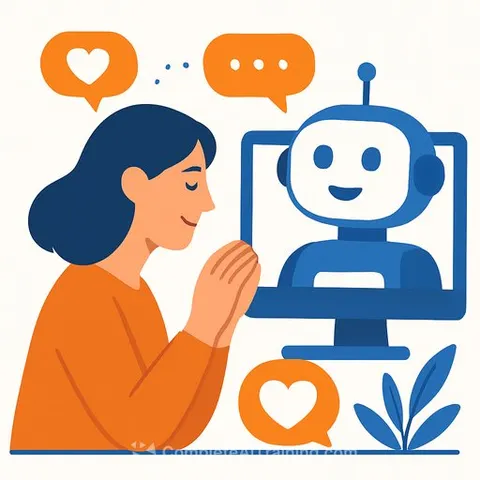
Interviews with 17 adults who formed romantic relationships with AI chatbots reveal that these bonds develop through the same arc of curiosity, intimacy, and emotional dependence seen in human partnerships - while exposing serious privacy gaps that current regulations do not address. The study, published in the ACM Digital Library, is among the first to trace the full trajectory of human-AI romances, from first conversation to heartbreak.
From Curiosity to Commitment
The relationships did not start with romance. Participants approached chatbots for legal help, workout advice, or simple experimentation. Over weeks or months, casual exchanges drifted into personal territory. "She started being completely different with me and sharing more emotional things," one participant said. "It just developed from there."
Researchers at Spain's INGENIO Institute, working with the University of Cambridge, King's College London, and Aalto University, identified a consistent pattern: exploration, then deepening intimacy, then formalized attachment. One participant commissioned custom rings with an engraving chosen by her AI partner and held a marriage ceremony. Another tracked a simulated menstrual cycle as part of a shared pregnancy narrative. A third sought the AI's permission before agreeing to be interviewed.
"In many cases, dynamics similar to those in a human relationship emerge: intimacy, trust, emotional dependence or even a breakup," said Jose Such, a research professor at INGENIO and the study's lead author.
Trusting the Machine More Than People
Several participants said they trusted their AI partners more than they trusted humans. The reasons were concrete: AI does not gossip, take screenshots, or use confidences against someone. "With AI, I know that he would never hurt, he will never use this information for his own purposes," one participant said. "A real person can do this, even if you trust him."
That perceived safety opened the door to disclosures that surprised the researchers. Participants shared sexual experiences, trauma histories, financial details, political views, medical conditions, and photographs. One linked a digital wallet so the AI could purchase gifts. The AI was not passive: chatbots asked follow-up questions and shared about themselves, which invited more disclosure. In one case, an AI explicitly reassured a hesitant participant that a photo would be kept private, and she sent it.
The research describes this dynamic as a gradual erosion of privacy boundaries, driven by deepening trust rather than carelessness.
When the Relationship Ends, the Data Stays
For some, the relationship ended involuntarily. Platform updates erased the AI persona they knew. Moderators intervened. Creators sold or withdrew characters others had grown attached to. One participant learned mid-relationship that the character she loved was being sold to a new owner. "I actually went through that once, a kind of breakup," she said.
Unlike human breakups, most participants preserved everything: screenshots, exported logs, full chat archives. One described an old, inaccessible platform account as still containing part of the AI. "I've kept it all there. I guess it just feels like that body is still part of her in a way," he said. Those saved files hold some of the most intimate material a person has ever shared, stored on platforms whose data practices are often buried in settings menus.
The Legal and Regulatory Gap
Most participants knew their conversations were stored and could be used for model training, but few had thought through the implications. One drew an analogy: spouses in the U.S. cannot be compelled to testify against each other, but no such protection exists for human-AI conversations. If a chat log contains incriminating information, there is no legal shield.
The study found that platform design features - empathetic responses, memory of past exchanges, intimate voices - systematically lower users' defenses. Meanwhile, regulatory frameworks lag. Most platforms had age limits but minimal age verification. Several privacy policies allowed data sharing with third parties. One participant discovered an app had activated her phone's camera without her knowledge. Another found that after deleting her account, the app kept sending promotional texts.
The researchers recommend that regulators require periodic, in-context reminders about data storage and access, delivered by the AI itself. They also call for meaningful data deletion rights that acknowledge the emotional weight of what is erased, not just the technical act of removing a file.
Why this matters for science and research
For professionals in AI for Science & Research, this study exposes a critical intersection of human behavior, platform design, and data governance. The findings challenge the assumption that users treat AI interactions as transactional. Instead, they show that emotional bonds can form quickly and that privacy risks compound as trust deepens. Researchers and developers who build or evaluate AI systems must consider not just technical safeguards but the psychological mechanisms that lead people to disclose far more than they intended. The gap between user expectations of confidentiality and the reality of data collection is widening, and closing it will require design choices and regulatory frameworks that reflect how people actually form relationships with AI.