Vibe coding is making dev feel fun again - but the trade-offs are real
Google CEO Sundar Pichai says software development is "exciting again" thanks to vibe coding. He's seeing non-technical teams submit their first changelists with AI support and believes the tools will keep getting better from here.
The pitch: coding becomes more approachable, faster to prototype, and easier to share with stakeholders. That's a strong pull for PMs, marketers, and anyone who wants to turn an idea into a demo without waiting on an engineering queue.
Democratization is happening - and leaders are cheering it on
Inside Google, Pichai says more people outside engineering are contributing because AI lowers the barrier to entry. Instead of describing an idea, they can build rough versions and show them. That changes how teams collaborate.
Andrew Ng echoed the same trend: more roles will "code," and the ones who use AI will outpace the ones who don't. Like spreadsheets did for finance, AI is pulling more people into software workflows.
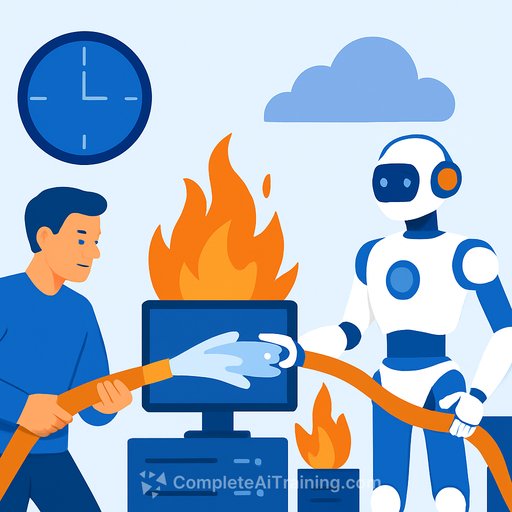
Developers are seeing the other side: rework
Adoption is rising, but trust is not. Google's State of DevOps found a large chunk of devs still don't trust AI-generated code, even as they use it daily. The 2025 Stack Overflow survey shows distrust in accuracy is growing year over year.
- 39% of developers reported low trust in AI-generated code in Google's DevOps report (DORA 2024).
- 46% of developers said they don't trust AI coding outputs in 2025, up from 31% in 2024 (Stack Overflow Developer Survey).
- 67% say they spend more time debugging AI-generated code than before.
The pattern is familiar: perceived productivity gains get eaten by review, fixes, and missed edge cases. Teams that treat AI as an intern-level collaborator report fewer surprises than teams that auto-merge generated diffs.
Security: involve AppSec early, or pay later
Pichai admits the risks, especially in security. Studies show roughly half of AI-generated code is secure out of the box, and only about a third of developers consistently review AI output before deploy. That gap invites supply chain issues, secrets leakage, and dependency drift.
His guidance is practical: keep vibe coding in the experimental lane for now, and make sure security has a say before anything touches a large codebase.
Practical playbook: make vibe coding work on real teams
- Use AI where ambiguity is low: test scaffolds, migration scripts, boilerplate, docs, and small refactors. Keep it away from critical paths without review.
- Default to test-first. Ask the model to generate tests and property checks before or alongside code. Treat failing tests as a hard gate.
- Always pair AI output with static analysis, secret scanning, SCA, and linting. No exceptions on CI.
- Enforce human review by code owners. If no owner is available, the change waits.
- Require the model to cite assumptions and risks in the PR description. Make threat modeling part of the prompt.
- Keep prompts, context, and decisions in the repo. Reproducibility matters more than wow-factor demos.
- Track the real cost: time to review, escaped defects, rollback rate, and security findings per LOC. If those trend up, tighten usage.
- Fine-tune prompts for your stack: framework versions, internal libraries, patterns to avoid, and approved dependencies.
- Block dependency additions without provenance checks. No mystery packages pulled in by a helper function.
- Treat AI as a junior partner. Great for options and drafts; final accountability stays with the engineer who merges.
The "worst it'll ever be" argument
Pichai compares the moment to early autonomous taxis: early skepticism, gradual reliability, eventual acceptance. He believes today's vibe coding tools are the worst they'll ever be - and progress will make them feel obvious in hindsight.
That may prove true. In the meantime, the teams that benefit will be the ones that add guardrails, measure outcomes, and keep security in the loop. Curiosity plus discipline beats vibes alone.
Level up your AI-for-coding workflow
If you're formalizing AI use in your dev org, this AI Certification for Coding covers practical patterns, review policies, and testing strategies that translate well to production work.
Your membership also unlocks: