
AI news ·
Supreme Court sets aside NCLT and NCLAT orders after finding reliance on fake AI-generated judgments, directs Bar Council to frame AI usage guidelines for advocates
India's top court voided insolvency orders citing six AI-fabricated precedents. It ordered the Bar Council to mandate verification of AI-generated legal research.
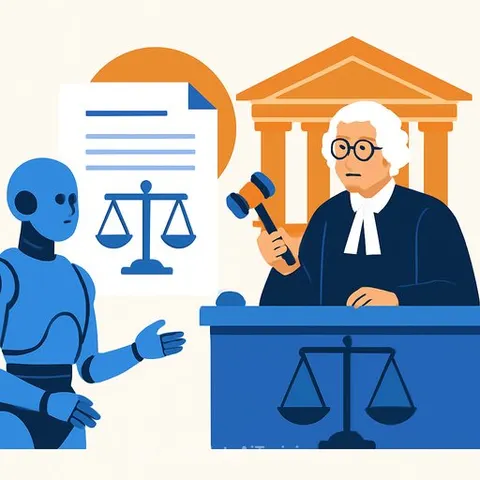
On 2 July 2026, the Supreme Court of India set aside insolvency orders from the National Company Law Tribunal and the National Company Law Appellate Tribunal after finding they relied on six fake, AI-generated legal precedents. The court directed the Bar Council of India to frame binding guidelines for advocates who use artificial intelligence in legal research, declaring that judgments contaminated by fabricated authorities are void.
The fake authorities that derailed the insolvency case
Pooja Ramesh Singh, a suspended director of Essel Infraprojects Limited, had challenged the NCLT's admission of a Section 7 IBC application filed by Jammu and Kashmir Bank. The NCLT's 28 August 2024 order cited six Supreme Court judgments to support its reasoning. After Singh's counsel demonstrated that several of these judgments did not exist or contained non-existent paragraphs, the bank filed an affidavit stating its advocates had not cited any of the fake precedents. The material appeared to have entered the order through the tribunal's own research.
The Supreme Court independently verified each citation and found a combination of invented case titles, non-existent citations, and genuine citations paired with fabricated extracts:
- State Bank of India v. M/s Shree Ram Urban Infrastructure Ltd., 2020 SCC OnLine SC 341 - the citation belonged to a real judgment but with an incorrect cause title; the quoted paragraph did not exist in the actual decision.
- Everest Kento Cylinders Ltd. v. Union of India, (2015) 2 SCC 1 - a genuine reported judgment, but the NCLT attributed a fabricated paragraph to it.
- ICICI Bank Ltd. v. Urban Infrastructure Real Estate Ltd., (2019) 16 SCC 528 - both the citation and the judgment were entirely non-existent.
- V.S. Dempo & Co. Ltd. v. Reliance Communications Ltd., (2021) 10 SCC 176 - the reported judgment did not exist.
- Canara Bank v. N.G. Subbaraya Setty, (2018) 16 SCC 228 - a real judgment, but the paragraph the NCLT reproduced was not in the actual ruling.
- Sarbjit Singh v. Union Bank of India, (2022) 7 SCC 464 - the citation and the judgment were entirely fabricated.
Zero tolerance for AI-hallucinated precedents
The court did not treat the fake citations as a minor error. "An adjudicatory decision based upon fabricated precedent is 'no decision in the eyes of law'," it said, applying a strict zero-tolerance principle. The order makes clear that even a small amount of hallucinated material - "an iota" - contaminates the entire decision-making process and violates the integrity of adjudication. Such a judgment must be set aside, regardless of whether the ultimate conclusion might have been independently defensible.
The court described AI's tendency to generate plausible but false information as especially dangerous in law. A fabricated precedent can mimic an authentic judicial decision in structure, language, and citation, making it hard to detect. "An advocate who cites an AI-generated judgment without verifying its existence and accuracy commits professional misconduct," the court said, adding that judges and tribunal members commit a serious lapse when they rely on such material.
The bench emphasised that AI may assist legal work but cannot replace human reasoning. "Adjudication must always remain under absolute human control," the judgment states, noting that judicial decision-making requires conscious reasoning, critical evaluation, and the ability to distinguish truth from falsehood - functions that cannot be delegated to an automated system.
Directives for the Bar and fresh adjudication
The Supreme Court directed the Bar Council of India to constitute a committee to formulate guiding principles for responsible AI use by advocates, prescribe verification standards, and determine disciplinary consequences for violations. The court said mere judicial condemnation was insufficient; enforceable professional accountability was necessary. It also questioned how the NCLAT had failed to spot the fake authorities while affirming the NCLT's reasoning, noting that an appellate process must scrutinise the legality of the original decision.
The judgment arrives as more legal professionals explore AI for Legal applications, making it critical for practitioners to understand their duties of verification. The court did not prohibit legitimate AI use - it targeted only the presentation or acceptance of unverified, hallucinated output as genuine precedent.
The Section 7 application was restored to the NCLT for fresh adjudication, preferably within two weeks, with all merits left open. The parties must maintain the status quo until disposal.
Why this matters for legal professionals
Every advocate, regardless of practice area, now faces a clear professional obligation: any AI-generated legal research, citation, or text must be independently verified from an authoritative source before it is submitted to a court or tribunal. The Bar Council will soon issue binding norms that will define verification standards and the disciplinary consequences of non-compliance. The ruling reinforces that the advocate's duty to the court overrides any efficiency gain from unverified AI tools. Legal professionals should review their research workflows and ensure every generative AI output is cross-checked against official law reports now, before the guidelines impose mandatory sanctions.