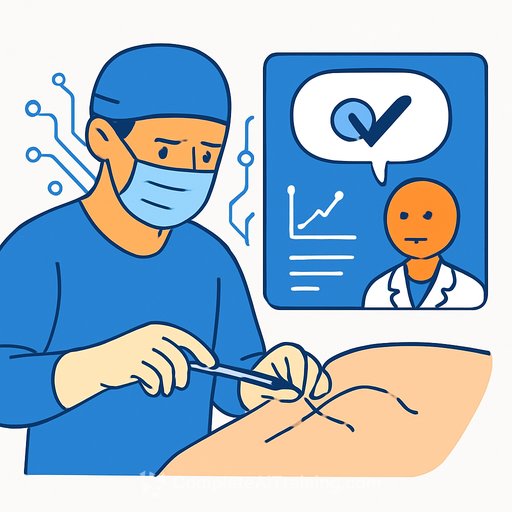
AI coaching steps in as surgical training stretches thin
The surgeon shortage is getting sharper, and training time is under pressure. A new explainable AI tool offers medical students real-time, personalized feedback as they practice suturing-without needing an attending to stand over their shoulder.
Built at Johns Hopkins University, the system learns from expert surgeons' movements and provides concrete, immediate advice. It doesn't just score a stitch; it shows students where their technique diverges from expert practice and how to fix it.
What this tool actually does
Many students learn by watching surgical videos and copying what they see. Some existing models rate performance, but they stop short of telling students why a score is high or low. "These models can tell you if you have high or low skill, but they struggle with telling you why," says Mathias Unberath, an expert in AI-assisted medicine focused on human-AI interaction.
This system is different. It tracks how experts close incisions-hand paths, timing, needle angles, spacing-and compares a student's attempt against that pattern. After each try, the AI texts clear guidance on what to change next: stitch spacing, tension, or motion economy.
"Learners want someone to tell them objectively how they did," says first author Catalina Gomez, a Johns Hopkins PhD student in computer science. "We can calculate their performance before and after the intervention and see if they are moving closer to expert practice."
Early results: who benefits most
In a randomized study with 12 medical students who had suturing experience, one group trained with immediate AI feedback while another relied on videos. Everyone then repeated the task. Students with stronger fundamentals learned faster with AI coaching compared to those watching videos.
"Beginner students still struggled with the task but students with a solid foundation in surgery, who are at the point where they can incorporate the advice, it had a great impact," Unberath says. In short: AI coaching accelerates improvement for learners who are ready for targeted adjustments.
Why explainability matters in skills training
- It closes the loop fast: try, get precise feedback, fix, repeat.
- It reduces faculty burden without losing specificity.
- It quantifies progress objectively, not just by "feel."
- It tells students where they deviate from expert patterns, so practice time targets the right habits.
How educators and program directors can use this now
- Pair AI feedback with existing skills labs for intermediate learners; keep beginners on fundamentals until they can act on detailed cues.
- Set clear performance thresholds (e.g., stitch spacing variance, needle angle range) and track progress session to session.
- Use quick instructor debriefs to interpret the AI's suggestions and align them with your program's technique standards.
- Collect pre/post metrics for each rotation to measure outcomes and justify lab time, kits, and devices.
What's next
The team plans to refine the model for easier use and broader access. The goal: let students practice at home with a suturing kit and a smartphone. That shift would scale practice opportunities without adding to faculty workload.
The technology was showcased at the International Conference on Medical Image Computing and Computer Assisted Intervention (MICCAI). Coauthors are from Johns Hopkins and the University of Arkansas. The work was supported by the Johns Hopkins DELTA Grant IO 80061108 and the Link Foundation Fellowship in Modeling, Simulation, and Training.
Why this matters for healthcare leaders
Training bottlenecks slow down workforce growth. Tools that deliver immediate, actionable feedback let students practice more, fail safely, and improve faster-especially once they have baseline skills. That's a practical way to expand capacity without burning out the attendings who hold programs together.
Further reading and upskilling
If you're building an AI-upskilling track for clinical educators or simulation teams, see curated programs by role at Complete AI Training.
Your membership also unlocks: