Surgical Nurses Need Targeted AI Training: What to Prioritize, How to Roll It Out, and What to Measure
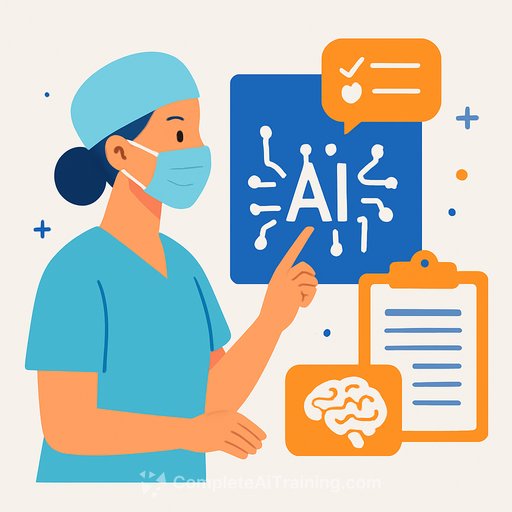
A new study signals a clear message: surgical nurses are central to safe AI adoption in the OR, yet most lack structured training that fits their workflow. The gap isn't about interest. It's about focused education that connects AI tools to real perioperative tasks, risks, and outcomes.
AI is showing up in scheduling, case preparation, intraoperative decision support, robotics, documentation, and infection prevention. Without targeted training, you get automation bias, privacy issues, and silent workflow errors that don't show until something goes wrong. With it, you get safer handoffs, faster decisions, and fewer preventable complications.
What AI literacy should cover for surgical nurses
- Clinical AI basics: What AI can and can't do, model limitations, false positives/negatives, and how that impacts a time-sensitive OR.
- Data literacy: Inputs, outputs, data quality, bias sources, and what "model drift" means for device performance on your floor.
- Safety and human factors: Automation bias, alert fatigue, escalation rules, and how to verify AI recommendations under time pressure.
- Workflow integration: Where AI fits in pre-op checklists, intraop decision support (e.g., antibiotics, VTE risk), and post-op documentation.
- Regulatory and labeling: What the device is cleared to do, off-label risks, and vendor updates that change behavior.
- Privacy and security: PHI handling, de-identification, audit trails, and how to spot risky data flows with ambient scribes and apps.
- Team communication: How to present AI outputs to surgeons and anesthesia, and when to push back or escalate.
- Documentation: How to record AI-assisted decisions, overrides, and verification steps.
Common gaps highlighted by the study
- Confusion about how AI systems reach a recommendation and how to check it quickly.
- Limited familiarity with device labeling and update notes that impact daily use.
- Unclear escalation pathways when AI advice conflicts with clinical judgment.
- Inconsistent documentation of AI-assisted decisions and overrides.
A practical training blueprint (built for the OR)
- Format: Microlearning (10-15 minutes), case-based scenarios, and simulation tied to your devices and EHR.
- Modules (8-10 hours total):
- AI fundamentals for clinical teams
- Data quality, bias, and safety
- Perioperative workflows: pre-op to PACU
- Human factors: automation bias and alert triage
- Verification procedures and escalation
- Device labeling, regulatory basics, and change logs
- Privacy, security, and PHI safeguards
- Documentation standards and audit trails
- Team drills and simulation (OR scenarios)
- Assessment: Short quizzes + simulation checklists + direct observation during pilots.
- Maintenance: Quarterly refreshers aligned to vendor updates and incident learnings.
90-day rollout for nurse leaders
- Days 1-30: Map current AI use (CDS, robotics, ambient scribe, image tools). Set policy for verification, escalation, and documentation. Pick 2-3 high-impact scenarios.
- Days 31-60: Deliver core modules. Run tabletop drills. Start a small pilot on one service line with clear guardrails.
- Days 61-90: Expand simulation to full team. Tune protocols. Launch standard operating procedures. Set quarterly refreshers. Nurse leaders planning pilots and measuring outcomes can use the AI Learning Path for Training & Development Managers as a template for rollout and metrics alignment.
Metrics that matter
- Process: completion of training, simulation pass rates, adherence to verification steps.
- Safety: near-miss reports related to AI, override rates with rationale, alert fatigue signals.
- Quality: timing of antibiotic prophylaxis, VTE risk documentation, accurate device counts, smoother handoffs.
- Experience: nurse confidence scores and surgeon/anesthesia feedback.
Risk controls you should hardwire
- Human-in-the-loop: No critical step should rely on AI without a defined verification.
- Escalation: Clear triggers for surgeon or anesthesia consult when AI conflicts with clinical judgment.
- Auditability: Document AI influence, overrides, and reason codes.
- Change management: Review vendor release notes and revalidate workflows after updates.
Quick OR scenario
An AI tool flags a patient as high risk for postoperative infection based on EHR patterns. The circulating nurse confirms inputs (recent labs, allergy list, weight-based dose), verifies the recommendation against protocol, and escalates to anesthesia for timing confirmation. The decision and verification steps are documented with an override option if clinical status shifts.
Helpful references
Build skills fast
If you're setting up role-based learning paths for perioperative staff, you can explore curated AI course lists by role and skill level here:
- AI Learning Path for Primary School Teachers - a structured, modular learning path that can be adapted for perioperative staff training formats like microlearning and simulation.
Bottom line: AI is already in your OR. Give surgical nurses targeted training, build verification into the workflow, and measure what matters. That's how you keep patients safe and teams confident.
Your membership also unlocks: