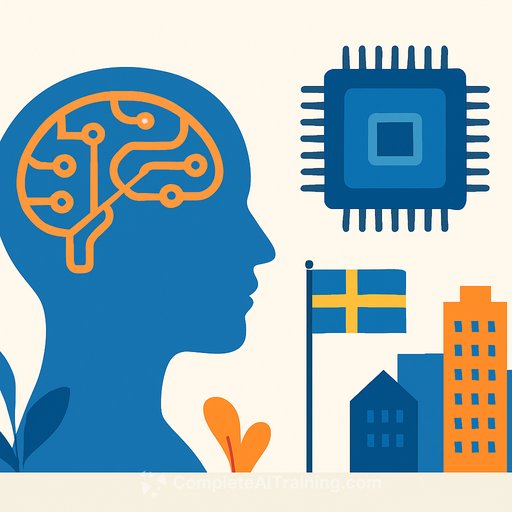
AI Bubble Talk Is Loud. Build So It Doesn't Matter.
Read the headlines and you'd think everyone is manifesting an AI bubble. Forecasts about a NASDAQ crash feed investor anxiety, which then breeds more content about a NASDAQ crash. That loop feels self-fulfilling. The cure isn't more takes. It's making AI so embedded in daily work that hype and panic can't move it much.
Markets swing when there's daylight between real use and boardroom buzz. The antidote is ubiquity. When a technology becomes routine-like email or spreadsheets-its value doesn't vanish overnight. That's the lesson from Sweden.
What Sweden Did Right
In the 1990s, Sweden launched the Home-PC reform: get a computer into every home. It wasn't a corporate memo or a glossy campaign. It was policy-simple, universal, and aimed at everyday life.
Long, dark winters did the rest. With up to 18 hours of darkness, people stayed in, learned the web, and experimented. That created a digitally fluent generation that went on to build global products.
Fast forward. Stockholm now produces more unicorns per capita than any city outside Silicon Valley. AI startups are thriving. Legora is automating legal work at a $1.8B valuation. Einride raised $100M to scale autonomous freight. Lovable's "vibe-coding" platform is exploding. Workday acquired Sana for $1.1B. Not bad for a country with half the population of New York State.
The Flywheel
Big outcomes fueled the ecosystem. Skype and Mojang were acquired for billions. King's Candy Crush, Klarna, Spotify-each exit minted a new pool of operators and angels. Many reinvested in new teams and ideas. Experience and capital cycled back in, again and again.
The System Around the Builder
Sweden backs builders with structure, not slogans. There's capital from firms like EQT, Northzone, and Creandum. It's straightforward to start a company, and stock options actually reward talent.
Talent pipelines are tight. KTH for engineering. Handelshögskolan for business. Many founders blend both-or skip school and ship anyway. High English proficiency removes friction with global markets.
Policy matters. Sweden spends a larger share of GDP on R&D than any other country in Europe (3.57%). That's sustained fuel, not one-off grants. See the data here: OECD R&D spend.
There's also tjänstledighet: any employee can take six months off to start a business. That turns "someday" into a clear option. Details here: Swedish leave to start a business.
And echoing the Home-PC reform, the government is backing a Swedish AI Reform-making agentic AI available to civil servants, students, teachers, research institutions, and non-profits. Same principle as before: get the tools into everyday hands.
Culture That Ships
Function and form live together here. Think Volvo and IKEA. Many engineers care about aesthetics as much as architecture. Landing pages and interfaces get the same attention a designer would give a chair.
There's also a humility bias. Flash is frowned on. Information flows between teams and companies. Low ego. High trust. When one group wins, everyone learns.
The Signal for IT, Engineering, and Business Leaders
If you're worried about a bubble, build so it doesn't matter. Get AI out of slides and into habits. The market can debate valuation while your team compounds operational wins.
A Practical Playbook to Weave AI Into Daily Work
- Give every employee an AI seat. Standardize on a secure provider, set budgets, and require basic training. If everyone has spreadsheets, everyone should have AI to boost Productivity.
- Create "safe sandboxes." Weekly office hours, shared prompt libraries, and internal leaderboards for best automations. Celebrate the boring wins that save time.
- Pick role-based workflows. Start with high-frequency tasks: support replies, QA checks, code reviews, research summaries, meeting notes, backlog grooming. Turn them into repeatable playbooks.
- Measure effectiveness, not noise. Track adoption rate, cycle time reduction, error rate, and cost per task. Tie bonuses or recognition to shipped automations and documented outcomes.
- Champion design and UX. Treat prompt UX and tool interfaces like product surfaces. Small UX lifts compound usage and trust.
- Lower the ego tax. Make it normal to share what works-even across departments. Run monthly "AI open source" sessions to demo and document wins.
- Build a builder ladder. Offer internal certification paths for AI automation, Data Analysis, and coding assistants. Promote from within for people who turn playbooks into platforms.
- Set guardrails early. Data access, logging, model choices, vendor review, and compliance checks. Keep it simple and enforceable.
- Seed reinvestment. Allocate a small internal fund for employee-led automation projects. Reward savings with budget kickbacks to teams that created them.
If your org needs structured upskilling by role, see curated tracks like the AI Learning Path for Administrative Assistants.
What This Looks Like in Practice
- Support: AI drafts first responses, humans approve, QA monitors tone and accuracy. KPI: first-response time and CSAT.
- Engineering: AI aides for code search, unit test generation, refactors, and doc updates. KPI: lead time and defect rate.
- Product: Research synthesis from interviews, spec drafting, and experiment analysis. KPI: cycle time from spec to test.
- Finance and Ops: Reconciliations, anomaly flags, and recurring report prep. KPI: hours saved and error incidents.
- HR and L&D: Role-based onboarding, policy Q&A, and internal knowledge assistants. KPI: time-to-productivity.
Mindset Check
- Bias to distribution: get basic AI into every desk before chasing exotic use cases.
- Bias to retention: make tools so useful people don't want to work without them.
- Bias to learning: weekly reviews of wins, misses, and updated playbooks.
- Bias to compounding: reinvest time saved into the next automation.
Make AI Boring. Make It Inevitable.
Sweden's lesson is simple: widespread access beats hype cycles. Put the tech in people's hands, teach them enough to be dangerous, and reward what works. Do that long enough and market moods matter less.
Bubbles pop. Habits stick. Build habits.
Your membership also unlocks: