Switzerland launches new vocational training in AI
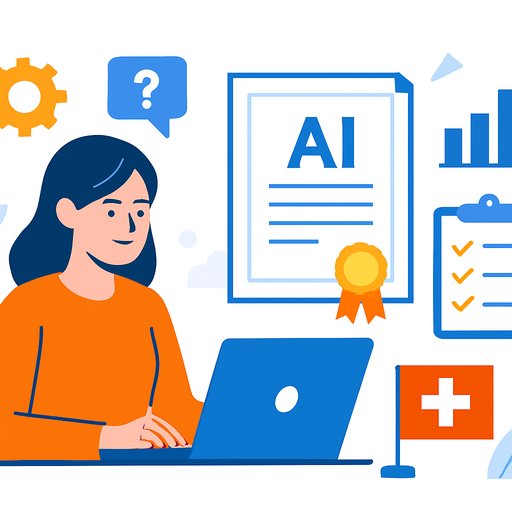
Switzerland has approved a new profession: artificial intelligence specialist at the tertiary level, earning a federal diploma. The goal is straightforward-equip people who can turn AI potential into measurable outcomes inside companies.
For education leaders, this is a clear signal. Vocational and professional education needs programs that build applied AI capability, backed by ethics, compliance and real business value.
What the new AI specialist will do
- Identify and assess AI application opportunities across departments.
- Support AI projects through their full lifecycle-from scoping to deployment and iteration.
- Improve operational processes and evolve products and services with data-driven methods.
- Enhance working conditions while meeting economic, social and ethical requirements.
This role focuses on responsible, efficient use of AI-practical outcomes, not experiments for their own sake.
Timeline and system updates
The State Secretariat for Education, Research and Innovation (SEFRI) will introduce the program with other revisions starting in the 2026 academic year. Alongside the AI diploma, 42 training courses have been updated, including electrical installer, farmer, orthopaedic shoemaker and technical business management specialist.
Switzerland reviews vocational programs at least every five years. The federal government issues ordinances and approves study plans. Implementation and enforcement sit with the cantons, professional organizations and higher education institutions.
What schools and training providers should do now
- Map demand: Talk to local employers about concrete AI use cases (process automation, quality control, customer support, forecasting, documentation).
- Define competencies: Blend data literacy, model selection, prompt-led workflows, evaluation, risk management and change enablement.
- Build the stack: Secure sandbox environments, version control, data governance and access to major AI platforms and MLOps-lite tools.
- Set guardrails: Establish policies for privacy, bias, safety and transparency aligned with national guidance and international principles.
- Upskill faculty: Create short cycles for hands-on practice, peer labs and industry mentoring.
- Co-design with employers: Lock in real projects, internships and applied assessments tied to business metrics.
- Assessment that mirrors work: Scenario-based tasks, model comparisons, error analysis and post-deployment reviews.
- Quality assurance: Review outcomes each term, capture lessons learned and update teaching materials on a fixed cadence.
Suggested program structure (tertiary, professional focus)
- AI foundations for business impact: problem framing, feasibility, ROI and risk trade-offs.
- Data practices: sourcing, cleaning, labeling, evaluation and documentation.
- Model use and integration: model selection, prompt patterns, APIs and workflow automation.
- Evaluation and monitoring: accuracy, drift, bias checks and human-in-the-loop controls.
- Legal, security and ethics: data protection, audit trails and responsible deployment.
- Change and adoption: stakeholder alignment, training and process redesign.
- Capstone with an employer: scoped project with defined KPIs and a post-mortem report.
Why this matters for education
Employers don't just need more data scientists; they need professionals who can translate business needs into safe, useful AI workflows. This diploma fills that gap and fits squarely in the Swiss strengths of applied, work-based learning.
If you build programs that ship real outcomes-faster processes, better decisions, safer practices-your graduates will be hired on sight.
Resources
Practical next steps
- Set up a cross-functional working group (curriculum, IT, legal, employer partners) within the next 60 days.
- Pilot one employer-backed AI project per department this semester and use the results to refine modules.
- Publish clear graduate profiles and assessment rubrics so employers know exactly what skills to expect.
Curated course options
If you need ready-to-use materials and certificates to support faculty and learners, see these selections:
Your membership also unlocks: