AI Robots In The Hospital: Practical Wins, Real Constraints
A hospital in Taiwan has rolled out AI-enabled service robots to ease pressure on staff and improve day-to-day operations. The aim isn't to replace people-it's to offload repetitive work so clinicians can focus on care.
If you lead a unit, run operations, or manage IT, here's what matters: where robots help today, how they integrate with your systems, what to measure, and the risks to plan for.
Where the robots help today
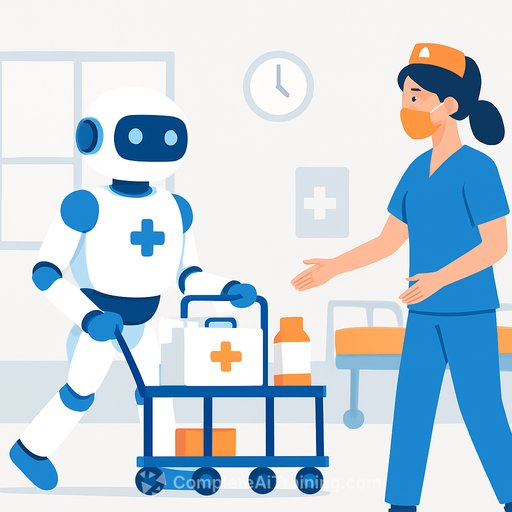
- Logistics: Deliver meds, supplies, and meals; pick up lab specimens; handle "last 100 meters" runs that eat nurse time.
- Environmental services: UV-C room disinfection between patients to reduce manual exposure time and bolster protocols.
- Telepresence: Remote rounding or consults so specialists can support more rooms without extra foot traffic.
- Monitoring: Routine vitals checks, simple alerts, and reminders in low-acuity areas.
These units pair sensors, computer vision, autonomous movement, and on-device decision logic to operate around people safely. Think elevator integration, door access, and route planning that adapts to changing hallway traffic.
What changes for your staff
- Fewer hallway trips for routine runs; more time for assessments, education, and escalation.
- Faster turnarounds for pharmacy and lab runs during peaks.
- Less exposure during cleaning cycles that involve UV-C or high-risk areas.
Staff still lead the process. Robots follow rules you set: where they can go, who approves tasks, and how exceptions are handled.
Benefits you can reasonably expect
- Time back for nurses and aides by removing low-complexity errands.
- Lower cross-contact for specific tasks, supporting infection control.
- More predictable logistics and fewer delays tied to staffing crunches.
Results vary by unit layout, elevator access, and EHR/device integration. The biggest gains show up where trips are frequent and distances are long.
Risks and how to manage them
- Reliability: Build a fallback process when a unit is charging or offline; track uptime.
- Safety: Set speed limits, restricted zones, and mandatory stop distances; log near-misses.
- Acceptance: Involve nurses, EVS, and transport early; run simulations; gather feedback weekly.
- Privacy: Minimize recorded data, restrict video access, encrypt at rest/in transit, and audit access.
- Costs: Plan for batteries, wheels, sensors, and software updates-not just purchase price.
Integration must-haves
- Task orchestration: Orders should trigger runs directly from approved systems (meds, lab, EVS).
- EHR alignment: Use standard interfaces where possible (HL7 FHIR) to avoid brittle one-offs.
- Building systems: Elevators, automatic doors, and secure areas need controlled access.
- Network and identity: WPA2-Enterprise, certificate-based auth, and role-based permissions.
For logistics-focused training on task orchestration, route planning, and in-hospital transport workflows, see the AI Learning Path for Transportation Managers.
Pilot plan: first 90 days
- Weeks 1-2: Map routes, define restricted zones, test elevators, run safety drills.
- Weeks 3-4: Limited hours on one unit; assign a robot "dispatcher" per shift; document exception paths.
- Weeks 5-8: Expand to two units; begin EHR or task-system triggers for standard runs.
- Weeks 9-12: Compare metrics to baseline; adjust routes, speed, and task rules; decide on scale-up.
What to measure
- Clinical time saved: Minutes per shift recovered from transport and room turnovers.
- Turnaround times: Order-to-delivery for meds/supplies; lab pickup-to-receipt.
- Infection control signals: Contact frequency for flagged tasks; adherence to cleaning steps. For UV-C, align with CDC guidance on use in healthcare settings (CDC Environmental Infection Control).
- Safety: Near-misses, emergency stops, restricted-zone entries.
- Uptime and dispatch backlog: Downtime per unit; queue length during peaks.
- Staff satisfaction: Short pulse surveys every two weeks.
Cost and ROI snapshot
Plan for capital plus annual software and maintenance. Include batteries, wheels, sensors, and disinfecting bulbs if used. Account for IT work (networking, access control, interfaces) and training hours.
The return shows up as time recovered, faster throughput, and fewer manual exposures. Put a dollar value on minutes saved per role to make the case stick with finance.
Governance, privacy, and safety
- Data: Log only what you need for operations and safety; redact or anonymize where possible.
- Access: Keep camera/mic feeds off by default unless required; expire temporary access.
- Policies: Post signage for patient areas; include opt-out workflows for sensitive encounters.
- Audits: Quarterly checks on logs, firmware, and physical integrity; review incident reports.
The bigger picture
This pilot fits a wider push to automate routine hospital work while keeping humans in control. Expect ongoing scrutiny from regulators, unions, and patient advocates-rightly so.
Hospitals that win here start small, measure honestly, and scale where the data supports it. The result is quieter hallways for staff and better response times for patients.
Action checklist
- Pick two high-volume routes that frustrate staff today.
- Define success metrics and a hard stop date to evaluate.
- Set safety rules and run a live drill before day one.
- Align integrations with IT early; avoid manual triggers as a crutch.
- Publish weekly results to frontline teams and fix the rough edges fast.
If your team needs a structured way to build AI fluency for hospital operations and procurement, see this curated catalog: AI courses by job role.
Your membership also unlocks: