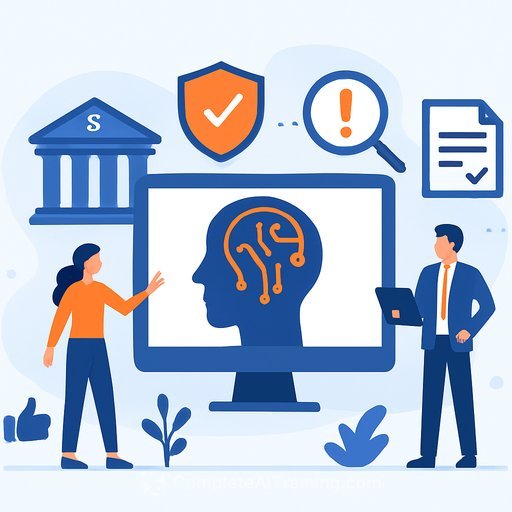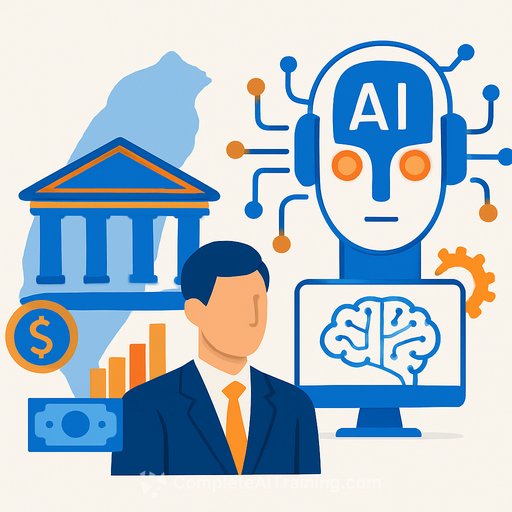
Taiwan's banks are stuck in AI silos. AI agents can move the needle.
Taiwan's financial sector is rolling out AI; see AI for Finance for sector-specific resources and patterns. Most deployments, however, live inside single departments. That limits impact, creates duplicate work, and slows compliance sign-off across the enterprise.
Recent reports from McKinsey Taipei cite a global survey of 2,000 companies across finance, tech, and retail. The signal is clear: firms that move from isolated tools to coordinated AI agents see bigger outcomes, with tighter control.
What "department-only AI" looks like
You've seen the pattern: a marketing model for next-best offer, a risk model for early warning, an ops bot for ticket routing. Each helps locally, but none talk to each other.
The result is vendor sprawl, inconsistent controls, and value capped at the team level. Costs creep up while model risk teams chase scattered approvals.
Why AI agents matter for banks
AI agents are systems that plan tasks, call tools, and take bounded actions across core platforms-under strict guardrails. Think of them as supervised doers, not just insight engines.
- Onboarding and KYC: pre-fill forms, trigger document checks, escalate exceptions.
- Credit underwriting: assemble data, draft memos, request verifications, log rationale.
- Collections: segment accounts, generate outreach, schedule follow-ups, record outcomes.
- Relationship manager copilot: summarize client intents, update CRM, prep meeting briefs.
- Compliance monitoring: scan communications, flag issues, create auditable cases.
- Fraud ops: cross-check events, pause risky flows, hand off to analysts with context.
- IT and back office: open/resolve tickets, reconcile breaks, keep an audit trail.
Done right, agents lift throughput and speed while keeping decisions traceable. The non-negotiables: auditable actions, role-based access, and human control at the right points.
What the 2025 survey signals
Surveyed firms that scale AI share three habits: common architecture, shared controls, and systematic upskilling. Those that don't standardize stay stuck in pilots, no matter how many models they build.
For banks in Taiwan, the takeaway is simple: shift from tool-by-tool deployments to an agent framework governed at the enterprise layer. CIOs should lead the architecture and risk-control design-see the AI Learning Path for CIOs for practical guidance on governance and secure orchestration.
A practical roadmap for finance leaders
- Pick three cross-functional journeys to start: onboarding, collections, and compliance case handling.
- Stand up an agent framework: planner, tool registry, secure connectors, observation logs, and a supervisor layer.
- Tighten data access: least privilege, data contracts, synthetic data for dev/test, and PII masking by default.
- Codify controls: model inventory, use-case risk tiers, human-in-the-loop points, and segregation of duties.
- Measure value weekly: cycle time, error rate, cost per case, and policy exceptions.
- Run change like a product: small squads, two-week releases, and outcome reviews with business owners.
- Rationalize vendors: fewer models and tools, more shared components, clear exit plans.
- Upskill fast: analysts on prompt patterns and retrieval, engineers on agent orchestration, risk teams on AI testing.
Architecture sketch: the agent loop
Keep it simple and safe. One planner decides next actions. Tools expose controlled functions (KYC check, CRM update, payment pause). A memory store holds case context. A rules engine enforces policies and routes approvals.
Everything runs through a message bus with full logging. A supervisor agent watches for drift, rate limits actions, and asks for human confirmation when thresholds are hit.
Controls first: audit, risk, and compliance
- Lineage: every prompt, tool call, and data pull is logged and immutable.
- Testing: bias, stability, and adversarial checks before go-live and on a schedule.
- Access: role and attribute-based gates; no raw PII in prompts; redaction on output.
- Approvals: pre-approved action sets; anything outside scope triggers human review.
- Monitoring: drift alerts, anomaly flags, and kill switches owned by first line and risk.
What to pilot next quarter
- SMB onboarding agent: pre-populate forms, run KYC/AML checks, draft rationale for account opening.
- Collections agent: prioritize accounts, choose outreach channel, track commitments, hand tricky cases to humans.
- Compliance copilot: draft case notes from communications, link evidence, propose disposition for review.
- Employee productivity: meeting summaries that push structured updates into CRM and ticketing tools.
Policy anchors worth using
Adopt public frameworks so your governance passes scrutiny. Start with the NIST AI Risk Management Framework and regional principles like MAS FEAT for fairness, ethics, accountability, and transparency.
Upskill your teams
If your staff can scope agent tasks, write safe prompts, and wire tools, you compress timelines. Start with focused, job-specific learning and a shortlist of vetted finance tools.
The move from siloed pilots to agent-driven workflows is a management choice, not a tech miracle. Pick the right journeys, put controls at the center, and ship value in weeks-not years.
Your membership also unlocks: