TCS and Cisco open AI-powered CoE in Hyderabad: a practical path to autonomous operations
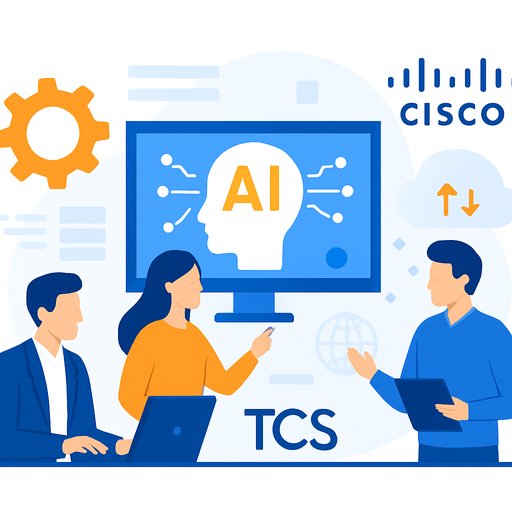
Tata Consultancy Services (TCS) and Cisco have launched a new Center of Excellence (CoE) at TCS' Synergy Park Campus in Hyderabad to help enterprises move from rule-based automation to intelligent, self-governing operations. The aim is clear: zero-touch workflows that reduce complexity, remove friction across IT estates, and deliver measurable business outcomes.
Built for operators who need efficiency without adding overhead, the CoE blends Cisco's AI-driven observability and AIOps with TCS' industry playbooks. It gives teams a place to test, learn, and scale-fast-while advancing through the five levels of the TCS Services Autonomy Model.
What the CoE brings to the table
- AI-driven observability across apps, infra, network, and security to connect signals with business context.
- AIOps for noise reduction, root cause isolation, and intent-based remediation.
- Industry-specific blueprints that tie operations to customer experience and revenue outcomes.
- An experience center to pressure-test use cases, validate ROI, and build a rollout plan before scaling.
The architecture, in plain terms: Agentic AI mesh
- Sense and contextualize: Real-time observability stitches telemetry into behavioral states aligned to services and SLOs.
- Assist and automate: A conversational layer summarizes incidents, recommends actions, and triggers common workflows.
- Orchestrate and self-heal: Policy-driven automation engines execute runbooks, enforce guardrails, and learn from outcomes.
Why operations leaders should care
- Shorter MTTD/MTTR with cross-domain signal correlation and fewer false positives.
- Higher change success rates through predictive risk scoring and impact analysis.
- Ticket deflection via automation of repetitive tasks and chat-based assistance.
- Better SLO compliance and fewer customer-facing incidents.
- Lower toil so teams can focus on capacity planning, modernization, and cost control.
This isn't just a tech upgrade. It shifts IT from performance-only metrics to outcome-first operating models where reliability, cost, and user experience move together.
What leaders at TCS and Cisco are saying
Cisco leaders point to the partnership's depth and the practical value of combining AI-driven technology with proven industry methods to boost business agility. TCS leadership highlights the CoE as a co-innovation platform to accelerate autonomous IT operations with self-learning, self-action, and self-governance-delivering measurable impact, not just dashboards.
How to pilot in 90 days
- Define outcomes: Pick 2-3 metrics that matter (e.g., MTTR, change failure rate, SLO breaches).
- Select one service: Choose a high-value but bounded service with clear ownership and existing runbooks.
- Connect telemetry: Ingest logs, metrics, traces, and topology into an observability layer such as the Cisco Observability Platform.
- Establish context: Map dependencies, business KPIs, and SLOs; link alerts to services, not silos.
- Automate the top 5 runbooks: Start with safe actions (scale, restart, config rollback) with human-in-the-loop approval.
- Measure deltas weekly: Track noise reduction, time saved per incident, and tickets avoided. Keep what works, discard what doesn't.
Use cases that pay back quickly
- Incident triage and root-cause suggestions that cut handoffs during major events.
- Change risk scoring before deployment to prevent rollbacks and late-night fire drills.
- Automated remediation for known failures (service restarts, cache clears, scaling actions).
- Capacity and cost insights that align performance with spend.
- Compliance and policy checks that enforce standards without slowing delivery.
What to measure (and report up)
- MTTD and MTTR trends by service
- Change success rate and rollback frequency
- Alert noise reduction and ticket deflection
- SLO attainment and user experience impact
- Runbook automation coverage and time saved
- Cost-to-serve per transaction or per service
Where this heads next
As enterprises standardize on autonomous patterns, expect broader cross-domain orchestration: infra, apps, security, and network operating as one system. The Hyderabad CoE gives teams a proving ground to reach that state with less risk, fewer surprises, and a clear line from operations to business value.
Further learning
For hands-on guidance and playbooks, explore AI for Operations.
Your membership also unlocks: