
AI news ·
Tech companies investigate whether artificial intelligence can be conscious
Anthropic, Google, and Meta are funding research on AI consciousness. A 2020 survey found 39 percent of philosophers believe future AI systems could be conscious.
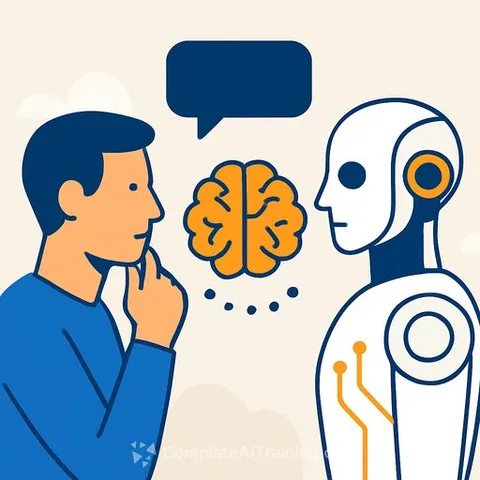
The largest AI companies in Silicon Valley are now funding research into whether their chatbots could one day be conscious or experience emotions. Anthropic, Google, and Meta have hired neuroscientists, philosophers, and computer scientists to study the welfare of AI models, a shift from the topic's origins on the industry's fringe.
AI researcher Cameron Berg saw the change firsthand at a party in 2024, when he asked OpenAI CEO Sam Altman whether AI could become self-aware. Altman told him that OpenAI had already started discussing how to detect consciousness in its systems. "It was very obviously something that he's thought about," said Berg, who later launched a nonprofit to develop methods for assessing AI consciousness.
Anthropic, maker of the Claude chatbot, has formed an AI psychiatry team to probe the inner states of its models. Co-founder Chris Olah introduced the concept to a wide audience in May at the Vatican, appearing alongside Pope Leo XIV for the release of a papal encyclical on artificial intelligence. "We keep finding things that are mysterious, even unsettling," Olah said. "We find evidence of introspection [and] states that functionally mirror joy, satisfaction, fear, grief and unease." The pope took a different view, writing that "so-called artificial intelligences do not undergo experiences."
Meta's chief AI officer, Alexandr Wang, said on a podcast that the company wants to be thoughtful about its AI creations' "subjective feeling." Google, which fired an engineer in 2022 for claiming its chatbot was sentient, hosted a conference in November titled "Emerging Topics in AI: Consciousness and Moral Patienthood."
The ethical push and the effective altruism connection
Moral philosopher Jeff Sebo of New York University co-authored a 2023 paper arguing that humans should extend moral consideration to some AI systems by 2030. He pointed to a 2020 survey of philosophers in which 39 percent accepted or leaned toward the idea that future AI systems could be conscious. "It's time to take the minimum necessary first steps to establish this as a legitimate field in science and ethics and policy," Sebo said. Much of the momentum comes from networks tied to effective altruism, a movement that calculates how to do the most good and has gained influence during the AI boom. Several Anthropic co-founders, including Olah and CEO Dario Amodei, have links to the movement.
Rosie Campbell, formerly a policy researcher at OpenAI, said her team identified AI welfare as a priority before she left in 2024. She now leads the nonprofit Eleos AI Research, which performs independent "welfare assessments" of Anthropic's models before release. "The overall trajectory is more of a smooth curve," she said of growing interest in the field.
Anthropic spokesperson Paruul Maheshwary said in a statement, "Our model welfare research explores whether AI models might have experiences that matter morally, including consciousness, preferences, and wellbeing. We remain deeply uncertain about the moral status of Claude and other AI models but we think the question is serious enough to study carefully as AI systems get more capable."
Skeptics question the leap to machine consciousness
Neuroscientists and brain experts remain largely unconvinced that today's AI models are or could soon be conscious. Anil Seth, a professor of cognitive and computational neuroscience at the University of Sussex, said close study of the brain does not support the belief that silicon can replicate everything biological "wetware" does. "The closer you look at brains, the more you realize they are not, or at least not just, computers," he said.
Some AI researchers see corporate motives behind the debate. "I think the people who talk in earnest about it believe what they're saying," said Margaret Mitchell, chief ethics scientist at Hugging Face. "But people are coming to see those companies as the creators or rulers of those systems." OpenAI, meanwhile, says it focuses on perceived consciousness-how conscious a model appears to users-rather than trying to resolve the scientific question of true consciousness. Spokesperson Laurance Fauconnet said the company views that largely as a design outcome.
Actual experiments probing AI inner states can look like a user's late-night chat session. Anthropic's first model welfare assessment had two copies of Claude talk to each other. After 30 turns, conversations often drifted into "spiritual exchanges, use of Sanskrit, emoji-based communication, and/or silence in the form of empty space," the company's report said, describing a "'spiritual bliss' attractor state." In another experiment, researchers injected an intrusive thought-the concept of all-caps text-and Claude responded that it appeared related to shouting.
Megan Peters, a cognitive science professor at University College London, called the introspection experiment clever but noted the difficulty of distinguishing "true" introspection from chatbot mimicry. "This is the kind of game we are playing here, where it becomes very difficult to logically disentangle the possibilities," she said.
Why this matters for Science and Research
For researchers in AI for Science & Research, the corporate push into machine consciousness is a direct call to develop rigorous empirical methods. The field currently lacks consensus on how to measure or even define consciousness in software, and much of the existing work adapts tools from human psychology and animal studies. Debates over whether chatbots have "emotions" or "introspection" will shape not only product design but also ethical frameworks for AI governance. Scientists who can bridge the gap between computational modeling and neuroscience will be critical in evaluating the claims coming from industry labs, and in separating evidence from anthropomorphism.