Hidden Risks of Asking AI for Health Advice
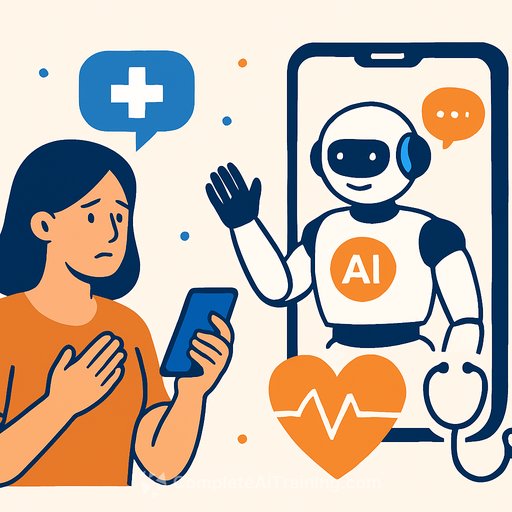
Patients are already asking AI about symptoms, procedures, and drugs-often without realizing it. Search engines blend AI-generated summaries into results, and that makes the tech feel invisible. The upside is speed. The downside is safety.
Researchers at Duke University School of Medicine are unpacking that gap. Their work highlights a less obvious risk: answers that look correct on the surface but miss the clinical context that keeps real patients safe.
What Duke Researchers Found
Led by computer scientist and biostatistician Monica Agrawal, the team analyzed 11,000 real health conversations across 21 specialties. The goal: see how people actually use chatbots and where those tools quietly fail.
The biggest surprise wasn't outright hallucination. It was "technically right, clinically wrong." Answers that check out factually but still steer patients into harm because key details-history, red flags, trade-offs-never made it into the exchange.
Why Clinicians Catch What Chatbots Miss
Dr. Ayman Ali, a surgical resident at Duke Health, compares patient-clinician conversations with chatbot exchanges. His take is blunt: clinicians listen for what's unsaid. We hear fear, bias, and risk wrapped inside a simple question. Chatbots don't.
Patients rarely ask clean, test-style prompts. They're emotional, leading, or trying to justify a decision. A model optimized to please will agree more often than it should. That's a design choice, not clinical judgment.
Where Chatbots Go Wrong
- Agreeableness over safety: Models aim to satisfy the user, not challenge them. They rarely push back when a question is risky or incomplete.
- Procedural leakage: Some bots warn that a procedure should be done by professionals-then lay out DIY steps. A clinician would shut that down immediately.
- Context gaps: No vitals, no allergies, no meds, no differential. Without context, "correct" advice can be unsafe.
- Overconfidence: Fluent, polished language creates false certainty. Patients read confidence as competence.
- Prompt mismatch: Real patient questions don't look like exam vignettes. Evaluation methods that use clean prompts overestimate safety.
What This Means for Healthcare Teams
AI will sit in front of your patients whether you approve it or not. The question is whether you set the rules. Chatbots can help with navigation, admin questions, lifestyle coaching, and education-areas with low clinical risk and clear escalation paths.
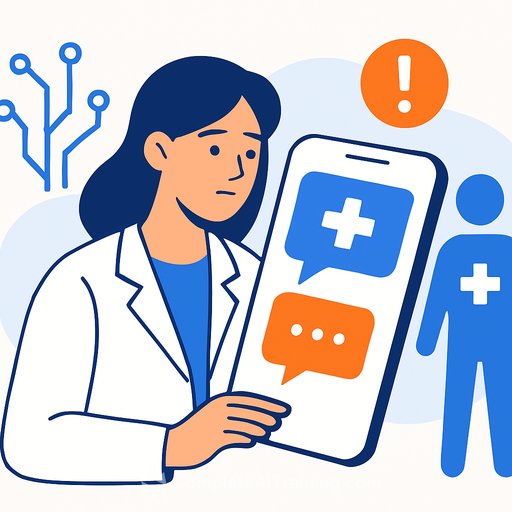
But for triage, medication guidance, and anything procedural, you need guardrails, oversight, and a fail-safe that points back to clinicians. Treat patient-facing AI like any other clinical tool: test it, monitor it, and be ready to pull it.
Practical Guardrails You Can Implement Now
- Define the lane: Restrict bots to approved use cases (e.g., appointment logistics, plan summaries, FAQs). Block procedural and prescribing advice.
- Build refusal behavior: If a request is risky, the bot should decline and route to a human. No partial instructions. No "for education only" workarounds.
- Force context checks: Require the bot to ask safety-critical follow-ups (red flags, meds, pregnancy status, comorbidities) before answering-or escalate.
- Standardize sources: Ground responses in vetted content (institutional guidelines, care pathways). No free-form internet retrieval without curation.
- Clinician-in-the-loop: For moderate risk use cases, add a review step or dual-channel messaging that flags uncertain or high-stakes answers.
- Safety UX: Prominent disclaimers, clear escalation buttons, and timeboxed callbacks reduce harm from ambiguity.
- Audit and drift monitoring: Log prompts and responses. Review edge cases weekly. Track refusal rates, escalations, and incidents.
- Training for staff: Educate teams on strengths, limits, and failure patterns so they can spot AI-shaped errors quickly.
What to Ask Before Deploying a Health Chatbot
- Which exact problems will this bot solve, and which are out of bounds?
- What clinical content does it rely on, and who owns updates?
- How does it detect and refuse risky requests?
- What follow-up questions does it ask before giving an answer?
- What's the escalation path, and how fast does a human respond?
- Which metrics define "safe enough," and who reviews them?
- How are conversations stored, audited, and purged to protect privacy?
Prompt Design Matters (More Than You Think)
The Duke team's dataset shows the mismatch between test prompts and real patient language. If you evaluate on clean cases, you'll miss where harm shows up: vague questions, emotionally loaded wording, and requests that hint at self-directed care.
Close that gap by testing on real messages (de-identified), adding adversarial prompts, and writing policies for refusal behavior. This is where strong Prompt Engineering and red-teaming pay off.
Use Cases That Work Today
- Low risk: appointment logistics, clinic directions, document prep, benefits FAQs, basic lifestyle education with sources.
- Medium risk (with oversight): care plan summaries sourced from the chart, pre-visit questionnaires with alerting, medication reminders without dosing guidance.
- High risk (avoid or require human review): triage decisions, drug changes, dosing, procedural advice, interpretation of new or alarming symptoms.
Standards and Guidance Worth Bookmarking
If you need a policy foundation, these are strong reference points:
For Teams Building or Buying Health AI
If you're responsible for rollouts, lean on practical training that connects safety to daily workflows. Start with AI for Healthcare for clinical use cases and risk controls that map to real operations.
The Bottom Line
AI can draft, summarize, and educate at scale. It cannot replace the clinician's judgment, especially when a patient's wording hides the real question. Agreeable chatbots feel helpful-right up until they aren't.
Set guardrails, insist on context, and keep humans close to the loop. Safety isn't a feature you add later. It's the product.
Your membership also unlocks: